Most contractors start their preventive maintenance schedules on spreadsheets or whiteboards. That works when you’ve got ten assets and one person running service. It breaks down once you’re managing 200 assets across 15 sites and the one tech who knows the system goes on vacation.
Now the cracks start to show. A customer calls at 6 a.m. because a cooling tower is down, and no one can say when it was last serviced. Or you send a tech out for a PM job only to find another crew handled it last week. Now you’re wasting labor, double-booking work, and frustrating customers because your preventive maintenance system doesn’t scale.
Automation fixes that. Instead of relying on someone to remember the next service date, the system triggers work automatically. Your techs can see what equipment needs service, where the job is, and what work needs to be done before it turns into an emergency call.
This article walks you through how to create and automate a preventive maintenance schedule so you can reap the benefits of service contracts without the chaos. We'll cover:
- What is a preventive maintenance schedule?
- How to create an automated preventive maintenance schedule
- 5 preventive maintenance schedule templates and examples to use for inspiration
Let’s start with how building a schedule is going to work:
What is a preventive maintenance schedule?
An effective preventive maintenance schedule is a structured plan that outlines when equipment should undergo routine service to keep it running reliably. Unlike reactive maintenance, where you deal with problems after equipment fails, you schedule regular maintenance tasks ahead of time so systems continue operating at optimal performance levels.
A typical preventive maintenance plan starts with the assets you’re responsible for maintaining. Each piece of equipment is assigned specific maintenance tasks along with how often those tasks should happen.
Preventative maintenance schedules usually follow one of two structures:
- Fixed preventive maintenance schedule – service happens on the same calendar date each cycle, such as the first Monday of every quarter.
- Floating preventive maintenance schedule – the next visit is scheduled after the previous service is completed.
When these maintenance activities are planned and tracked consistently, you can reduce costly repairs, extend asset lifespan, and improve equipment reliability for your customers.
Why is a preventive maintenance schedule necessary?
A solid preventive maintenance schedule solves problems before they start. Instead of waiting for equipment failures and emergency calls, you’re handling regular maintenance tasks on a predictable schedule.
For customers, that means fewer disruptions. Planned service helps catch issues early and maintain equipment effectiveness.
It’s also far less expensive than waiting for things to break. Companies that rely on reactive maintenance often spend 2–5× more dealing with emergency repairs than those that have service contracts with predictable maintenance costs.
Preventive maintenance also reduces unplanned downtime by 30–50% and can extend equipment life by 20–40%, helping customers avoid costly failures and get more years out of their equipment.
But the benefits aren’t just for the customer. For contractors, a strong preventive maintenance program turns service into a predictable, scalable part of the business.
Here’s what that looks like in practice:
- Pull-through revenue – Preventive maintenance work gives your techs a chance to uncover worn parts, performance issues, or aging components during routine inspections. Those findings can lead to additional work, creating pull-through revenue. Industry benchmarks put pull-through at roughly a 3:1 ratio, meaning a $2,000 maintenance contract could generate about $6,000 in repair and replacement work on top of it.
- Higher margins than installation work – Maintenance agreements run roughly 40% gross margin compared to 24% on installation work, and that's without bidding or GC headaches.
- Predictable cash flow – A routine maintenance schedule means you know what your maintenance operations look like weeks out. That visibility helps you plan your maintenance team's workloads, group service visits by location to reduce travel time, and stay ahead of seasonal service spikes.
- Business valuation – A strong preventive maintenance contract base is a recurring revenue asset. A $4 million maintenance contract base can be expected to recur at roughly 90% year over year, giving buyers predictable revenue they can underwrite with confidence. By comparison, even a larger one-time installation project provides no guarantee of future income once the job is complete.
In other words, a well-run preventive maintenance strategy is good for everyone involved. Customers get reliable equipment and fewer surprises. Contractors build recurring revenue, uncover additional service work, and grow a more predictable service business.
eBook: From Reactive to Proactive
Review the data behind why commercial contractors can't afford to find problems late
What a preventive maintenance schedule should include
In practice, a preventative maintenance schedule is a system that tracks equipment, service tasks, and when work needs to be performed.
In real-world maintenance operations, the schedule typically includes:
- The asset or equipment being serviced
- The preventive maintenance tasks to be performed
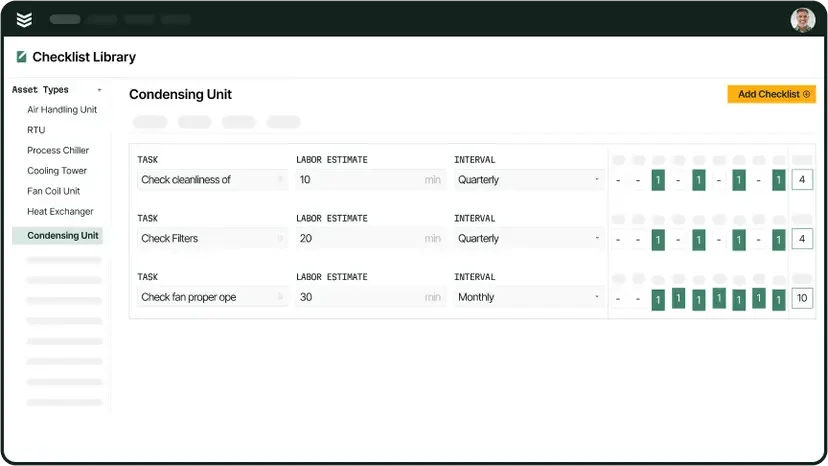
- The frequency of service (monthly, quarterly, annually, or usage-based)
- Estimated labor hours per inspection or service visit
- Required parts or materials
- The technician or maintenance personnel responsible for the work
Once this information is organized in a spreadsheet or software platform, the schedule becomes a working system for managing recurring tasks across all customer sites. Technicians follow defined maintenance procedures, document completed work, and update maintenance data like readings, repairs, or equipment condition after each visit.
How to create an automated preventive maintenance schedule
These steps will show you how to actionably build out and automate your preventive maintenance schedule:
1. Select preventive maintenance software to run the schedule

Automation starts with getting out of spreadsheets. You need a computerized maintenance management system (CMMS) to manage assets, schedules, and work orders in one place.
A good platform should allow you to:
- Build a preventive maintenance plan for every asset
- Track maintenance history and asset performance
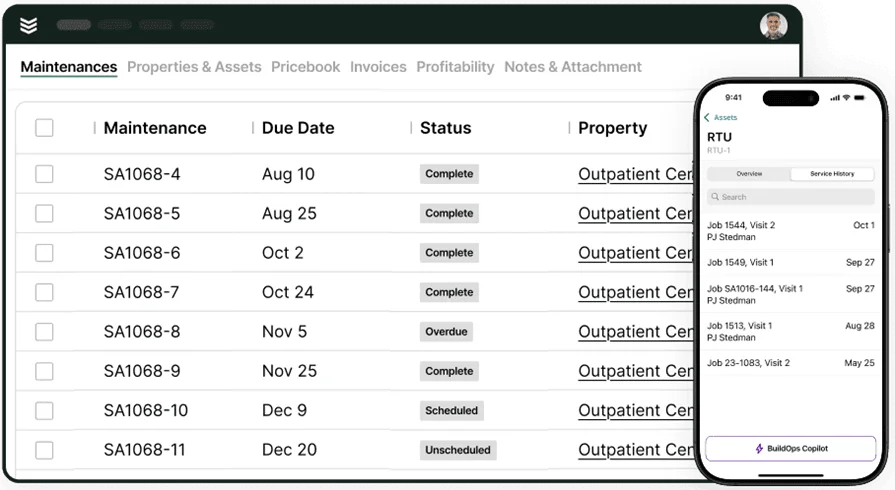
- Automate work orders based on maintenance intervals
- Monitor completion status and key performance indicators
- Manage technicians and maintenance resources
This system becomes the backbone of your PM schedule. Once it’s in place, the rest of the automation process becomes much easier to manage.
Automate recurring revenue with BuildOps
Our Service Agreements features are built to handle commercial-scale recurring projects.
2. Define your maintenance triggers
Next, determine what should trigger each preventive maintenance visit. These triggers define the maintenance intervals for each asset.
Most automated schedules use one of two approaches:
- Time-based PM schedules – service happens at set calendar intervals such as quarterly or annually
- Meter-based schedules – service is triggered by usage thresholds like operating hours, production cycles, or equipment run time
Setting the ideal preventive maintenance intervals ensures equipment undergoes service before problems escalate into costly downtime.
3. Let the system assign the work
Automation also simplifies scheduling and dispatch. Instead of manually managing tasks, the system can assign work orders based on technician availability, location, or skill set.
This improves operational efficiency and ensures technicians with the right experience handle the most critical tasks.
For example, a technician already working near a customer site can automatically receive the preventive maintenance visit for that area.
4. Capture maintenance data and schedule the next visit automatically

When technicians complete the job, the system records the work performed, updates the asset’s maintenance history, and schedules the next visit automatically. This data helps you monitor asset performance, spot potential failure modes, and identify components that may need attention soon.
Those insights allow you to recommend repairs or replacements before equipment fails, turning routine service visits into profitable pull-through repair work. Catching issues early also helps customers reduce downtime, keep systems running reliably, and improve overall equipment effectiveness.
5 preventive maintenance schedule templates and examples to use for inspiration
If you're building a preventive maintenance schedule from scratch, templates can help you organize the basics like equipment lists, service tasks, and maintenance intervals.
But templates still rely on manual updates. As your customer base grows and service contracts expand, most contractors move from spreadsheets and static documents to software that can automate preventive maintenance scheduling with work order generation, dispatch, and service history tracking.
Below are a few examples to help you get started.
Automated preventive maintenance scheduling templates
Automation turns your preventive maintenance schedule into a system that runs itself. Instead of manually tracking service dates, software generates recurring work orders, assigns technicians, and records service history so nothing gets missed as your service contracts grow.
1. Purpose-built platform for commercial preventive maintenance: BuildOps

A template gives you a static document to fill out. BuildOps gives you a live system where your preventive maintenance schedule connects directly to scheduling, dispatching, invoicing, and asset management.
Everything your field techs and office staff need to manage, bill, and grow the service side of your business is connected in one place.
Key Features:
- Preventive maintenance scheduling that creates recurring work orders from defined service intervals, helping ensure every asset undergoes maintenance on time
- Full service history on every asset that tracks completed work, maintenance notes, and repair records so your team always knows what’s been done and what needs attention next
- Mobile app for field technicians that syncs real-time schedule updates and lets techs complete work orders, capture photos, collect signatures, and generate quotes directly from the field—even offline
- AI-powered tools that automate busywork and analyze service data, refine field notes, scan invoices and assets, and assist technicians with real-time troubleshooting
- On-site quoting tools that help technicians capture pull-through work by generating repair or upgrade quotes the moment issues are discovered during routine service
- Pre-loaded workflows and parts lists for common service tasks so technicians arrive on-site with clear instructions and the right materials for the job
- Reporting on pull-through revenue and customer profitability that shows which maintenance contracts and service calls are driving the most revenue for your business
Manual preventive maintenance schedule templates
If you're just getting started, templates can help you outline a preventive maintenance plan and organize service tasks. These tools are useful for documenting schedules and agreements, but they still require manual updates and tracking as your operation grows.
2. Free plumbing contract agreement: PandaDoc
PandaDoc’s plumbing contract template provides a structured starting point for service agreements, including sections for scope of work, scheduling and completion timelines, payment terms, scope changes, termination, warranty, indemnity, and governing law.
The template includes fillable fields for client and contractor details, making it easy to customize the agreement for each job while keeping the overall contract structure consistent.
What to take from it: Built-in fillable fields and e-signature support streamline approvals and reduce paperwork, making it easier to send, sign, and store service agreements digitally.
Looking for more plumbing templates? Plumbing preventive maintenance contract templates
3. HVAC service contract: Rocket Lawyer
Rocket Lawyer’s HVAC contract template guides you through a short questionnaire to generate a customized agreement. By answering a few questions about the contractor, client, and scope of work, the platform automatically fills in the contract with the appropriate details.
The template includes standard legal sections such as services, scope of work, site conditions, permits, insurance, change orders, and governing law. Once completed, the document can be signed online, stored securely, downloaded, or shared.
What to take from it: The guided setup fills in key contract details automatically, reducing manual editing and helping ensure the agreement includes essential legal clauses.
Looking for more HVAC templates? HVAC preventive maintenance contract templates
4. Electrical services agreement template: Revv
Revv’s electrical services agreement template provides a structured contract for documenting electrical work, including sections for scope of work, provided services, excluded services, pricing and payment terms, obligations of both parties, termination, and arbitration.
The template also includes clear sections for outlining additional projects, excluded costs, and acceptance signatures. You can customize it with your company logo and edit directly in Revv’s platform, with options to manage agreements digitally.
What to take from it: Clear separation of included and excluded services helps electrical contractors define scope upfront and avoid scope creep.
Looking for more electrical templates? Electrical preventive maintenance contract templates
5. Planned refrigeration maintenance contract: PDFfiller
PDFfiller’s planned refrigeration maintenance contract template provides a structured agreement for documenting recurring refrigeration service. It includes sections for equipment definitions, planned maintenance work, service frequency, charges, warranty terms, liability limitations, termination conditions, and dispute resolution.
The document includes fillable fields for company information, service terms, pricing, and signatures, making it easy to customize the contract for each customer or facility.
What to take from it: The detailed maintenance task section helps refrigeration contractors clearly define what’s included in a service visit, which can reduce misunderstandings about the scope of work.
Looking for more refrigeration templates? Refrigeration preventive maintenance contract templates
If you're ready to stop managing maintenance schedules manually and start running a service department that scales, BuildOps has everything you need built in. Schedule a demo today to see exactly how we can help automate your preventive maintenance program, and unlock new sources of recurring revenue from your customers with scheduled maintenance contracts.
Automate scheduled maintenance with BuildOps
Let our AI-powered platform unlock new sources of recurring revenue