How To Max Ops Efficiency with AI HVAC Scheduling

The HVAC industry is projected to grow from $241 billion in 2024 to $505 billion by 2035, according to Spherical Insights. Contractors across the country are gearing up to meet that exponential growth, with 71% reporting regional booms fueling new construction opportunities in BuildOp’s The Pivot Point survey. Data centers fuel much of the demand, especially in hot spots like Virginia, Dallas-Fort Worth, Phoenix, Atlanta, Chicago, and California.
With 91% of contractors saying bidding is more competitive than ever and 74% reporting operations are more complex than ever, according to The Pivot Point, HVAC businesses must leverage artificial intelligence (AI) to stay competitive in this booming market.
"One trend I have seen is that some of the smaller clients are winning these bigger opportunities, work on these data centers, and they're getting these contracts that are allowing for them to expand a new bucket that they haven't seen before," said Grant Spiegel during a BuildOps webinar on The Pivot Point.
AI systems can optimize HVAC companies across the board, but leveraging AI software for scheduling and dispatching brings a significant advantage to HVAC and other field service businesses aiming to take advantage of this growing market.
The article will dive into:
- How AI-powered tools empower HVAC companies
- 4 ways AI HVAC scheduling optimization improves tech dispatching
How AI-powered tools empower HVAC companies
AI tools bring clarity, predictability, and precision to HVAC operations. With a unified view of demand, equipment needs, and workforce capacity, contractors can stay ahead of issues, deliver more reliable service, and build a business that runs smarter at every level.
Automated scheduling & dispatching
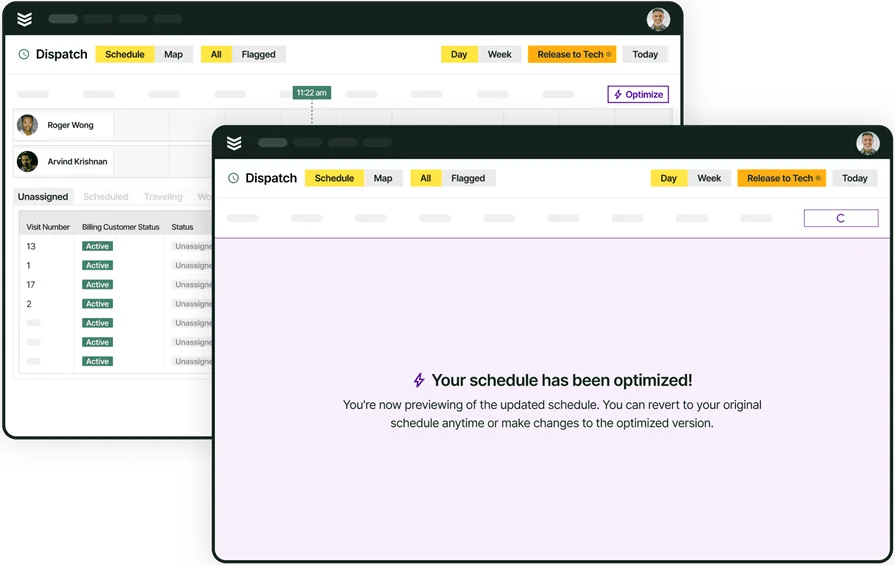
Automated scheduling and dispatching tools give HVAC pros a clearer, more predictable way to schedule jobs and keep work on track. Instead of relying on manual judgment or guesswork, AI evaluates technician schedules and location while evaluating real-time context like traffic, parts needs, and job complexity.
If a job runs long, weather disrupts a route, or an emergency call comes in, the AI system automatically rebalances assignments to protect timelines and keep customers happy and informed.

The artificial intelligence revolution is here, with nearly 78% of contractors reporting it can improve operational efficiency, and 80% saying it will be essential to stay competitive in three years. BuildOps gives contractors a single, data-driven platform to put all of these AI advantages into action—aligning skills, optimizing routes, reducing downtime, and helping teams stay ahead of demand with confidence.
Proactive maintenance scheduling
AI tools help control HVAC systems management, identifying when customers are due for maintenance and when HVAC systems are at risk of falling behind by analyzing equipment history, site data, sensor trends, and past service patterns. It automatically recommends maintenance plans that include the ideal timing and technician for each visit, so contractors can stay ahead of seasonal maintenance spikes and keep predictive maintenance programs on track.
If a customer adds new HVAC system components, usage patterns change, or a previous visit uncovers new requirements, the system updates instantly to give contractors a more accurate view of their client portfolio and business operations to ensure efficiency and profitability. Customers experience reliable uptime, fewer surprises, and a service partner that’s always one step ahead.
Predictive maintenance
By detecting how HVAC systems are performing over time based on sensor data, energy consumption, runtime trends, and equipment history, AI systems can surface early signs of decreased energy efficiency or failure. Technicians get insights they can actually use, like which units are running outside normal parameters, where energy waste is happening, and which assets should be prioritized for service.
The system can generate alerts, recommend corrective actions, and automatically adjust the schedule to route the right tech to the site. This predictable approach using real-time data allows contractors to gain stronger visibility across their entire portfolio, while building owners get better system performance, substantial energy savings, and equipment longevity.
Forecasting & strategic planning
AI-powered forecasting gives HVAC contractors a clearer view of what’s ahead. By analyzing historical demand, seasonal patterns, equipment data, and even regional weather trends, AI can predict when workloads will surge, which skills will be in highest demand, and where capacity gaps may form.
Strategic planning helps leaders make smarter decisions about labor, training, inventory, and customer commitments for more stable operations built around data-driven expectations rather than guesswork. It gives teams the insight they need to allocate resources, prioritize investments, and build a service model that’s ready for whatever comes next.

4 ways AI HVAC scheduling optimization improves tech dispatching
AI systems give HVAC teams a clearer, more confident way to run the day—matching the right technician to every job, optimizing routes for efficiency, and responding to emergencies without derailing the schedule. By combining skill-based decisions with real-time insights, contractors reduce downtime, boost productivity, and deliver faster, more reliable service across every call.
1. Technician skill-based assignments
AI-powered scheduling tools give HVAC teams a smarter way to align technician assignments and skills with the needs of every job. Instead of relying on memory or manual sorting, the platform automatically evaluates each tech’s certifications, specialties, past job performance, and experience with specific equipment. It then recommends the best match for the work at hand—whether it’s a complex rooftop unit, a warranty repair, or a first-time install.
As the schedule shifts, AI systems keep those skill-based decisions intact. If a job runs long or a tech becomes unavailable, the system rebalances assignments while still prioritizing technical fit. Dispatchers get a clearer, more-confident view of who can handle what, and technicians spend more time working within their strengths.
With nearly 50% of contractors reporting a quarter of positions are unfilled and a whopping 76% reporting skilled labor is in short supply, matching valuable technicians to the right HVAC jobs for their skill levels improves productivity and morale–benefiting the company’s culture and retention rates. When there are more jobs than technicians, every effort to maximize productivity and retention counts.
2. Route optimization
HVAC teams can leverage AI-powered scheduling tools to move work forward by making smarter, faster decisions about technician proximity. Instead of dispatchers manually scanning maps or guessing who’s closest, the tool automatically analyzes real-time location data, traffic conditions, and jobsite clustering to recommend the most efficient option.
As the day shifts, AI systems keep those distance-based decisions optimized. If a job runs long or an urgent request comes in, the system instantly evaluates who can reach the site fastest without disrupting the rest of the schedule. It identifies smart opportunities to group jobs geographically and fill gaps in real time, giving dispatch a clearer, more dynamic view of where every technician can add the most value while reducing windshield time. The result is a schedule that feels tighter, more intentional, and easier to manage.
3. Reduced equipment downtime
Teams can respond to HVAC equipment downtime with speed and precision using AI-powered tools. When a critical system goes down, the platform immediately evaluates which technicians have the right mix of skills, certifications, and experience. It then prioritizes the call and recommends the fastest, most capable tech to restore uptime. Instead of scrambling to reshuffle the board, dispatch gets clear, data-driven guidance that facilitates optimal performance for customer operations and reduces the risk of extended HVAC equipment outages.
Technicians arrive prepared with the context they need, and customers get faster resolutions with fewer operational disruptions. Reducing idle time allows technicians to comfortably meet their schedules every day, an invaluable benefit at a time when 69% of contractors report rising burnout across entire teams, according to The Pivot Point.
4. Emergency & urgent work response
AI-powered scheduling tools give HVAC teams a smarter way to respond to emergency or urgent work. When a critical call comes in, the tool instantly evaluates technician skills, certifications, location, and availability to recommend the fastest, most capable tech for the job. Instead of dispatchers manually juggling the board, AI provides clear guidance on how to shorten the response time to urgent work while keeping other appointments on schedule.
As conditions evolve, AI continuously adjusts the schedule to balance emergencies with planned work. It can reroute technicians, shift non-urgent calls, and alter routes in real time, optimizing performance and ensuring that every urgent task gets the attention it needs without disrupting productivity elsewhere. Customer satisfaction increases when they see the benefits of a team that can handle the unexpected without compromise.
“Most companies are thinking about AI wrong,” said Chris Stanton at BuildOps’ Forge 2025. “This isn’t going to be about replacing people … it’s about enhancing productivity.”