How To Scale Field Service with AI & Automation

We surveyed 606 commercial contractors in our Pivot Point: AI and the Future of Commercial Contracting report, and learned a number of key things, including that 30% believe that outdated tech is limiting their growth, and that 80% believe that AI will be essential to stay competitive in 3 years.
It’s not an option anymore to wait—you need to address AI tool adoption within your field teams now if you want to stay in the game. There’s only one path ahead, and it’s that you need to implement AI in your field operations if you want to scale. Don’t know how yet? We’ll show you, explaining:
- Who uses AI tools for field management, and why it’s critical for operations
- 4 types of AI tools used in field service management
- How to scale field service operations with AI & automation
Let’s start with how each member of your team can use machine learning tools to optimize their roles in the field service work your business does.
Who uses AI tools for field management, and why it’s critical for operations
Artificial intelligence is transforming construction operations by supporting every role on the jobsite—from field technicians to business owners, customers, vendors, and leadership. Field service AI helps teams work more accurately and efficiently, and allows for fast, data-driven decision-making to improve service delivery and operational efficiency.
Field service techs
AI-powered field service management tools help field techs pinpoint issues quickly by analyzing equipment data, error codes, and historical service records—reducing guesswork and cutting down on repeat visits. AI tools surface the exact manuals, wiring diagrams, and step-by-step workflows field technicians need, making even complex or unfamiliar equipment easier to service. This real-time guidance gives every field service team the confidence and capability of senior technicians, even under pressure.
Field service AI also eliminates much of the administrative burden that slows techs down. Instead of typing long reports at the end of a shift, field service techs can speak into their phone and let AI generate clean, accurate service documentation automatically—complete with photos, readings, and parts used.
Business owners
Construction business owners turn to AI in field service management to model risks, predict schedule impacts, and understand where crews or subcontractors are likely to fall behind.
Owners use AI-driven forecasting tools to get clearer control over their operations and keep projects moving with fewer surprises. Instead of relying on fragmented reports or gut feel, AI consolidates real-time data, schedules, safety metrics, and financial information into a single source of truth—making it easier to spot delays, cost overruns, or productivity issues before they become expensive problems.
Jobsite leadership
Jobsite leadership—including field supervisors, foremen, superintendents, project managers, and safety managers—relies on AI to gain instant access to real-time visibility and control over daily operations. AI tools help leaders track progress across trades, verify that work matches the plan, and identify delays, bottlenecks, or potential rework before they escalate.
Superintendents and project managers use predictive scheduling and analytics dashboards to coordinate crews, optimize sequencing, and forecast schedule or budget impacts, while safety managers leverage AI to monitor site conditions, detect unsafe behaviors, and predict high-risk situations.
Customers
Construction customers—whether property owners, facility managers, or clients commissioning a build—increasingly use field service AI to improve project visibility, predictability, and efficiency. AI tools give them real-time insights into jobsite progress, schedule adherence, and potential risks, allowing them to make informed decisions without constantly checking in with the contractor. Giving the customer real-time access leads to dramatically increased customer satisfaction.
Vendors and suppliers
Vendors supplying materials, equipment, or specialty services use AI solutions to optimize inventory, deliveries, and fulfillment across multiple job sites. AI predicts demand based on project schedules, usage trends, and real-time jobsite progress, helping vendors avoid stockouts or last-minute rush orders, saving operational costs. Automated alerts and predictive ordering ensure the right materials arrive on time, reducing delays and keeping projects on schedule.
4 types of AI tools used in field service management
AI-powered automation helps field service businesses work more efficiently, reduce operational costs, and focus on delivering high-quality results on every jobsite.
1. Agentic AI
Agentic AI acts like an autonomous digital co-manager, capable of planning, decision-making, and executing multi-step workflows across a jobsite. Unlike traditional AI, agentic AI can monitor real-time site data, predict risks, and adjust schedules or resource allocation.
Field service technicians use agentic AI to optimize scheduling, coordinate subcontractors, monitor equipment health, and ensure work aligns with project plans. By integrating with systems like BIM, ERP, and IoT sensors, AI agents maintain situational awareness and continuously adapt to changes on the site.
2. Conversational AI
By understanding natural language and integrating with project management, scheduling, and equipment data, conversational AI makes critical information more accessible and actionable to improve field service efficiency.
Field techs can ask the AI questions like “Which part do I need for this unit?” or “What jobs are scheduled for today?” and receive instant, context-aware guidance. Project managers and superintendents can use it to check real-time progress, reschedule crews, or get automated status updates without manually combing through spreadsheets, emails, or reports.
3. AI Field Service Assistant
AI field service assistants combine natural language processing, machine learning, and integration with construction systems like BIM, ERP, and IoT sensors. They interpret user queries, pull relevant information from connected systems, and execute actions like generating service reports, updating schedules, or alerting team members about issues.
AI assistants act as digital copilots, streamlining day-to-day operations on construction sites. By providing instant guidance and automating routine tasks, these tools increase first-time fix rates, reduce downtime, and allow teams to focus more on actual work rather than administrative overhead.
4. Generative AI
Generative AI analyzes large volumes of data—like equipment logs, BIM models, jobsite photos, and historical job data—and quickly turns it into usable outputs.
Field technicians leverage Generative AI to automatically produce service reports, work orders, or maintenance logs based on observations, photos, or voice notes captured on site. It can draft schedules, create progress summaries, or simulate “what-if” scenarios, such as the impact of a delayed delivery or labor shortage. These abilities reduce administrative overhead and ensure teams spend more time executing work rather than compiling information.
How to scale field service operations with AI & automation
AI in field service management helps teams work smarter, reduce errors, and focus on delivering high-quality service—keeping jobs on time, on budget, and running smoothly. Here are the top 5 ways field teams use AI to scale operations and improve efficiency.
1. Scheduling

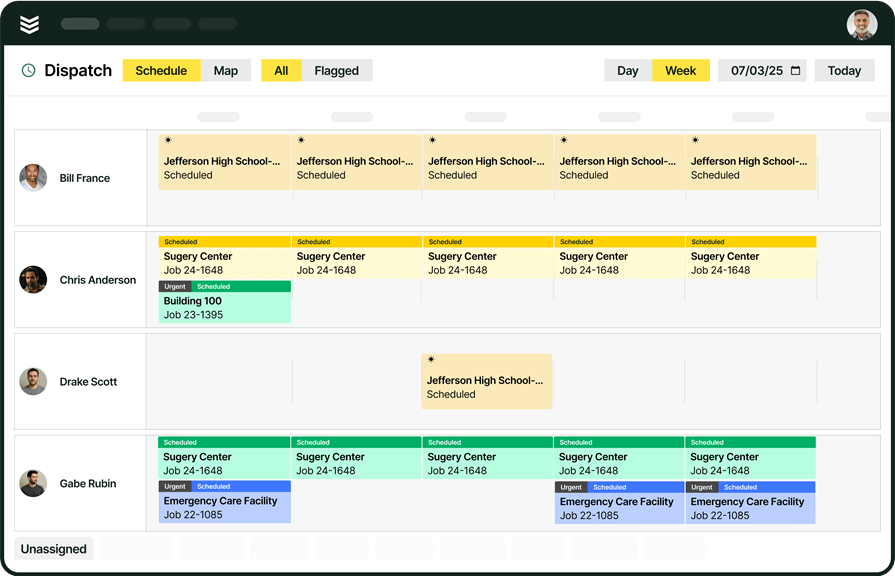
AI-powered field service scheduling tools help construction and field service management teams optimize how work is assigned and executed in real time. By analyzing factors like technician skill sets, certifications, availability, and equipment requirements, tools like BuildOps can automatically recommend the right technician for each job.
If unforeseen events occur—like weather delays, last-minute cancellations, or emergency service calls—automated scheduling tools can instantly reschedule or reassign tasks to minimize downtime and keep the workflow on track.
These tools are invaluable for trades like HVAC contractors, where timely service is everything. For example, if a rooftop unit breaks down at a commercial site, the system can identify the nearest qualified technician. If an emergency call comes in mid-day, AI systems can reshuffle the schedule to accommodate the urgent request without disrupting other appointments. The result is higher first-time fix rates and less wasted travel time.
2. Field notes & reporting automation

AI streamlines the creation of field notes and reports by automatically capturing, organizing, and summarizing jobsite data. Field technicians can simply take photos, record voice notes, or input observations, and the AI interprets this information to generate structured, professional reports. It can log completed tasks, equipment used, measurements, and work status, while also flagging issues such as deviations from plans or potential safety concerns.
For example, after completing a routine HVAC inspection, a technician can snap photos of the unit, speak notes into a mobile device, and generate a complete, professional report—ready for internal records or client delivery—without any manual data entry.
Every field in tools like BuildOps, including quotes, jobs, labor and assets, becomes a reportable metric. Field techs no longer need to deal with spreadsheets and jobs don’t get held up by finance. Insights are available immediately, allowing all jobs to stay on track.
3. Fleet route optimization

By analyzing factors like job priority, technician availability, traffic patterns, job locations, and skill requirements, the AI automatically sequences work orders to ensure that each technician follows the fastest and most productive route.
If last-minute changes occur—like urgent service calls, cancellations, unexpected traffic delays, or weather disruptions—AI can dynamically recalculate routes, keeping crews on schedule and minimizing wasted time on the road.
These factors can be managed easily with tools like BuildOps that provide fleet insights to the office. Staff can see all jobs and field techs from one map to assess real-time availability, location, and job status, saving field service companies like HVAC contractors hundreds of hours per year in travel alone.
4. Invoices & purchase orders
Managing parts, materials, and subcontractor invoices can be a logistical headache. AI automatically reads, extracts, and categorizes key information from documents, reducing the need for manual data entry. Field teams or office staff can simply upload scanned or photographed invoices and purchase orders, and AI systems identify critical details such as vendor names, dates, line items, quantities, and amounts.
For instance, if an HVAC contractor orders replacement compressors for several sites, the AI can ensure the invoices are recorded against the correct project budgets and alert managers to discrepancies.
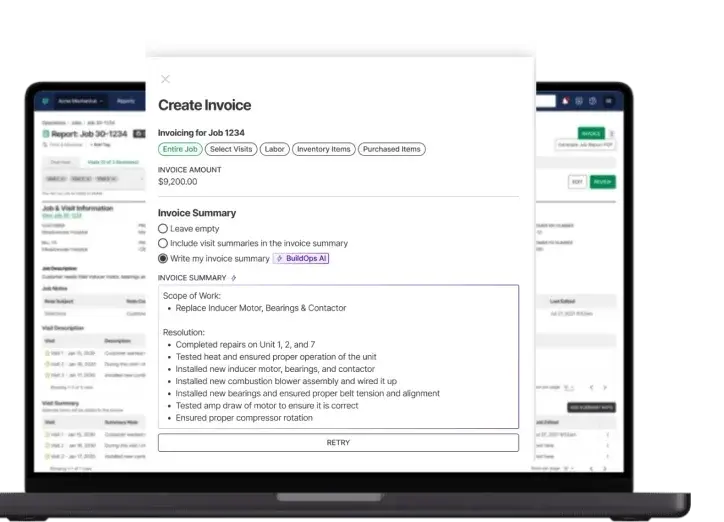
Some tools, like BuildOps, can even take field notes and automatically generate invoices. This kind of automation ensures accuracy, reduces errors, and speeds up the processing of financial documents, allowing teams to focus on project execution rather than paperwork.
5. Asset capture
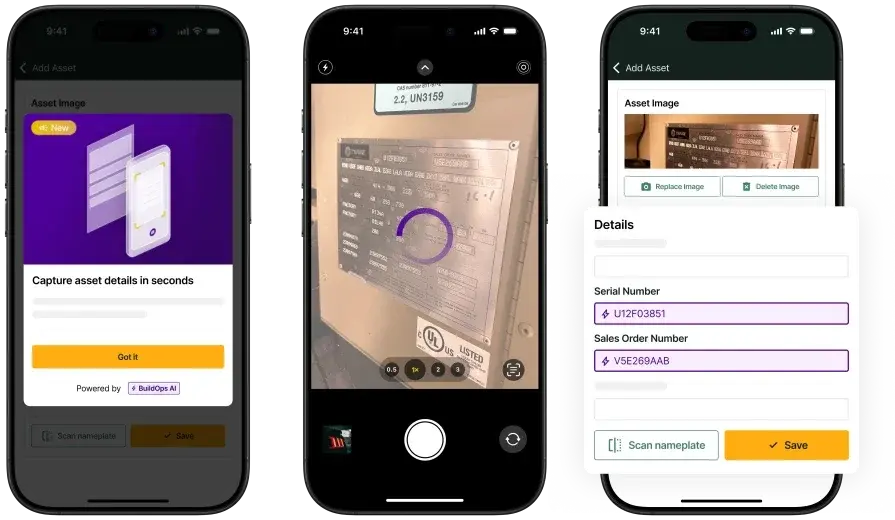
AI automatically identifies, records, and tracks equipment, tools, and materials on a jobsite. Field teams can use mobile devices, cameras, or IoT sensors to scan or photograph assets, and the AI logs details like asset type, location, condition, and usage history. For HVAC companies managing many appointments and technicians, this ensures that specialized tools or critical parts are not misplaced and are allocated efficiently.
AI tools eliminate manual inventory tracking, reduce loss or misplacement of equipment, and provide real-time visibility into the assets available for each project. Over time, contractors gain better visibility into asset usage, maintenance needs, and replacement schedules—helping control costs and avoid downtime.
Artificial intelligence is reshaping construction field operations by combining role-specific support, advanced AI capabilities, and practical field service management automation. Together, these technologies empower teams to work smarter, reduce errors, and complete projects more efficiently—resulting in improved customer satisfaction and seamless business growth.
Download our Pivot Point: AI and the Future of Commercial Contracting report below. It has key takeaways on the use of AI in field service operations from leading field service businesses, and could help you improve your own operations. If you’re looking for tools today, set up a demo with BuildOps to learn how OpsAI could start saving you countless hours in different aspects of your field operations.