When Your Best Leaders Become the Jobsite Bottleneck

When too much of your contracting business depends on a few high-performing employees, the whole operation becomes fragile. One sick day can throw jobs off schedule, burn hours on back-and-forth, and leave crews waiting for answers. It might feel efficient early on, but as your team grows, that setup quickly turns into a bottleneck.
This article breaks down where leadership bottlenecks in business show up in field service ops and how leadership teams can clear them with better operational strategies, informed decision-making, and long-term thinking.
We'll cover:
- The 5 most common leadership bottlenecks in field service businesses
- How field service automation platforms reduce bottlenecks in business processes
- How BuildOps helps commercial contractors clear bottlenecks and scale smarter
The 5 most common leadership bottlenecks in field service businesses
Many of the most common causes of delays in construction projects, from miscommunication to slow approvals, can be traced back to leadership bottlenecks like the ones below.
Here’s where common leadership bottlenecks hit commercial field service teams hardest and what they look like on real jobs.
1. Siloed workflow knowledge slows down field service operations
This leadership bottleneck creeps in quietly for most organizations. It starts with a skilled team member taking ownership of an operational gap to keep the work moving forward.
Their involvement is critical, but as your business starts to grow and things get more complex, that “go-to” role turns into a single point of failure. Without documentation, all the essential knowledge they have stays siloed.
There’s no clear process, no backup plan, and no easy way to train the next hire. The gap between individual experience and a shared vision gets wider.
In commercial service ops, it shows up like this:
- A service manager knows which subcontractors to avoid, but no one else does
- A project coordinator tracks job status using a personal spreadsheet no one else can access
- Only one office staff member knows how to navigate a key customer’s billing requirements
- A supervisor knows which field crew combinations work best but never shares the rationale
It feels efficient early on. But as the team grows, that go-to expert becomes a leadership bottleneck. Jobs stall when they’re out, new hires can’t ramp, and leaders spend more time answering questions than leading.
That’s where outdated tech quietly does the most damage. Thirty percent of industry leaders say legacy tools are limiting growth. These systems fail to capture, standardize, and share the knowledge teams rely on to move quickly and work consistently. When essential experience stays locked in one person’s head instead of a shared system, even your top performers can become a constraint.
Effective leadership changes that. Strong leaders turn individual knowledge into repeatable processes everyone can follow. That shift builds consistency, sets a clear focus, and keeps the business running smoothly even when your top people aren’t around.
2. Decision-making power bottlenecked at the top
When every decision flows through the same few people, the entire operation slows down. Pricing approvals, change orders, and schedule tweaks all require sign-off, creating constant delays.
A major driver of this bottleneck is fragmented systems. When job-critical data is scattered across spreadsheets, disconnected software, or buried in inboxes, frontline teams can’t access what they need to act. That forces them to escalate even simple decisions up the chain—because they don’t have the full picture or the decision-making authority to move without it.
Thirty percent of contractors say their fragmented tools are already slowing them down. And as complexity grows, the cracks widen, slowing delivery, increasing labor costs, and stalling business growth. The leadership team stays stuck in reactive mode, with no time for long-term thinking or strategy. Meanwhile, teams lose clarity, and momentum stalls.
Effective organizations don’t lead from the bottleneck. They build systems with clear rules, thresholds, and approval paths so decisions happen closer to the work. That shift gives teams more ownership, restores momentum, and keeps leaders focused on guiding the company forward.
The outcome? Faster execution, stronger alignment, and leadership with the power to drive strategy, not just react to the latest fire drill.

3. Inefficient dispatching slows progress as the business grows
Dispatch plays one of the most critical roles in field service operations, but too many commercial contractors still rely on whiteboards and spreadsheets to run it. Without automation, dispatch is reactive. Work gets assigned based on who’s free, not who’s best for the job.
Assigning a tech who’s already in the area, has the right credentials, and knows the equipment means fewer callbacks, faster resolutions, and better margins. When those decisions rely on memory or guesswork, efficiency suffers and leadership stays stuck in the weeds.
Effective dispatch systems solve this. They match techs to jobs based on skill and availability, update routes in real time, and give field teams mobile access to what’s next.

4. Manual job costing and invoicing bottlenecks delay business results
Manual job costing and invoicing add friction where speed and accuracy matter most.
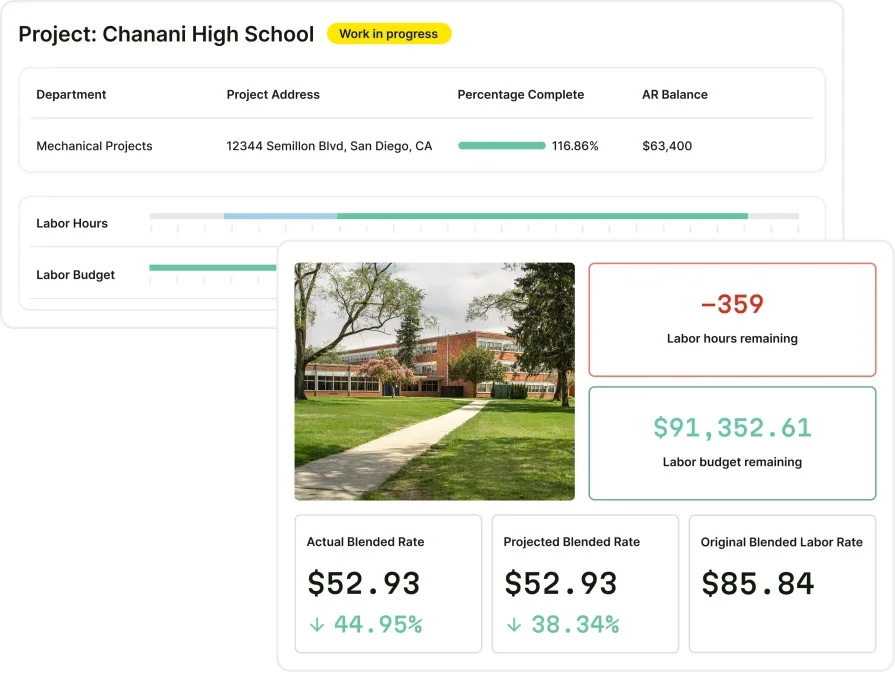
Job notes, labor hours, and material receipts often sit in inboxes or field notebooks for days before anyone organizes them into an invoice. Those delays obscure job performance, limit visibility, and keep leadership from understanding where money is made or lost.
Without timely insight into cost and labor, leaders can’t forecast accurately, adjust project plans, or make strategic decisions that move the business forward.
The cost of this inefficiency adds up quickly. On average, U.S. companies lose $28,500 per employee each year to manual data entry. In commercial construction, job costing and invoicing are common friction points where these losses appear early and often.
To fix it, contractors need systems that connect labor hours, materials, and job costs directly to the project timeline. When field updates flow into a central platform in real time, you can generate invoices quickly and accurately. Leadership can view job profitability mid-project, compare actuals against estimates, and spot problems before they escalate.
5. Field-to-office communication gaps slow execution
When field and office teams aren't working from the same information, the chances of delays and mistakes go up fast.
Job updates shared over phone calls, scattered texts, or buried email threads lead to critical details slipping through the cracks. A technician might arrive on-site without full scope, the office might order incorrect materials, or a project manager might not hear about an issue until it's too late to fix it.
These kinds of breakdowns are among the leading causes of delays in construction projects, slowing execution and stalling momentum. Leaders waste time chasing updates, and while everyone is busy with admin, progress becomes uneven and unpredictable.
A connected office and tech mobile app helps leadership eliminate the back-and-forth by syncing job scope, labor hours, documentation, and field updates in real time. Everyone, from technicians to project managers, works from a single source of truth, reducing confusion and keeping jobs on track.

How field service automation platforms reduce bottlenecks in business processes
Field service automation platforms help commercial contractors eliminate inefficiencies, streamline workflows, and keep jobs moving, even as teams grow and complexity increases. They reduce bottlenecks by improving visibility, speeding up approvals, and connecting teams in real time.
These platforms also help solve one of the industry’s most persistent challenges: how to manage delays in construction projects. By making job data accessible, automating routine tasks, and keeping field and office teams aligned, automation platforms reduce friction and empower effective leaders with practical tools to focus on the bigger picture.
And increasingly, AI is powering that automation behind the scenes. From intelligent scheduling to real-time cost tracking, AI-enhanced platforms make faster, smarter decisions possible at every level. It's no surprise that 78% of contractors say AI will improve operational efficiency, and 80% believe it will be essential to stay competitive in the next three years.
Below are five ways the right platform helps leadership teams remove friction, restore momentum, and keep the organization growing.
1. Automate scheduling, dispatching, and route optimization
Manual dispatch doesn’t scale. Automation uses real-time data like skills, location, availability to assign the right techs to the right jobs faster. That shift gives teams more ownership, improves job margins, and keeps leaders focused on strategy, growth, and long-term success, not last-minute adjustments.
2. Store critical workflow knowledge so it’s accessible to both field and office
When job details and operational knowledge live in someone’s head (or a personal spreadsheet), the entire operation is vulnerable. Field service platforms centralize that knowledge by making SOPs, job history, customer preferences, and pricing rules accessible across the team. That closes gaps, speeds up training, and reduces the responsibility of any one person.
3. Standardize approvals to keep decision-making power close to the work
Delayed approvals drain momentum and trap leaders in reactive mode. Automation lets you set clear thresholds and workflows for things like quotes, change orders, and schedule shifts so frontline teams can move faster without constant check-ins. It frees up leadership to focus on responsibilities that actually drive the organization forward.
4. Connect job costing and invoicing to real-time field updates
Manual invoicing creates delays, obscures performance, and stalls business results. When field notes, labor hours, and materials sync directly to project timelines, you can invoice faster, catch budget issues earlier, and make better decisions backed by real data.
5. Keep field and office teams on the same page in real time
Communication gaps kill efficiency. A connected platform keeps everyone from techs to PMs to accounting working from the same information. Job scopes, updates, and documentation sync instantly so no one’s stuck waiting for an email, phone call, or meeting to move forward.
How BuildOps helps commercial contractors clear bottlenecks and scale smarter
BuildOps is purpose-built for commercial contractors, giving your team the structure, visibility, and control needed to remove business bottlenecks that stall growth.
Here’s how BuildOps clears the path:
- Important job knowledge, like customer preferences, subcontractor history, and pricing rules, is easy to access, so teams don’t have to rely on one person to keep things moving effectively.
- Approvals for quotes, change orders, and scheduling adjustments follow a customizable workflow, reducing delays and unnecessary escalation.
- Dispatchers can match the right tech to the right job based on key priorities like location, availability, and credentials.
- Field updates feed directly into job costing and invoicing, so billing is accurate, timely, and tied to real data.
- Everyone works from the same information, whether they’re in the field or the office, cutting down on back-and-forth and keeping jobs on track.
This kind of structure keeps your teams productive, your communication clear, and your business focused on long-term growth.
As BuildOps CEO Alok Chanani puts it: “Yesterday’s tools can’t build tomorrow.” You’ve already built a strong team, now give them the systems to match.