Selling Commercial Plumbing Preventive Maintenance

If your commercial plumbing business is still running on installation jobs and one-off service calls, you're leaving serious money on the table.
A commercial plumbing preventative maintenance program converts unpredictable call volume into scheduled, billable, high-margin work you can plan around.
This guide will help you sell plumbing PM contracts so your team stops chasing emergencies and starts building a real recurring revenue base. We'll cover:
- Understanding plumbing preventative maintenance contracts
- 5 components to include in an plumbing preventative maintenance contract structure
- How much value recurring plumbing maintenance contracts contribute to your business
- 4 strategies to sell more commercial plumbing maintenance contracts to your customers
- 4 best commercial plumbing preventative maintenance contract templates
Understanding plumbing preventative maintenance contracts
Most commercial building owners don't think about their plumbing until a sewer backup shuts down a kitchen or a burst pipe floods a mechanical room. Commercial plumbing preventative maintenance changes that dynamic entirely, putting your company in the building on a defined schedule to catch problems before they turn into expensive repairs.
The contract formalizes that relationship: you commit to showing up, completing regular maintenance tasks, and documenting everything, and the customer commits to paying for it on a predictable billing cycle.
How do plumbing preventive maintenance contracts work?
A preventive plumbing maintenance contract locks in regular service visits for a customer's commercial plumbing systems. Visit frequency depends on the building type, system complexity, and usage, but most contracts are structured around quarterly, semi-annual, or annual visits.
Each visit follows a defined scope of work spelled out in the routine maintenance plan. That typically includes inspections, cleaning, testing, and documented findings across the building's plumbing system. The goal is to catch slow drains, pressure issues, leaking pipes, and early signs of equipment failure before they turn into plumbing emergencies that shut down a customer's operation.
When a tech finds something outside the normal scope during a visit, a water heater showing corrosion, a backflow preventer that's failing, or a sewer line that needs a camera inspection, that becomes a separate billable job. That pull-through revenue is one of the strongest financial arguments for building a solid contract base in the first place.
What kind of work does a plumbing preventive maintenance contract usually include?
The specific scope depends on the type of plumbing system, but most commercial plumbing maintenance agreements cover the same core categories. Here's what that typically looks like across the building.
Water Systems
- Inspect and test water pressure at multiple points throughout the building
- Test backflow prevention devices and document results for compliance
- Service water heaters and verify water heater temperature against code requirements
- Inspect pressure relief valves for proper operation and signs of wear
- Check exposed pipes for corrosion, leaking pipes, or physical damage
- Perform leak detection across supply lines and fixture connections
Drain and Sewer Systems
- Inspect and flush floor drains to clear buildup and maintain flow
- Clean and inspect grease traps on a frequency appropriate to kitchen volume
- Check for slow drains throughout the facility
- Conduct camera inspection of the main sewer line and drain lines when conditions indicate
- Inspect and test sump pumps for proper operation
- Document and clear clogged drains
Inspections and Testing
- Perform thorough visual inspections of the building's plumbing system
- Inspect shut off valves and outdoor faucets for function and condition
- Check backflow preventers for compliance and operational status
- Conduct pressure testing on suspect lines to identify hidden leaks
- Document findings from inspecting pipes for early signs of failure
Why sell plumbing maintenance agreements to your customers?
Your customers aren't thinking about their plumbing until something fails at the worst possible time. A preventive maintenance plan gives them a way to stop that cycle before it starts, and your job is to help them understand why that matters before a crisis makes the case for you.
Avoid emergency expenses
Emergency service calls typically carry 50 to 100% markups over standard rates, and expedited parts can run double the standard cost.
A burst pipe emergency can cost $5,000 to $25,000 depending on the extent of the damage, compared to $2,400 to $4,800 per year for a service contract on a medium-sized commercial property. That's one incident. Customers who experience it once don't need much convincing about the value of preventative plumbing maintenance.
Stay compliant and protect occupants
Commercial buildings in food service, healthcare, and other regulated industries face real consequences when systems fall out of compliance. Backflow testing, pressure relief valve checks, testing temperature on hot water heaters, and documented plumbing inspections aren't optional in those environments.
Beyond compliance, neglected systems create potential health hazards tied to contaminated water supply, mold, or sewage exposure. A maintenance agreement gives customers the documentation trail they need to satisfy inspectors, insurers, and property managers while keeping occupants safe.
Extend equipment lifespan and reduce energy waste
Water heaters, sump pumps, backflow preventers, and drain systems all last longer when serviced by licensed plumbers on a defined schedule. Proactive water heater maintenance alone can extend equipment lifespan by 30 to 40%.
Systems that are functioning properly and free of hidden leaks also consume less energy and put less strain on the water supply, which shows up directly in lower utility bills. That's a tangible number any owner can put in front of a budget conversation, and it's one that keeps the business running smoothly long after the contract is signed.

5 components to include in an plumbing preventative maintenance contract structure
A solid contract protects you legally, sets expectations clearly, and makes renewal a natural next step rather than a negotiation. Don't hand customers a summary email and call it an agreement. Cover the details upfront and you'll have fewer disputes, more renewals, and customers who actually understand the value of what they're paying for.
1. Scope of work
Be specific, because this is where you protect your margins. List every system covered, every task included, and every building location where work will be performed.
Be equally clear about what isn't included. If grease traps, sewer line inspections, or capital replacements aren't part of the agreement, say so in writing.
The same goes for emergency calls. Whether they're included in the contract, billed at a discounted rate, or handled separately at standard rates, that needs to be spelled out before anyone signs. Ambiguity always costs you money and it can cost you the customer relationship too.
2. Visit schedule
Define how many visits per year, when they're scheduled, and how much advance notice you'll provide. Customers in commercial buildings need to coordinate access and staff availability, especially in regulated environments like healthcare.
3. Pricing and payment terms
Spell out the full contract value, billing frequency, late payment terms, and what happens if a visit is rescheduled or missed. Be clear about what's included in the flat rate and what triggers a separate work order.
4. Reporting and documentation
After every visit, your commercial plumber should submit a completed preventive maintenance checklist, note any plumbing problems flagged during the inspection, and document any work performed or recommended. This paper trail is your best renewal sales tool.
5. Renewal terms and cancellation policy
Build in automatic renewal with a defined notice window for cancellation, typically 30 to 60 days before expiration. This is how you protect your renewal rate and stop contracts from quietly lapsing while you're busy running the field.
How much value recurring plumbing maintenance contracts contribute to your business
Most plumbing contractors know maintenance is good for the business. Fewer have actually looked at what it does to the numbers.
Pull-through revenue
For every $1 of plumbing maintenance agreements you sell, you can expect $1 to $3 in additional repair and replacement revenue. Your techs know the systems, they've built a relationship with the customer, and when they flag something that needs attention, they're the obvious choice to fix it. There's no cold calling or competitive bidding required to land that work.
Margin comparison
Commercial plumbing maintenance agreements typically carry gross margins around 40%. Compare that to roughly 24% on installation and project work, and the financial case becomes impossible to ignore. You're doing less margin-compressing estimation and bidding and more of the high-margin, repeatable work that actually compounds over time.
Business valuation impact
Here's what most commercial contractors don't think about until it's too late: A $4 million base of maintenance contracts is worth more to a buyer or investor than $10 million in one-off installation revenue.
Recurring revenue is predictable, and predictable revenue is something a buyer, a bank, or a growth partner can work with in a way that project work will never be.
Industry benchmarks put contract renewal rates at around 90% year over year, which means the revenue you build today doesn't evaporate at the end of the year. It compounds. If you ever want to sell, bring in a partner, or access growth capital, that stable, renewing contract base is the number that drives the entire conversation.
4 strategies to sell more commercial plumbing maintenance contracts to your customers
Selling commercial plumbing maintenance agreements isn't about pressure tactics. It's about showing the right customers the right value at the right time. These strategies work because they're built around real conversations with people who already have skin in the game.
1. Start with the customers you already have
Your current and past customers are the lowest-hanging fruit. You already have the relationship, you know their systems, and they know your work.
That applies whether you installed the plumbing on a new build, completed a major retrofit, or have been handling service calls for years. The contractor who put the system in is the obvious choice to maintain it, and most building owners understand that logic without much convincing.
If a customer has also recently called you for an emergency repair, that's an even easier conversation. They've already felt the cost of reactive maintenance plumbing, and a maintenance agreement is a straightforward alternative to going through it again.
2. Use the checklist as a sales tool
Walk a customer through a sample commercial plumbing maintenance checklist during a proposal meeting or service call. Show them every system component that gets checked, tested, or cleaned on a routine visit. Most decision-makers have no idea how many parts of their plumbing system require regular attention or the consequences of neglected maintenance, and that education is often enough to close the agreement.
3. Offer a first-year incentive
Lower the barrier to entry with a discounted or trial first year, then lock in pricing for two or three years. This gets the customer comfortable with the relationship while securing your recurring revenue base long enough to actually demonstrate value.
4. Build a renewal system
Renewals don't happen automatically just because you did good work. Build a process: 90 days before a contract expires, send a simple one-page summary that shows visits completed, problems caught early, and what those findings likely saved them. It doesn't need to be detailed or technical. It just needs to make the value obvious at a glance.
4 best commercial plumbing preventative maintenance contract templates
These are the strongest templates available for plumbing maintenance agreements, ranging from a purpose-built contractor platform to customizable standalone documents that get a professional agreement in front of customers fast.
1. Plumbing Service Agreement Platform | BuildOps
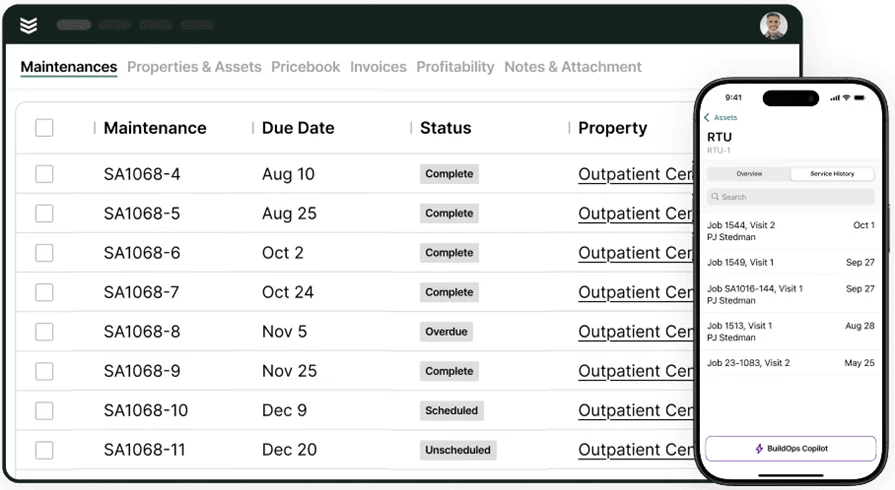
BuildOps is built specifically for commercial plumbing contractors, not adapted from a residential platform or a generic service tool. Once a contract is in place, the platform handles scheduling and dispatch, auto-schedules inspections, tracks job and asset histories so techs show up informed, and keeps inventory, invoicing, and accounting integrations connected in one place. Field crews access everything through a mobile app, and digital approvals mean no chasing signatures or paper trails.
What to take from this template: The agreement feeds directly into a platform where your scheduling, dispatch, PM documentation, invoicing, and field workflows all run together instead of across separate systems.
2. Plumbing Maintenance Contract Template | Venngage
Venngage's plumbing maintenance contract template covers scope of work, frequency of service, payment terms, warranties, and signatures in a clean, branded layout. It's fully customizable with your company logo and colors, and exports as a PDF, PNG, or PowerPoint file. The template also includes an AI-powered editing feature that can speed up customization significantly.
What to take from this template: A visually polished agreement that's easy to brand and present professionally to commercial clients.
Get Venngage’s plumbing maintenance agreement template here.
3. Free Plumbing Contract Agreement | PandaDoc
PandaDoc's plumbing contract template covers the core structure you need in any service agreement: scope of work, payment terms, changes to scope, termination, warranty, indemnity, and governing law.
It's a general-purpose template that requires customization to reflect plumbing-specific maintenance tasks and visit schedules, but the framework is solid and the built-in e-signature functionality means customers can sign without printing a single page.
What To Take From This Template: It has built-in digital execution for sending contracts and collecting signatures. That means faster approvals and less back-and-forth on paperwork.
Get PandaDoc’s plumbing maintenance agreement template here.
4. Plumbing Contract | Housecall Pro
Housecall Pro's template covers scope of work, material costs, payment terms, and termination clauses, with e-signature support via mobile and PDF export for customers who prefer a printed copy. Like most standalone templates, it requires customization to reflect commercial PM scope, visit schedules, and exclusions.
What to take from this template: A straightforward agreement structure that's easy to get signed in the field quickly.
Get Housecall Pro’s plumbing maintenance agreement template here.
How to scale your commercial plumbing maintenance program
Over 30% of contractors say a lack of clear processes and systems is a primary barrier to growing their maintenance business. That's not a sales problem. That's an infrastructure problem, and it's one you can easily fix.
BuildOps gives commercial contractors the operational backbone they need to sell, manage, and renew maintenance agreements without drowning in administrative work. The platform includes tools for:
- Building and tracking routine maintenance agreements in a single system
- Scheduling and dispatching PM visits with automated reminders and route optimization
- Generating plumbing maintenance checklists from the field on mobile devices
- Tracking pull-through revenue tied directly to each maintenance contract
- Managing digital customer approvals without the back-and-forth of manual documents
When the right infrastructure is in place, selling and managing commercial plumbing maintenance at scale stops being a grind and becomes a repeatable system that's easy to scale.