A Preventive Maintenance Checklist for Multi-Trade PM

Key Takeaways
- Building and implementing a preventive maintenance checklist can save you thousands in risky, hidden costs to your bottom line
- An effective preventive maintenance checklist contains 10 essential items
- Using a platform with a built in template for preventive maintenance checklists will be more effective than using Excel or other spreadsheet templates
Preventive maintenance is a key component of mastering field service operations, especially when it comes to improving your bottom line, and avoiding risky, hidden costs across your projects. A preventive maintenance checklist helps your techs catch issues early, extends asset life, reduces emergencies, improves safety, and delivers consistent, professional service on every visit.
Before building or updating your preventive maintenance checklist, you need to get full clarity on what actually makes it work in the real world, both for your techs, and for your bottom line.
Below, we’ll break down the core elements of an effective preventative maintenance checklist, the benefits it delivers, must-have items, and a plug-and-play template for your workflows. This is what we’ll talk about to do that:
- What is a preventative maintenance checklist?
- 7 benefits of implementing a preventative maintenance checklist
- 10 essential things to include in a preventative maintenance checklist
- Using a built-in preventative maintenance checklist template in your field service platform
Before we get into specific items, let’s define exactly what a preventative maintenance checklist is and how it fits into your day-to-day operations.
What is a preventative maintenance checklist?
A preventative maintenance checklist is a step-by-step guide technicians use on a recurring schedule to inspect equipment, complete required tasks, and confirm safety standards. It keeps critical assets running reliably, cuts unplanned downtime, and extends equipment life by catching small issues before they become expensive failures.
With a strong checklist in place, your maintenance program becomes consistent and repeatable. It clearly defines what to inspect, when to do it, and who owns each step—improving technician consistency, tightening documentation and compliance, and giving service managers clear visibility into asset health and upcoming work.
{{related-content-block="/resources/business-toolkit"}}
7 benefits of implementing a preventative maintenance checklist
A preventative maintenance checklist turns “remember to fix that later” into a consistent, trackable workflow. Instead of relying on tribal knowledge, your team follows the same steps on every visit—so equipment is protected, technicians stay aligned, and your maintenance management system always has clean, reliable data to work with.
- Less unplanned downtime: By checking critical points on every visit, technicians catch early warning signs before they turn into shutdowns, keeping chillers, boilers, RTUs, and other assets online when customers need them most.
- Longer equipment life: A structured checklist makes sure filters get changed, belts get inspected, and bearings get lubricated on schedule, extending the life of high-value equipment and delaying expensive replacements.
- Stronger safety and compliance: Consistent inspections reduce the risk of unsafe operating conditions and help document that you’re meeting AHJ, manufacturer, and contract requirements—especially when paired with modern building maintenance software.
- Clearer asset visibility: Standardized tasks and readings (amps, pressures, temperatures) roll up into a single record per asset, so service managers can quickly see history, trends, and true cost to maintain each unit.
- More predictable scheduling: When PM tasks are clearly defined, it’s easier to plan routes, balance workloads, and use maintenance dispatch software to keep the right techs on the right jobs at the right time.
- Cleaner work orders and documentation: Each visit generates a complete digital trail—tasks completed, issues found, photos, and recommendations—streamlined through modern work order software for contractors.
- Better technician productivity in the field: Techs don’t waste time figuring out what to do next; the checklist inside your field work app guides each step, reduces callbacks, and makes it easier for new hires to perform like seasoned pros.
When you combine a well-designed preventative maintenance checklist with software built for commercial contractors, PM work stops being “busywork” and becomes a dependable revenue engine that protects margins, assets, and customer relationships.
10 essential things to include in a preventative maintenance checklist
Think of your preventative maintenance checklist as the blueprint for every visit: it tells techs exactly what to inspect, record, and recommend so nothing gets missed and every asset gets the same standard of care.
Here are 10 things every preventative maintenance checklist should include:
1. Asset and system context (by trade and location)
Capture trade, system, and asset details up front: “MEP – RTU-3,” “FLS – wet system, Zone 4,” “Refrigeration – rack B, walk-in freezer 2,” “Construction – roof drain system, Building B.” Include make/model, serial, tonnage/BTU or GPM, voltage, and precise location (roof zone, riser, level, unit tag) so techs can find the right equipment fast and you maintain clean, trade-specific history.
2. Visit type, frequency, and code/contract requirements
Specify whether this is annual, semi-annual, quarterly, monthly, or per-run-hours—and tie it back to standards: NFPA 25/72/80 for fire, manufacturer specs for chillers and boilers, AHJ requirements, warranty conditions, and contract language. For construction close-out or warranty walks, call out which punch items or commissioning points are in scope.
3. Safety, isolation, and site access steps
Before anyone turns a wrench, the checklist should walk through trade-specific safety: electrical LOTO for MCCs and gear, valve/tag sequences for sprinkler and standpipe systems, ammonia or CO₂ procedures in refrigeration machine rooms, confined-space/roof access rules, and hot work or impairment notifications. If a valve shutdown affects multiple tenants or systems, that dependency belongs on the list.
4. Trade-specific visual inspection points
Go beyond “general look-over” and list the exact visuals techs must confirm by trade:
- MEP: belts, sheaves, bearings, vibration, VFDs, contactors, condensate drains, economizer dampers, piping supports.
- FLS: sprinkler heads, escutcheons, hangers, gauges, FDC caps, tamper/flow switches, alarm devices, fire doors, extinguishers.
- Refrigeration: oil level, sight glasses, frost patterns, insulation, door gaskets, case fans, drain pans, line vibration/support.
- Construction: penetrations and firestopping, sealants, roof terminations, expansion joints, equipment curbs, supports, and access paths.
5. Baseline readings and test results that matter later
Standardize the numbers you expect every time so you can trend by asset and trade:
- Mechanical/HVAC: suction/discharge pressures, superheat/subcooling, supply/return temps, ΔT across coils, static pressure, amp draws.
- Electrical: loading by phase, breaker settings, IR scan results, megger readings, ground tests.
- FLS: main/branch pressures, pump test results, trip times, alarm panel status, battery voltage.
- Refrigeration: case temps, defrost performance, rack suction/discharge pressures, compressor amps, oil differential, condenser split.
- Construction: moisture readings, slab/roof movement markers, settlement or cracking notes, envelope inspection results.

A good checklist starts with what your data is telling you—use preventive maintenance analysis to pinpoint your top failure points, then turn those patterns into simple, repeatable steps your team follows on every visit.
Standardize checks around airflow, system sounds, temperatures, electrical connections, filters, coils, moving parts, and refrigerant levels so nothing gets missed.
6. Service actions by component (clean, tighten, calibrate, replace)
Break tasks down into repeatable actions, not vague “inspect”: tighten lugs and terminations, clean coils and strainers, exercise valves, stroke actuators, calibrate sensors and safeties, test fire alarm zones, flush drains, grease motors, and replace filters, cartridges, and consumables with the right part numbers. The checklist should make it obvious which items are required this visit vs. “as found/as needed.”
7. Failure criteria, deficiency codes, and risk level
Define what “fail” looks like per trade: leak rate thresholds, insulation damage, corroded hangers, NFPA non-compliance, high superheat, overloaded circuits, negative slope on roof drains, failed emergency lighting, etc. Pair each with standard deficiency codes and severity (e.g., life-safety, critical asset risk, nuisance, efficiency) so office teams can sort, price, and prioritize work without re-reading every note.
8. Recommended corrective work and project opportunities
Give techs a structured way to surface revenue: one-off repairs (valve replacement, motor swap, control fix), quoted change-outs (RTUs, pumps, panels, fire pumps, compressors, cases), FLS impairments that must be cleared, and minor construction scopes (curb repairs, drains, access platforms, seismic upgrades). Capture estimated labor, materials, and urgency so service managers and PMs can turn field findings into approved work quickly.
9. Photos, documentation, and customer-ready reporting fields
Require “before/after” photos for key trades—sprinkler heads, risers, pump rooms, panels, walk-in coils, roof details—and tie them to each deficiency. Include fields for test forms (NFPA reports, functional tests, TAB reports, commissioning checklists) so your software can generate clean, branded reports for facility, safety, and construction teams without extra admin work.
10. Sign-offs, follow-up triggers, and cross-trade handoffs
Close each checklist with technician and supervisor sign-offs, time on site, impairment/restoration confirmations (for FLS), and simple toggles that automatically spin out follow-up items: repair work orders, quoted projects, construction RFI/CO candidates, or additional PM visits. Where trades intersect—like a sprinkler main reroute that affects HVAC or electrical penetrations—your checklist should flag the cross-trade handoff so nothing falls through the cracks between teams.
{{related-content-block="/resources/preventive-maintenance-procedures-examples"}}
Using a built-in preventative maintenance checklist template in your field service platform
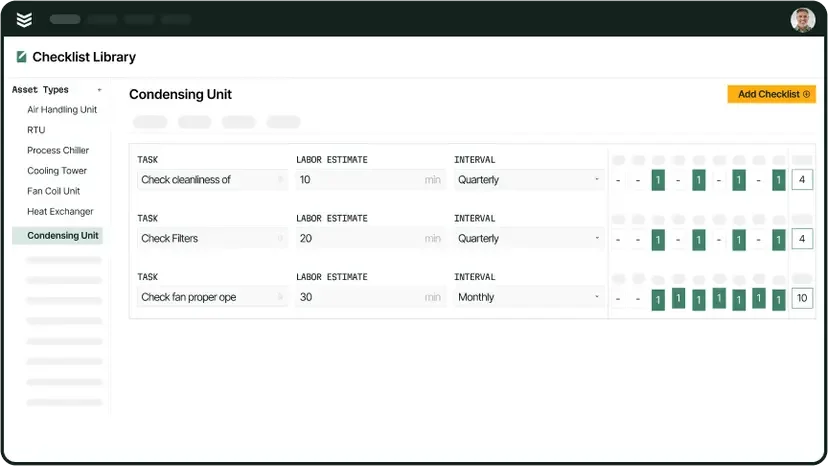
A good preventative maintenance checklist shouldn’t live in someone’s notebook or inside a one-off spreadsheet. It should be a repeatable template your team can use across every property, asset, and trade—mechanical, electrical, plumbing, fire/life safety, refrigeration, and even construction warranty walks.
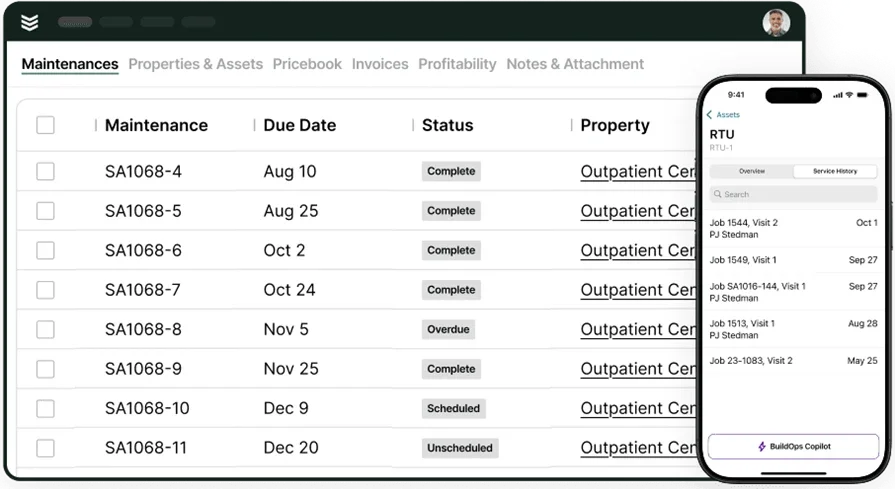
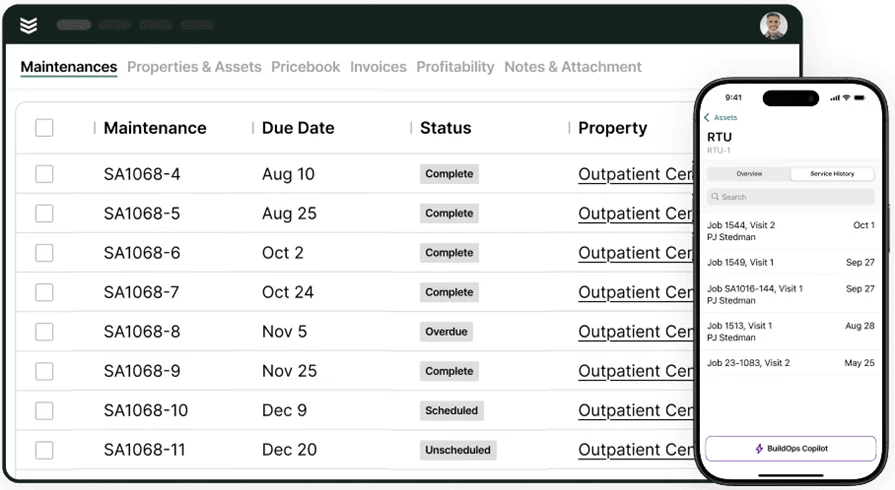
In practice, that means one checklist where techs can quickly see which assets are covered, what needs to be done on this visit, and how to document what they find. In the example below, an electrical maintenance agreement captures every panel, breaker, and device tied to the contract, so each visit automatically pulls in the right assets and tasks for that customer.
This keeps your PM work consistent, reduces missed steps, and makes it easy to show owners exactly what they’re getting for their maintenance dollars.
Once you’ve locked in a template like this, you can clone it for other trades, tweak the fields (tests, readings, forms, photos), and roll out a standardized preventative maintenance program across your entire service and construction business.
A strong PM checklist is more than boxes to tick—it’s the shared playbook your MEP, FLS, refrigeration, and construction teams use to protect assets, keep facilities safe, and prove contract value. Standardized tasks, readings, photos, and recommendations create clear equipment history and eliminate chasing tribal knowledge after every visit.
Inside BuildOps, those checklists plug directly into dispatch, work orders, quotes, projects, and accounting—then AI does the heavy lifting, flagging aging assets, repeat failures, and missed follow-ups so you can tighten margins without burying the office in spreadsheets.
If you’re ready to see what this looks like in your world, you can walk through a live commercial PM workflow with our team—no pressure, no hard sell, just a chance to map your existing checklists into an AI-driven system and see where it could take the business next.