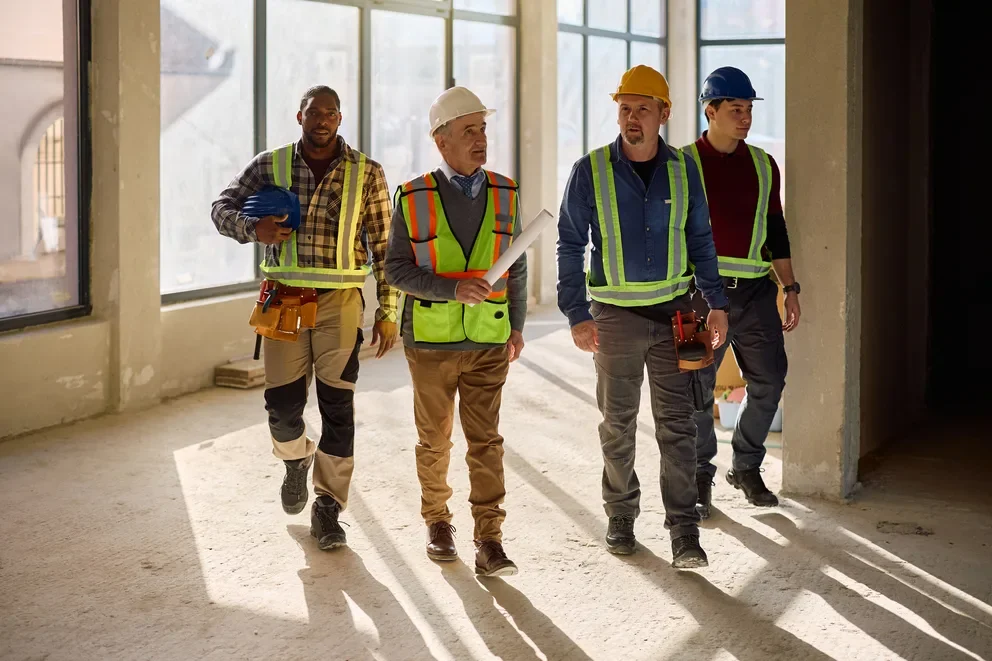
The data is clear: 30% of commercial contractors report that outdated technology limits their growth, and 80% believe AI will be essential to staying competitive within three years, according to our Pivot Point: AI and the Future of Commercial Contracting report.
For leaders in the trades who manage field service operations—including construction, installation, maintenance, and emergency calls—AI automation is the fastest path to construction efficiency, optimized scheduling, reduced callbacks, protected job margins, and sustainable growth. The need to leverage AI in the competitive field service industry is now.
This guide details the blueprint for adoption:
- How AI automation supports every field service contractor role
- 4 types of AI tools for field service management
- How to scale field service operations with AI & automation
We begin by exploring how machine learning tools optimize roles across your field service workforce.
How AI automation supports every field service contractor role
AI connects every phase of the job—from bid to closeout—through one live source of truth. Dispatch stays ahead, techs move faster, billing is accurate, and leadership sees real-time P&L. Here’s how every team, from the field to the back office, powers a tighter, AI-driven operation.
Field technicians and crews
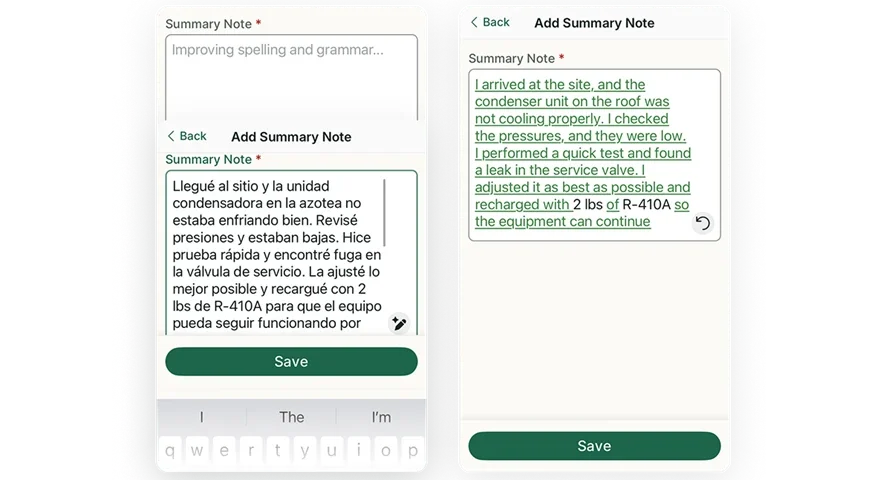
AI tools empower technicians to quickly diagnose issues on installations, maintenance, and service calls. Access to equipment history, failure points, and technical diagrams allows newer crew members to handle complex troubleshooting with confidence. AI also streamlines admin work: technicians can input notes via voice, and the system instantly creates a complete job record—including photos, readings, and parts—for office processing.
Deep Dive
AI is transforming field service from first call to final invoice. It analyzes service history and equipment data to spot issues early, speed up diagnostics, reduce callbacks, and boost capacity without adding headcount.
The top AI use cases in field service break down exactly how leading field service contractors are turning field data into faster, smarter job management.
Office administration and dispatch teams
AI optimizes scheduling by assigning the best technician based on qualifications, workload, and location to service, construction, and emergency jobs. A live dashboard unifies all work, instantly rebalancing the schedule, notifying customers, and flagging high-risk jobs during urgent issues.
Commercial field service business owners and executives
AI provides immediate, granular visibility into profitability, identifying issues like excessive labor hours or material overruns before they affect the P&L. For construction leaders, AI highlights schedule and budget risks early. Predictive scheduling optimizes technician utilization, while safety managers can analyze data to preemptively address incident risk patterns.
Field supervisors and project managers
Predictive scheduling optimizes technician utilization across service, installation, and construction jobs based on skills and location. Supervisors utilize AI for real-time project oversight, from mobilization to closeout, ensuring projects stay on track by spotting schedule risks early.
Customers and facility managers
AI provides clients with instant clarity, offering live dashboards and automated notifications on technician arrivals, schedule status, and emerging risks. This also enables smarter maintenance by flagging critical facility equipment failure patterns, shifting the business to profitable planned service.
Vendors and equipment suppliers
AI predicts material demand based on project timelines and service schedules, enabling early releases, reducing rush freight costs, and ensuring critical parts are delivered precisely when crews need them on site.

4 types of AI tools used in the commercial field service industry
AI offers comprehensive solutions to optimize the entire field service operation, from initial estimating and field deployment to final invoicing and customer engagement.
1. Agentic AI
Agentic AI is autonomous software that uses real-time field data to spot issues (e.g., system anomalies or component warnings), determine the most likely fix using service history, and automatically dispatch the correct certified technician.
This system can also automatically schedule the visit, generate a client estimate, order parts, and manage follow-ups. Tasks requiring manual effort are now handled by agentic AI in field service, running based on business logic and real-time crew availability.
2. Predictive AI
Predictive AI transforms service history into an early warning system, identifying issues across critical client assets before they escalate into high-cost emergencies. By tracking component usage and failure patterns, it flags at-risk units, allowing contractors to schedule repairs proactively and expand planned maintenance revenue.
3. Generative AI
Generative AI converts field inputs—voice notes, photos, and readings—into professional service and installation reports instantly, including key measurements and code references, enabling the office to invoice quicker.
4. Computer vision AI
Computer vision AI converts jobsite photos and video into structured field service data rapidly. Technicians can snap a picture of a nameplate to instantly capture manufacturer, model, and specifications. The system also checks for PPE, material handling, and safety compliance in real time.
BuildOps AI for Field Service
See how OpsAI auto-optimizes your work across the whole field service ops.
How to scale field service operations with AI and automation
AI-powered field service management allows commercial contractor teams to operate faster, eliminate errors, and manage every job from initial installation to final invoice.
1. Scheduling and dispatch
AI-driven scheduling systems ensure the right technician is assigned to every job—construction or emergency—by analyzing qualifications, certifications, workload, and proximity. If a critical job (like an urgent equipment failure or construction breakdown) arises, the AI instantly rebalances the schedule, reassigning less urgent tasks and notifying affected customers automatically. This automated scheduling paired with smart dispatch tools keeps field crews productive, minimizes downtime, and boosts utilization rates.
2. Field documentation and reporting automation

Following an installation, maintenance visit, or complex repair, technicians document the work quickly using photos, nameplate scans, and voice input. AI automatically generates a comprehensive service report containing component status, measurements, and code references. All field data (labor time, assets, parts) is converted into measurable metrics via reporting automation. This eliminates manual note-typing for technicians and ensures the office receives clean, complete documentation immediately upon job closure.
3. Fleet route optimization
AI optimizes route sequencing by factoring in job criticality, technician skills, traffic, and location, ensuring crews take the most efficient path. In case of a sudden emergency (e.g., safety failure), AI instantly recalculates routes and reassigns the nearest qualified technicians without disrupting the dispatch board. For commercial contractors with wide service areas, robust fleet management features can save hundreds of hours of travel time annually.
4. Invoices and purchase orders

Manual invoice and PO processing delays projects and cash flow. AI automates the capture and coding of key details (vendors, line items, totals) from scanned documents, instantly tying costs to project budgets. Advanced invoicing tools paired with a payment processing tool use field notes to auto-generate final invoices after major work, accelerating billing and shortening the service-to-cash cycle for commercial firms.
5. Asset capture and lifecycle management
AI auto-captures key asset details from a nameplate photo or scan—manufacturer, serial, model, and install date—and links them to the customer record, eliminating manual entry. Data collected via the technician mobile app creates a comprehensive equipment history, empowering the team to proactively sell service agreements and schedule predictive maintenance, maximizing client equipment uptime.
AI changes how commercial services operate. BuildOps is the AI‑native platform that unifies scheduling, dispatch, quotes, work orders, maintenance, and reporting with OpsAI.
With OpsAI, contractors can schedule smarter, improve field productivity, reduce manual work, and give technicians the tools to diagnose issues faster, avoid shutdowns, and close out jobs efficiently. The result is tighter schedules, stronger margins, and better service for both customers and teams.
Download our Pivot Point: AI and the Future of Commercial Contracting report to see how leading contractors are using AI to optimize scheduling and streamline operations.
Ready to explore? Set up a demo with BuildOps to see how OpsAI can eliminate manual tasks and streamline your commercial workflow.

The AI Pivot Point
Key insights on how leading field teams are using AI to power up their ops.