8 Best HVAC Field Data Capture Apps for Your Field Techs
Key Takeaways
- A mobile app for capturing equipment data for HVAC contractors can automate a lot of redundant field tasks like cataloging assets form nameplates with the snap of a photo
- Choosing the best HVAC field data capture app for your techs depends on the scale of your work, like whether you do primarily commercial, residential, multi-trade, etc.
- Some of the top apps include BuildOps for commercial service teams, Kickserv for residential, and Tradify for multi-trade
HVAC contractors running commercial jobs need accurate equipment records captured on-site, every time. A mobile app for capturing equipment data gives techs the ability to log asset details, tag serial numbers, snap photos, and sync everything back to the office in real time.
For contractors operating in the HVAC service industry, this eliminates the handwritten notes and manual data entry that slow down service calls and create costly errors.
Here’s what we’ll cover:
- Key features to look for in an HVAC equipment field capture mobile apps
- 8 best HVAC equipment field capture apps
- 7 benefits of using a mobile app for HVAC equipment data
- Questions to ask when choosing an HVAC equipment field capture mobile apps
- 4 important HVAC equipment field capture app FAQs answered
Choosing the right mobile app for HVAC equipment data shapes how your team handles asset tracking, inspections, and compliance. This guide highlights top platforms, what to look for, and how better field data capture can tighten operations across your service business.
Key features to look for in an HVAC equipment field capture mobile apps
The right HVAC field app starts on the job site and ends in your back office. It should capture asset details fast, sync in real time, and push field data straight into your workflows—no extra steps.
1. Technician mobile app

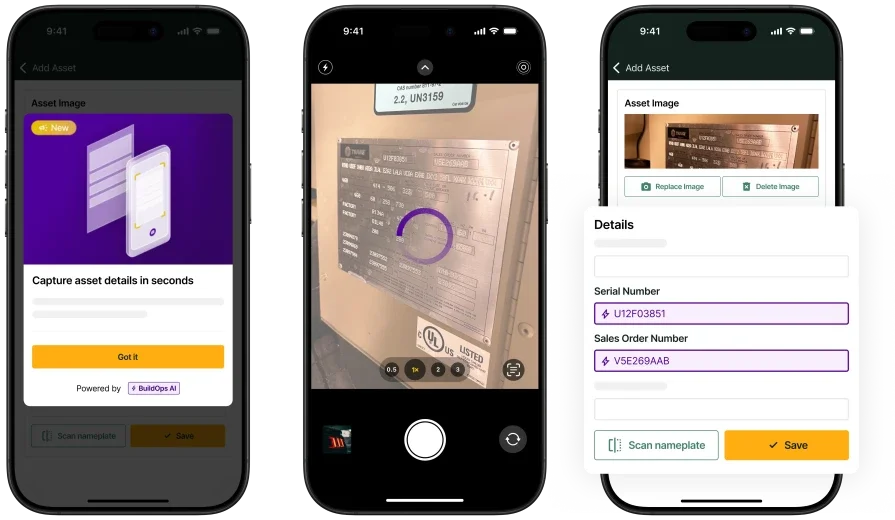
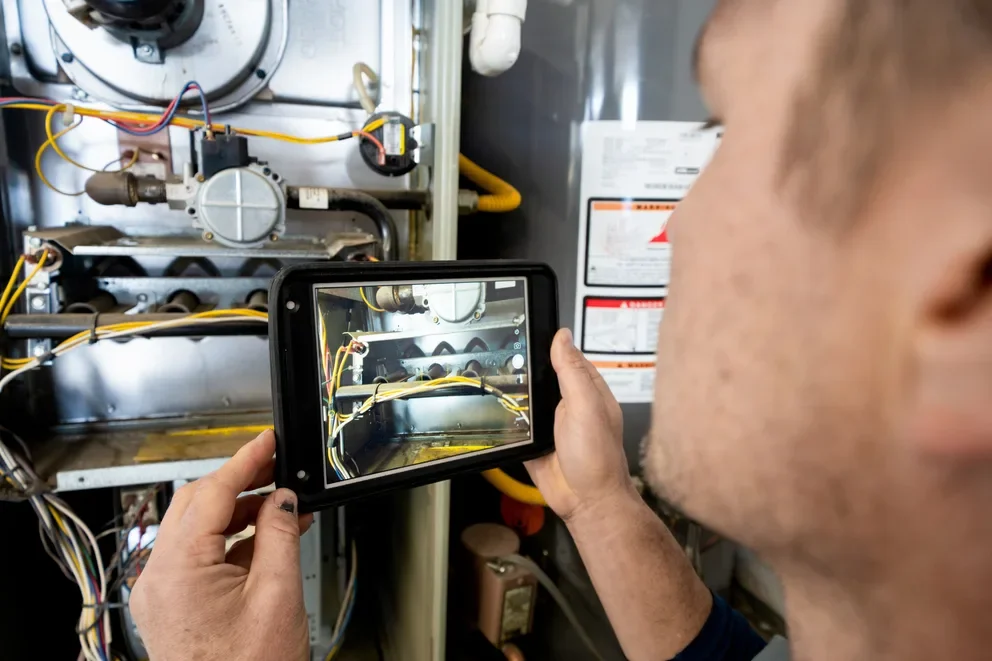
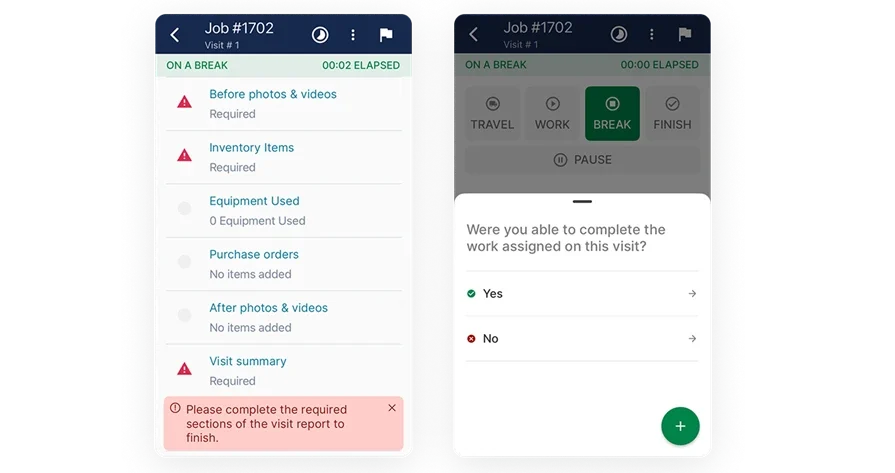
Every piece of equipment data your team captures starts at the unit. A purpose-built technician mobile app lets techs scan nameplates, capture key details and photos, and add notes to the asset record right from their mobile device. Data syncs to the office instantly, works offline in low-signal areas, and requires key fields (like refrigerant type or filter size) before closing a visit, keeping equipment records consistent across every property and tech.
2. AI-powered equipment insights
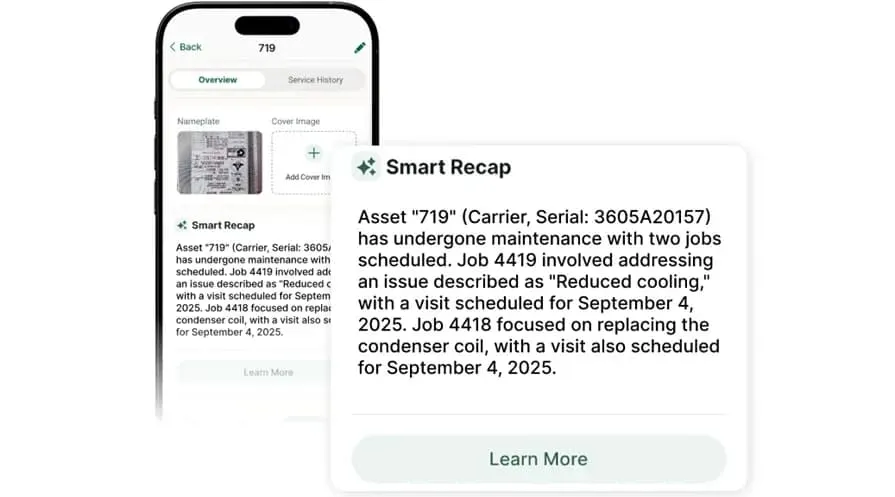
Accurate equipment records are only useful if you can act on them. Field service platforms with AI capabilities can clean up technician notes, auto-correct grammar, and surface patterns across asset service history. AI matches techs’ skills to each call, uses OCR to auto-fill asset data from nameplate photos, and flags aging equipment nearing end-of-life to support replacement recommendations.
3. Equipment & asset reporting

Tracking equipment means nothing if you cannot pull clean reports from it. A strong reporting engine lets you build dashboards around asset age, service frequency, cost-per-unit, and warranty status across your entire customer base. AI-powered reporting lets you instantly pull asset histories and generate QBR-ready reports that show what was serviced, when, and at what cost.
4. Service agreement management
Most commercial HVAC contractors tie their equipment maintenance schedules directly to service agreements. The platform should let you build agreements for specific assets at specific properties with set maintenance intervals. When visits are due, it auto-generates tickets with the right checklists and links any pull-through work back to the agreement so you can track profitability and pull-through revenue per contract dollar.
5. Fleet & asset logistics
Getting techs and their tools to the job site on time is part of the equipment management equation. Integrated fleet tracking connects GPS data from service vehicles directly to the dispatch map, so dispatchers can see who is closest to an emergency call and route accordingly. Fleet tracking also covers equipment, helping you track usage, inform rent-versus-buy decisions, and coordinate work from one platform.
Other notable features for HVAC contractors
Beyond the five core equipment-focused capabilities above, several additional features support the broader workflow around HVAC field service operations:
- Scheduling & dispatching — Coordinating multi-day, multi-tech visits across properties is handled through a unified scheduling and smart dispatch board that also supports drag-and-drop rescheduling and dispatch for project-based work.
- Service quoting — Techs can log recommendations in the field, and the office can convert those into field service quoting documents with photos, labor, and materials already populated.
- Field service CRM — Customer and property records, contact hierarchies, credit limits, and communication history are centralized in a field service CRM that both office staff and techs can access.
- Invoicing & payments — Completed jobs flow directly into invoicing workflows, and techs can collect payments on-site via mobile to shorten the cash cycle.
- Time tracking — Technician hours are captured through the mobile app and automatically posted to both the job cost record and the payroll time tracking export, eliminating double entry.
Features set the baseline. The next step is seeing how specific platforms put them to work across commercial HVAC operations.
8 best HVAC equipment field capture apps
Not all platforms handle field equipment capture the same way. The tools below are rated on how well they help HVAC contractors capture, organize, and use equipment data in the field across commercial, residential, and construction work.
1. BuildOps: best for commercial HVAC businesses
BuildOps gives commercial HVAC contractors one connected platform for every asset in the field. Techs capture nameplates, photos, and checklists from any device — even offline — and everything syncs straight to the asset record, job history, and service agreement.
Powered by OpsAI, BuildOps auto-cleans technician notes, reads nameplates to fill in key fields, spots recurring issues, and feeds real-time dashboards so you can track asset age, service frequency, and cost-per-unit at a glance.
How Pricing Works: BuildOps provides weekly live demos and the option to schedule a personalized session. Pricing is tailored to the size and needs of each operation, so teams can explore the platform and identify which capabilities match their workflow before committing.
Features Beyond Equipment Capture:
- Real-time drag-and-drop scheduling and dispatch for coordinated multi-tech teams
- AI-powered nameplate scanning and automated asset field population
- Advanced customer hierarchy management for multi-location clients
- Technician-friendly mobile app with offline mode, photo capture, and automated checklists
What Sets It Apart for Commercial HVAC Teams: BuildOps links equipment capture with dispatching, invoicing, and agreements in one platform, eliminating data silos for commercial HVAC contractors managing many assets across multiple properties.
Rating: 4.5 on Capterra from 151 user reviews

2. Kickserv: best for residential teams
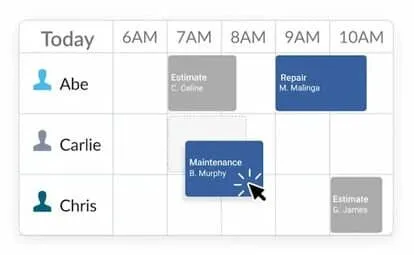
Kickserv works well for residential HVAC contractors who need a simple way to track customer interactions and basic job details from the field. Its self-service portal lets homeowners manage jobs and payments while techs log notes and photos to each customer account.
However, Kickserv lacks the advanced asset hierarchy tools, AI-powered nameplate scanning, and multi-location equipment tracking that commercial HVAC operations require — making it a less practical fit for contractors managing large-scale service portfolios.
How Pricing Works: Kickserv offers tiered pricing, with core features like payment processing and customer management unlocked at higher tiers. Entry-level plans cover basic scheduling and invoicing, while equipment-related tracking capabilities vary by plan.
Features Beyond Equipment Capture:
- Customer self-service portal for estimate approvals and payment
- Integration with payment systems like Stripe and QuickBooks
- Simplified job scheduling for smaller-scale teams
- Basic equipment notes and photo attachments per job
What Sets It Apart for Residential HVAC: Kickserv's customer portal reduces back-and-forth communication between the office and homeowners, saving administrative time on routine service calls and follow-ups.
Rating: 4.4 on Capterra from 387 user reviews
3. Procore: best for general contractors

Procore is designed for general contractors coordinating complex construction projects across multiple trades and teams. Its tools span pre-construction through daily job logs and document control, giving HVAC contractors on large projects strong coordination and submittal tracking.
That said, its focus on construction project delivery means it lacks the trade-specific equipment capture workflows, recurring maintenance scheduling, and asset lifecycle tracking that HVAC service contractors depend on for day-to-day field operations.
How Pricing Works: Procore uses a custom pricing model based on company size and annual construction volume. Demos are available to evaluate the platform before committing to a contract.
Features Beyond Equipment Capture:
- Robust project management with submittals, RFIs, and change order tracking
- Daily logs and job site documentation tools
- Multi-trade coordination across subcontractors and vendors
- Drawing and document management with version control
What Sets It Apart for General Contractors: Procore excels at managing the full lifecycle of a construction project from preconstruction through closeout. For general contractors running multi-million-dollar builds with dozens of subcontractors, its project-level visibility and document control are hard to match.
Rating: 4.5 on Capterra from 2,655 user reviews
4. mHelpDesk: best for small residential operations
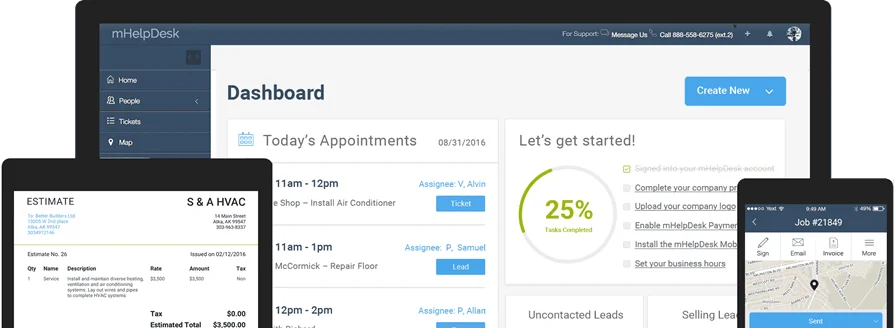
mHelpDesk provides residential HVAC contractors with a lightweight platform for managing service calls, scheduling techs, and tracking basic job details from the field. Techs can use mobile devices to manage jobs, add notes, and update work orders, with built-in invoicing and a customer portal for booking.
It suits small residential service teams, but its weak asset management and lack of advanced equipment capture make it a poor fit for commercial HVAC contractors managing large property portfolios.
How Pricing Works: mHelpDesk offers a flat monthly rate per user, with access to most features included at a single tier. A free trial is available for teams that want to test the platform before committing.
Features Beyond Equipment Capture:
- Drag-and-drop scheduling calendar for daily tech assignments
- Built-in invoicing with payment collection
- Customer portal for online appointment requests
- GPS tracking for field technicians
What Sets It Apart for Small Residential Teams: mHelpDesk keeps the interface simple and the learning curve short. For one- to five-tech shops running residential HVAC calls, the platform handles scheduling, billing, and basic job tracking without requiring extensive setup or training.
Rating: 4.3 on Capterra from 823 user reviews
5. Tradify: best for multi-trade contractors
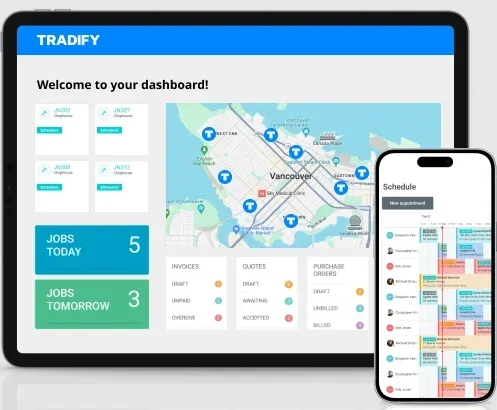
Tradify targets trade contractors who handle HVAC alongside electrical, plumbing, or other mechanical disciplines. Its mobile app lets techs create quotes, log time, and capture photos on-site, with everything syncing to the office for invoicing and reporting.
It delivers a simple, end-to-end quoting-to-invoicing workflow for multi-trade shops, but lacks equipment profiles, asset lifecycle tracking, and structured field workflows like serial number, refrigerant, and PM checklist capture that HVAC service contractors need for accurate commercial equipment records.
How Pricing Works: Tradify charges a per-user monthly fee with all features included at one price point. No tiered plans or feature gating.
Features Beyond Equipment Capture:
- Quote creation and approval tracking from the field
- Time tracking with job costing integration
- Supplier purchase order management
- Xero and QuickBooks accounting sync
What Sets It Apart for Multi-Trade Contractors: Tradify treats every trade the same inside the platform, which makes it easy for shops running HVAC, electrical, and plumbing crews to standardize their quoting and invoicing process across all disciplines without managing separate systems.
Rating: 4.7 on Capterra from 152 user reviews
6. Buildertrend: best for home builders and remodelers
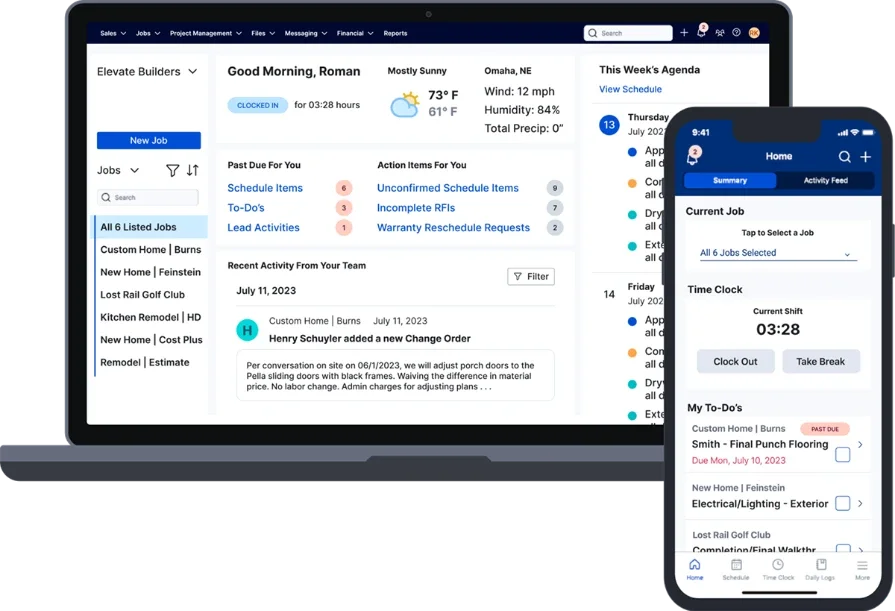
Buildertrend is a construction project management platform designed for home builders, remodelers, and specialty contractors working on residential construction projects. It is a single portal for HVAC contractors to coordinate with GCs, manage bids, schedules, change orders, selections, and client communication, with strong project visibility and customer-facing tools.
However, Buildertrend lacks the service-side workflows that HVAC field service teams depend on — recurring maintenance scheduling, technician-level equipment capture, asset history by serial number, and on-site diagnostic documentation — which limits its usefulness for contractors whose primary revenue comes from ongoing HVAC service and maintenance work.
How Pricing Works: Buildertrend uses tiered pricing based on the number of active projects and users. Higher tiers unlock features like financial tools and advanced reporting. A demo is available to evaluate the platform.
Features Beyond Equipment Capture:
- Client-facing portal with selections, change orders, and messaging
- Bid request management and subcontractor coordination
- Project scheduling with Gantt chart views
- Daily logs and photo documentation by project phase
What Sets It Apart for Home Builders: Buildertrend centralizes the entire residential construction lifecycle — from lead capture through warranty management — in one platform. For builders and remodelers managing multiple active projects with homeowner-facing communication needs, it streamlines coordination across every phase of the build.
Rating: 4.5 on Capterra from 2,481 user reviews
7. ServiceTitan: best for large residential and light commercial

ServiceTitan is a field service management platform built around high-volume residential and light commercial HVAC operations. It offers robust call booking, dispatching, and sales presentation tools that help techs present repair-versus-replace options on-site with visual price menus. The platform tracks equipment at the property level and supports maintenance agreement management with automated renewal workflows.
ServiceTitan works well for large residential shops with 20+ techs and high call volume, offering strong revenue-per-call tools. But its equipment tracking is geared to residential unit replacements, not the detailed asset documentation — like nameplate data, multi-building hierarchies, and compliance-grade histories — that commercial HVAC contractors need for hundreds of assets across hospitals, campuses, and data centers.
How Pricing Works: ServiceTitan uses custom pricing based on the number of active technicians. Implementation includes onboarding and training packages. A demo walkthrough is available to assess fit.
Features Beyond Equipment Capture:
- Visual pricebook with good-better-best presentation for techs
- Marketing scorecard with call tracking and ROI attribution
- Membership and maintenance agreement management
- Payroll integration with commission tracking
What Sets It Apart for Large Residential Operations: ServiceTitan excels at turning every service call into a revenue opportunity. Its pricebook presentations, membership tools, and marketing attribution give large residential HVAC shops the data they need to maximize average ticket value and track marketing spend down to the individual call.
Rating: 4.3 on Capterra from 325 user reviews
Check out our breakdown of how ServiceTitan stacks up when compared to BuildOps.
8. FieldEdge: best for legacy HVAC service shops

FieldEdge has been in the HVAC service management space for decades, offering dispatching, invoicing, and customer management tools tailored to small and mid-sized service contractors. Its mobile app gives techs access to customer history and equipment notes on-site, and the platform integrates directly with QuickBooks for accounting. FieldEdge also supports flat-rate pricing books and service agreement tracking, which helps shops standardize their billing across common HVAC repairs.
FieldEdge handles core service operations well for contractors used to its interface, but its lack of AI nameplate scanning, asset hierarchies, and deep asset lifecycle reporting makes it hard to scale for larger commercial HVAC work.
How Pricing Works: FieldEdge offers custom pricing based on the number of users and selected modules. A guided demo is available to walk through the platform before purchase.
Features Beyond Equipment Capture:
- QuickBooks integration for real-time accounting sync
- Flat-rate pricing book with mobile access for techs
- Service agreement tracking with renewal reminders
- Dispatch board with drag-and-drop scheduling
What Sets It Apart for Legacy HVAC Shops: FieldEdge has deep roots in the HVAC trade and a familiar interface for contractors who have been using it for years. Its QuickBooks integration and flat-rate pricing tools make it a dependable option for shops that prioritize accounting accuracy and standardized billing over advanced field capture technology.
Rating: 4.2 on Capterra from 305 user reviews
7 benefits of using a mobile app for HVAC equipment data
Equipment data only matters if it changes how you work. When asset records are accurate, accessible, and tied into scheduling, quoting, and billing, commercial HVAC contractors see real impact across the entire business.
1. Accurate equipment records captured at the source
Techs capture asset details on-site directly into the system, eliminating duplicate data entry, reducing errors, and improving accuracy over time. When your team handles on-site field services across dozens of commercial properties, clean equipment records mean fewer callbacks caused by misidentified units, wrong parts ordered, or maintenance performed on the incorrect asset.
2. Faster diagnostics through AI-powered field tools
A mobile app for HVAC equipment data management can do far more than store records. Platforms with agentic AI field service capabilities let techs scan a nameplate, auto-populate asset fields, and instantly pull the full service history for that unit — All before they open a panel—past-visit patterns give techs instant context and save time on packed days.

AI has already started shifting how contractors handle HVAC equipment management. What used to take hours can now happen in minutes — with more accuracy and fewer surprises.
In our 2025 survey, The Pivot Point: AI and the Future of Commercial Contracting, 78% of contractors said they believe AI improves efficiency, and 47% are already using AI in some capacity for their field ops.
3. Stronger compliance and audit-ready documentation
Hospitals, data centers, pharma, and food service facilities need detailed service histories for compliance. A mobile HVAC app lets techs attach photos, checklists, and sign-offs to each asset, so when auditors ask for proof of maintenance, your office can pull complete records by serial number in seconds instead of digging through paperwork.
4. More profitable quoting driven by real field data
Techs who capture detailed equipment data—age, efficiency, repair history, photos—give sales better insight to make data-driven replacement recommendations, resulting in stronger proposals and higher close rates. Contractors who tie field-captured equipment data into their HVAC price book workflows can build quotes faster and present customers with clear justification for every line item.
5. Deeper customer relationships through equipment visibility
Commercial customers expect their HVAC contractor to know their buildings. When your team can pull up every asset at a property — including what was serviced, when, and by whom — it builds trust that generic service providers cannot match. A strong contractor CRM links equipment records to customer hierarchies, giving account managers QBR-ready insights that turn service calls into long-term partnerships.
6. Smarter scheduling aligned to equipment priorities
Some maintenance visits are more urgent than others. Using field data, dispatchers can schedule based on asset condition—not a static calendar—so critical or at-risk equipment gets priority. Contractors leveraging AI HVAC scheduling optimization can match the correct tech — with the correct certifications and parts — to the correct unit, reducing repeat visits and keeping critical systems online.
7. Less admin drag on your field team
Mobile capture syncs asset data, photos, and checklists in real time so techs close out visits faster, office staff stop chasing missing info, and managers get accurate job costs—turning documentation into a built-in part of the service call, not extra end-of-day work.
Questions to ask when choosing an HVAC equipment field capture mobile apps
Choose a mobile app that matches how your HVAC team actually works—these questions separate purpose‑built commercial platforms from generic tools that just add work.
- Data capture depth — Does the app support structured field entry for nameplate specs, refrigerant types, and filter sizes, or does it rely on free-text notes? Can techs attach timestamped photos and condition tags directly to the asset record during a visit?
- AI and automation — Does the platform use AI to auto-populate asset fields from nameplate scans? Can it flag equipment with escalating service frequency or declining performance trends without manual report pulls?
- Offline reliability — Does the app function in mechanical rooms, basements, and rooftops with no cell signal? Does it queue and sync captured data automatically when connectivity returns, without requiring the tech to re-enter anything?
- Compliance and audit readiness — Can the system generate a complete, time-stamped service history by serial number on demand? Does it enforce gated checklists that require specific fields before a tech can close out a visit?
- Feature integration across field ops — Does equipment data captured on-site flow directly into scheduling, dispatching, service agreements, and invoicing without manual handoffs? Can the office pull asset-level reporting across properties, and does the platform connect field capture to quoting workflows so recommendations turn into revenue?
4 important HVAC equipment field capture app FAQs answered
These questions mainly come from commercial HVAC contractors with active field operations who are assessing if their capture workflow is limiting them. The answers focus on real operational priorities, not the basics.
1. What is an HVAC equipment field capture mobile app?
A mobile-first tool techs use on-site to capture asset details — serial numbers, nameplate specs, photos, refrigerant type — straight into a structured digital record that syncs with the office in real time, cutting out duplicate data entry.
Modern equipment capture goes far beyond basic note-taking. It standardizes data with guided checklists, OCR nameplate scanning, and reliable offline sync — so asset records stay accurate and consistent for every tech, every property, and every visit, no matter the connection.
2. How does a mobile app for HVAC equipment data management connect to existing service workflows?
For commercial operations running multiple properties and service lines, the value of field capture is only realized when the data flows downstream without friction.
A purpose-built HVAC field app pushes asset data straight into your CRM, agreements, dispatch, and reporting—no double entry, no delays. Everyone sees the same live equipment record, so estimating, PM scheduling, and cost-per-unit reporting stay in sync. The difference isn’t data capture; it’s a fully connected field system.
3. Is an HVAC equipment field capture app worth the cost?
For commercial HVAC contractors with multi-site portfolios, the real cost isn’t the software—it’s running without structured asset capture. A dedicated capture platform cuts errors and re-entry, drives accurate PMs, and produces audit-ready records, delivering top ROI for contractors with 10+ techs.
Contractors who have consolidated fragmented systems into a single platform, where the team recovered a full week of manual work every month — consistently report that the efficiency gains outpace the platform cost within the first quarter of adoption.
{{related-content-block="/resources/customer-success"}}
4. What are the best practices for HVAC equipment field capture in commercial service operations?
Field capture discipline is what separates contractors with clean asset data from those chasing incomplete records—no matter your team size or whether you’re doing installs, maintenance, or repairs.
- Require refrigerant, nameplate, and filter data before closing any visit.
- Standardize photos per asset: at least one nameplate and one condition shot every visit.
- Use OCR to scan nameplates and auto-fill asset fields instead of manual entry.
- Link every asset to a property/location hierarchy, not just a customer record.
- Sync asset data to service agreements in real time to auto-generate PM schedules.
- Use asset-specific checklists that differ by equipment type.
- Capture pull-through work recommendations directly in the asset workflow.
- Quarterly audit asset records for missing fields and untagged photos.
- Use dashboards to flag high-service or high-cost assets and alert account managers.
- Train techs on capture standards at onboarding and reinforce via dispatch coaching.
Incomplete equipment data, missed maintenance, and broken field-to-office handoffs cost commercial HVAC contractors real money.
With a mobile app built for commercial service, your techs capture clean equipment data on-site — scanning nameplates, logging serials, and completing checklists that sync instantly to the office. No double entry. No lost asset info.
Most tools stop at data capture. BuildOps OpsAI connects every asset to dispatching, service agreements, and customer history in one platform — so equipment data actually drives revenue.
See how it works for your team. Schedule a free demo.