

Plumbing contractors deal with nonstop service calls, dispatching, parts tracking, and invoicing, all while keeping crews productive across job sites. For anyone running or growing a business in the plumbing service industry, software is now a critical tool for keeping operations tight and cash flow healthy.
This guide breaks down everything you need to know about choosing and using field service software for plumbing to run your operation. Here is what we will cover:
- Choosing the right field service plumbing software
- Top field service plumbing software features to look for
- 8 best field service software for plumbing
- 7 benefits of using plumbing field service software
- 4 important plumbing field service software FAQs answered
Whether you’re upgrading from spreadsheets, whiteboards, or limited software, choosing the right field service platform for plumbers starts with understanding what it does, how it fits your daily work, and why it’s worth the switch.
Choosing the right field service plumbing software
Every plumbing operation runs differently, so no single platform is going to check every box for every team. Before you commit, work through these questions to narrow down which plumbing field service software actually fits the way your crew operates day to day.
- Cost and contract structure – What is the total monthly or annual cost per user, and does that include onboarding? Is pricing locked in, or does it jump after the first term? Can your team test the platform before signing?
- Ease of adoption – How long does it take to get dispatchers and field techs fully up and running? Can techs who aren't especially tech-savvy use the mobile app without constant hand-holding?
- Industry fit – Is the platform designed for plumbing contractors handling service and repair work, or is it a generic tool retrofitted for the trades? Does it account for how plumbing jobs actually flow — from dispatch through diagnosis, repair, and closeout?
- AI-powered capabilities – Does the platform use AI inside dispatching, quoting, and reporting — or is it bolted on as a separate feature? Can it analyze field notes, auto-generate line items, and flag unbilled work before a job closes out?
- Vendor support and accountability – What does ongoing support look like after onboarding wraps up? Is there a dedicated account manager, or are you routed to a general help queue? How fast do they resolve issues that hit your dispatchers or techs in the field?
- Reviews and reputation – What are contractors in your segment saying about field service software for plumbing on third-party review sites? Are the most common complaints deal-breakers, or minor friction points? How recent are the reviews?
- Field service integration – Does the software connect scheduling, dispatching, invoicing, and reporting in a single workflow? Can your techs update job status, capture notes, and collect payments from the field without switching between apps?
With these questions answered, you'll have a clear picture of which platforms deserve a closer look — and which ones are worth evaluating on features alone.
Top field service plumbing software features to look for
The use of software can support your operation in dozens of ways, from coordinating crews across job sites to managing customer relationships and keeping your financials clean. To help you zero in on what matters, we break the core features into three categories below.
Field service management & project management features

Field service and project management software keeps plumbing operations organized from the first call to the final walkthrough. It simplifies scheduling and dispatch, pulls all job data and documentation into one place, and helps teams stay on top of labor, tasks, and milestones for multi-phase work.
- Scheduling & dispatching – Getting the appropriate tech to the appropriate plumbing job at the appropriate time is fundamental to running a field service operation. Software with a robust field service scheduling engine lets you view every tech's availability, skill set, and location from a single board, then assign jobs with a drag-and-drop action. Paired with dedicated smart dispatch software, your dispatchers can push real-time job details directly to techs' devices, adjust routes on the fly when emergencies come in, and reassign calls when someone is running behind.
- Mobile connectivity – Your plumbing techs spend their entire day in the field, not at a desk. A reliable technician mobile app puts customer history, job details, and equipment records in their hands the moment they arrive on site, so they don't have to call the office for context on every call. It lets techs get dispatch alerts, request help, and share job updates in real time for smoother scheduling, invoicing, and reporting.
- Time tracking – Knowing exactly how many labor hours go into each plumbing job is critical for accurate job costing and payroll. Software with built-in time tracking captures clock-in, clock-out, and drive time automatically, tying every hour directly to a specific work order. This eliminates end-of-day guesswork on timesheets and gives your office team clean data to work with.
- Service quoting & AI-assisted operations – Speed on estimates wins jobs. Field service software for plumbing with integrated service quoting tools lets techs build professional, multi-option proposals on site using pre-loaded pricebook items, so customers see transparent pricing before any work begins. When field ops is paired with AI-powered capabilities, the software can analyze a tech's field notes and auto-generate line items, flag potential upsell opportunities, and draft reports in a fraction of the time manual entry would take.
- Invoicing & payment processing – Getting paid quickly keeps your cash flow healthy. Software with invoicing features converts completed work orders into invoices automatically, eliminating the lag between finishing a job and sending the bill. Integrated payment processing lets techs collect credit card or digital payments on the spot, so you're not chasing checks weeks later.
- Reporting, analytics & fleet management – You can't improve what you don't measure. Software that includes AI-powered reporting and analytics tools tracks KPIs like revenue per tech, average ticket size, close rate on estimates, and time-to-completion by job type. Pairing that with fleet management gives you visibility into vehicle locations, fuel usage, and idle time so you can cut unnecessary drive time and reduce overhead.
CRM & sales plumbing software features

Plumbing sales and CRM software built for growing field service teams, so you win more bids, keep every detail tight, and always know the next best move from first touch to long-term repeat work.
- Customer relationship management – Repeat business is the lifeblood of a plumbing operation, and a purpose-built field service CRM helps you protect it. It stores every customer interaction, property detail, and service record in one searchable hub so your team always has context on who they're serving and what work has been done. Customer hierarchies show multi-property relationships instantly, so you know which unit needs service, where it is, and who to contact.
- Service agreements – Recurring revenue from maintenance contracts stabilizes your cash flow and fills your schedule during slower months. Software with dedicated service agreement management lets you automate recurring job generation, send renewal reminders, and track agreement profitability across your entire customer base.
- Service history & upsell intelligence – To predict what plumbing services your customers may need next, you should know what work they've already had done. Having an extended record of a customer's service calls can help you identify patterns of what work they need and when, and you can use AI analysis to generate suggestions and potential upsell opportunities.
- Targeted communication & feedback – Use customer interaction history to guide future communication. Reward clients who pay on time with incentives like discounts or priority, follow up with late payers, and track all touchpoints and feedback.

Plumbing system design, engineering & simulation features
System design, engineering, and simulation software helps plumbers visualize layouts, calculate water pressure and flow, check code compliance and performance, troubleshoot issues remotely, and manage required materials.
- Pipe sizing & hydraulic calculations – Accurate pipe sizing maintains proper pressure and flow at every fixture. Modern design software replaces guesswork with hydraulic calculations based on layout, load, demand, elevation, and code to give contractors reliable results.
- Plumbing layout & drafting – Plan pipe routes, materials, and access points with 2D/3D drawings so installers and inspectors see exactly what’s required.
- Code compliance & standards verification – Automatically check designs against IPC, UPC, and local codes to catch violations early and avoid failed inspections.
- Simulation & diagnostic modeling – Model system performance, peak flow, and failure scenarios to spot issues and troubleshoot without touching the system.
From here, focus on solutions that align with your must‑have workflows, scale with your team, and are proven to streamline scheduling, dispatch, and job management for plumbing businesses specifically.
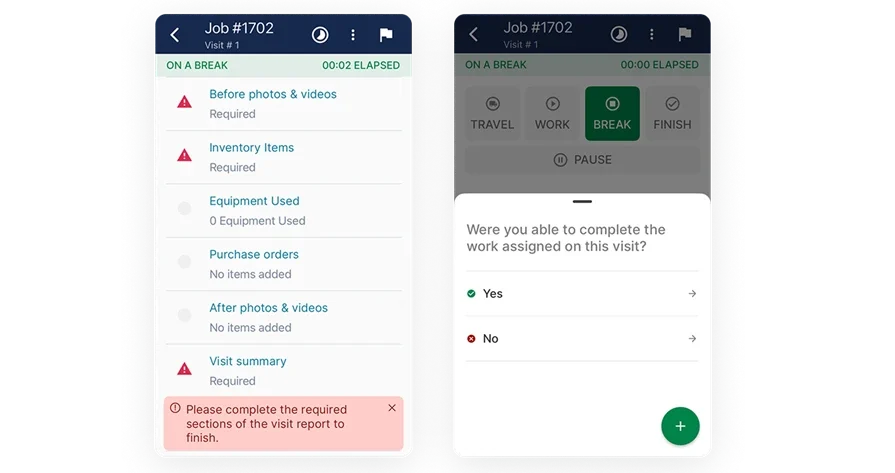
Run every plumbing job from call to cash
Dispatch, track your techs, and invoice on the job—all in one platform.
8 best field service software for plumbing
With those core features in mind, here are our top picks — grouped by the same three categories so you can jump straight to what your operation needs most.
Best field service management & project management plumbing software
These platforms handle the daily grind of plumbing field service: dispatching calls, coordinating techs, building estimates on site, and closing out jobs with clean invoices and reports.
1. Best for commercial plumbing teams: BuildOps

BuildOps connects dispatch, scheduling, quoting, invoicing, and project management in a single system designed for commercial plumbing contractors. Built-in AI tools like OpsAI help techs capture cleaner field notes, flag unbilled work before a job closes out, and surface property history so your crew shows up prepared and your office stays ahead. Everything syncs with your accounting system, so nothing falls through the cracks between the field and the back office.
Industry Specialization: Commercial
How Pricing Works: BuildOps pricing is based on the size of your team and the features your business needs, so you only pay for what you actually use.
What Sets It Apart: BuildOps lets plumbing contractors manage customers with many properties in one place, so dispatchers always know which asset needs service, at which site, and who to notify on the account.
Key Features:
- Global Search finds customers, invoices, POs, and job records instantly — even with partial or inexact entries — so your dispatch team avoids duplicates and spends less time hunting for information between calls.
- Real-time dispatch board with built-in tech filtering by skills, certifications, and availability helps you assign the closest qualified plumber to the next job faster.
- Mobile app gives techs full job details, property history, and the ability to capture notes, photos, and reports from the field without calling the office.
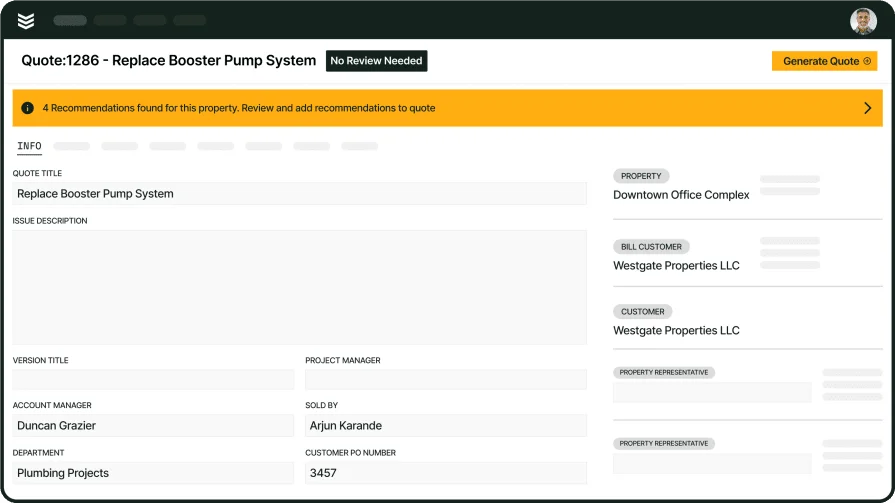
Commercial plumbing, done faster
Quote, schedule, and bill every job in one system.
2. Best for residential: ServiceTitan

Image Source: ServiceTitan
ServiceTitan is a field service management platform used by residential contractors, combining scheduling, dispatching, CRM, invoicing, and reporting in a single system. Its dispatch board gives you drag-and-drop scheduling with real-time technician tracking, while the mobile app equips techs with job details, a pricebook, and customer history on every call — so they can quote and close work on site without waiting on the office.
That said, ServiceTitan's residential focus means commercial plumbing teams managing multi-property accounts and complex job hierarchies may find it lacks the depth they need for those workflows.
Industry Specialization: Residential
How Pricing Works: Custom pricing based on technician count and selected modules.
What Sets It Apart: Deep reporting and analytics, including technician scorecards and CSR performance tracking, give you granular visibility into how your field crews are performing across every aspect of your plumbing operation.
Key Features:
- Dynamic flat-rate pricebook with bulk editing and Good-Better-Best proposal creation lets techs present professional estimates on the spot, cutting the back-and-forth between the field and the office.
- Marketing Pro add-on automates campaigns and targets outreach using your existing customer database.
- Direct integrations with QuickBooks and Sage Intacct keep your accounting in sync without double data entry.
Compare ServiceTitan against BuildOps directly to see who comes out on top.
3. Best for general contractors: Service Fusion

Image Source: Service Fusion
Service Fusion is an all-in-one FSM platform designed for residential and multi-trade businesses. It lets you manage jobs and your entire fleet with GPS tracking, giving dispatchers added visibility over vehicle locations so they can reduce fuel costs and keep trucks moving between calls.
However, plumbing field service teams running complex commercial operations may find Service Fusion's feature set better suited for simpler, multi-trade workflows than for deep plumbing-specific job management.
Industry Specialization: Residential and multi-trade operations
How Pricing Works: Monthly subscription based on included features, their Starter pack starts at $245 billed monthly.
What Sets It Apart: GPS tracking for advanced fleet management, ideal for plumbing companies dispatching multiple crews across different service areas daily.
Key Features:
- Schedule plumbing jobs from a single dashboard and dispatch techs the moment it's time to roll.
- Analyze vehicle downtime and fuel usage with GPS tracking to get the most out of your fleet across every service area.
4. Best for small residential businesses: Jobber

Image Source: Jobber
Jobber is a plumber software system geared toward residential contractors, helping them manage day-to-day field operations while growing their business. It automates customer follow-ups for appointment confirmations and invoice reminders, and syncs timesheets with payroll, customer management, invoicing, and payment so everything stays connected from the field to the office.
Jobber's residential focus and light commercial feature set may leave plumbing field service teams handling commercial accounts or complex multi-phase jobs looking for deeper workflow capabilities.
Industry Specialization: Residential
How Pricing Works: Monthly subscription based on the number of users and features, starts $19/month for 1 user.
What Sets It Apart: Exclusively geared toward residential contractors and home services, with a clean Client Hub where customers can approve quotes and pay online — keeping the field-to-customer loop tight without extra admin.
Key Features:
- Customers can book jobs with you online, with Jobber handling the scheduling automatically so your dispatch board stays current without manual input.
- Intuitive job forms and checklists make sure your techs complete every required step on site — whether it's a client-facing inspection or an internal quality check — before closing out a work order.
Best plumbing CRM & sales software
CRM and sales software focuses on the customer side of your plumbing field service operation — winning new work and keeping the accounts you already have.
5. Best for residential CRM & automation: Housecall Pro

Image Source: Housecall Pro
Housecall Pro is a CRM and sales solution built for residential contractors and home service businesses, specializing in plumbing, HVAC, electrical, and cleaning services. The platform offers advanced reporting, invoice tracking, and accounting tools that make it easy to manage the full customer relationship from first estimate to repeat service.
For plumbing contractors running larger commercial field service operations, Housecall Pro's residential orientation may not offer the multi-property management and job hierarchy depth those workflows demand.
Industry Specialization: Residential contractors
How Pricing Works: Monthly subscription starting at $59/month, scaling based on user count.
What Sets It Apart: Automated customer communication — including on-my-way texts and appointment reminders — keeps your clients informed without your dispatchers or techs lifting a finger.
Key Features:
- Pipeline management lets you intake and manage customers from first contact through closed invoice, automating handoffs so nothing stalls between the field and the office.
- Sales proposal tools help techs create multi-option presentations on site that lead to additional closed contracts and larger ticket sizes.
See how Housecall Pro stacks up against BuildOps.
6. Best for established home services businesses: FieldEdge

Image Source: FieldEdge
FieldEdge is a cloud-based field service management solution tailored for home service contractors in plumbing, HVAC, and electrical. It streamlines operations with a smart dispatch board, robust reporting, and a mobile app that puts customer details and pricing information directly in techs' hands on every call. Its built-in pricebook comes loaded with thousands of plumbing parts and supports on-site price presentations for transparent quoting.
Plumbing teams that have outgrown basic tools and need tighter field-to-office data flow will find FieldEdge a solid step up, though contractors managing complex commercial portfolios may hit its ceiling on multi-property and project management depth.
Industry Specialization: Home services (plumbing, HVAC, electrical)
How Pricing Works: Tiered licensing model based on business needs. Contact them for custom pricing.
What Sets It Apart: A comprehensive built-in flat-rate pricebook with thousands of parts and automatic alternative product suggestions, helping techs upsell at the job site without flipping through catalogs.
Key Features:
- Seamless QuickBooks integration eliminates double data entry and saves an estimated 20+ hours per week on accounting tasks — keeping your field data and financials in sync without manual reconciliation.
- The dispatch board suggests technician assignments based on skill set and expected location, optimizing your crew's coverage across active service areas.
- Mobile CRM gives plumbers access to full customer history, work orders, and pricing, letting them deliver personalized service at every appointment without calling the office for context.
Best plumbing system design, engineering & simulation software
Design and simulation software handles the technical side of plumbing — pipe sizing, code compliance, and diagnostic testing that support your field service teams before and after they arrive on site.
7. Best for plumbing engineering: h2x Engineering
h2x is a web-based mechanical and plumbing design platform that combines standards-led configuration, transparent calculations, and connected design tools into a single workflow. It handles pipe sizing, hydraulic calculations, hot and cold water system design, and gas system design.
Instead of isolated spreadsheets or rigid templates, h2x lets engineers define their own standards and system parameters, calculate precise sizes across an entire network, and generate code-compliant documentation automatically — giving your field crews accurate specs before they ever start an install.
Industry Specialization: Plumbing and mechanical engineering
How Pricing Works: Subscription-based, with tiered plans based on features and team size.
What Sets It Apart: Cloud-based platform with real-time collaboration, output to Revit, and transparent calculation traceability so you can verify every pipe size and pressure result before sending plans to the field.
Key Features:
- Automatic pipe sizing based on fixture units, flow rates, and your specified code requirements (IPC, UPC, AS/NZS, BS EN, and others).
- Material list and design report generation exported in PDF, giving you professional documentation for approvals and installations.
8. Best for plumbing takeoff & layout: PlumbingCAD
PlumbingCAD is a drawing-based software for fast takeoff and quoting of plumbing systems on residential and commercial projects. Import PDF or AutoCAD drawings, trace the plumbing system, and generate PEX-based materials lists and quotations.
The software produces instant 3D views as you define the system in 2D, making it easier to visualize and communicate your work to install crews and inspectors — reducing misinterpretation that leads to field rework.
Industry Specialization: Plumbing design and takeoff
How Pricing Works: Annual subscription-based licensing, with a 30-day free trial available.
What Sets It Apart: True CAD-based plumbing design that auto-generates 3D views, detailed materials lists, and professional quotation documents directly from your layout drawings.
Key Features:
- Import PDF or AutoCAD plans and trace the plumbing system to generate accurate materials lists, including fittings, pipe lengths, and quantities by diameter.
- Special analysis views let you isolate hot piping, cold piping, specific pipe sizes, or fixture types for targeted review of your design work.
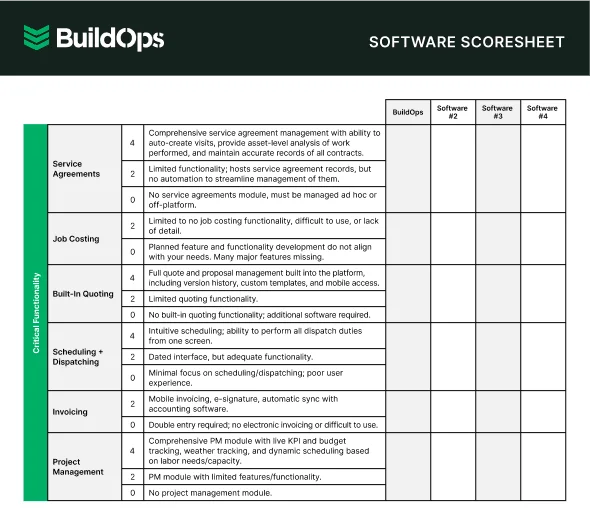
Get the software scoresheet
Compare top tools at a glance with this easy-to-use scoresheet.
7 benefits of using plumbing field service software
For plumbing contractors running field crews, every delay, missed invoice, or scheduling gap adds up — slowing down jobs and cutting into profit. Plumbing field service software eliminates the everyday friction that gets in the way, streamlining everything from the first dispatch to the final payment so your team moves with more structure, more speed, and more clarity across every call.
1. Faster job scheduling and dispatching
Coordinating jobs, techs, and trucks gets chaotic fast. Plumbing field service software lets dispatchers assign work by availability and location, update schedules in real time, and keep every call covered—while the office and crews stay in sync from a single screen. Mastering field service management for plumbing contractors gives a clear view into how this works on the ground.
2. Accurate, automated invoicing

Manual billing leads to delays and errors. Plumbing field service software auto-sends accurate invoices at job completion, cutting admin time and speeding up payments. Understanding how plumbing takeoff and estimating tools connect to your billing workflow shows how much time you can save between the field and the books.
3. Better visibility into field operations
Real-time dashboards and job tracking give owners and managers instant visibility into what’s working in their field service operation—no more digging through spreadsheets or handwritten logs. Software with built-in field service dashboards centralizes these metrics so you can spot trends and act on them without waiting for end-of-month reports.
4. Professional-looking quotes and documents

Polished, consistent estimates and invoices build customer confidence. Plumbing field service software lets you quickly generate branded, line-item documents and send them in seconds—no extra design work needed. That level of professionalism can give you an edge when competing for service contracts.
5. Consistent growth tracking
Growth is also about improving how those jobs get done in the field. With historical job data and performance trends, contractors can see where they are improving, where they are losing time, and how team output changes over time. Software with strong field service reporting functions outlines the patterns that drive revenue, so you are making decisions based on data rather than gut feel.
6. Fewer dropped jobs and missed steps
Small mistakes can cause big problems in a busy field service operation. Structured workflows, digital checklists, and real-time job updates help techs work faster and more accurately, even when handling multiple calls a day. Keeping your parts and materials organized through plumbing inventory management software adds another layer of control, making sure techs show up with what they need and nothing gets left off the ticket.
7. Stronger customer relationships
Repeat customers keep your plumbing business steady, and software helps you take care of them with clear service history, automated follow-ups, and easily searchable property records. A dedicated CRM for plumbers keeps every interaction, preference, and agreement in one place so nothing slips through the cracks between visits.
Deep Dive
AI is transforming how plumbing contractors manage service and field work, using smart dispatching and pattern detection to prevent issues and streamline workflows without adding staff.
The top AI use cases in field service show how plumbing operations are turning job data into faster decisions and stronger margins.
These benefits compound over time, and they apply whether you are a growing operation or an established plumbing company looking to tighten up field service processes. Up next, we answer some of the most common questions about the best field service software for plumbers.
4 important plumbing field service software FAQs answered
Plumbing leaders running active field crews, juggling service calls, and evaluating software options ask us these questions all the time — so here are clear, direct answers for each one.
1. What is plumbing field service software?
Plumbing field service software is a single platform that unifies scheduling, dispatching, estimating, invoicing, CRM, and reporting—built for commercial plumbing contractors to manage service, maintenance, and projects between the field and office.
Some tools handle one or two workflows. Others run everything, from first call to final payment. Pick based on how many techs you're coordinating, how complex your jobs get, and how tightly your field data and financials need to stay in sync.
2. How does field service software for plumbing work in day-to-day operations?
At the workflow level, field service software for plumbing keeps every handoff tight and automatic — no slow, messy passes between departments.
Service calls appear on the board in seconds, get dispatched by availability and skill, go straight to the tech’s phone with full history, and auto-generate an invoice when the job’s done—creating a seamless path from dispatch to payment.
3. Is plumbing field service software worth the investment?
Plumbing software starts around $20 per tech per month and can run up to $500 for an all‑in‑one platform—but the real number that matters is ROI. The right system speeds up billing, cuts double entry, tightens dispatch, and recovers missed revenue, often paying for itself in months. The only real risk is buying it and never rolling it out to the whole team.
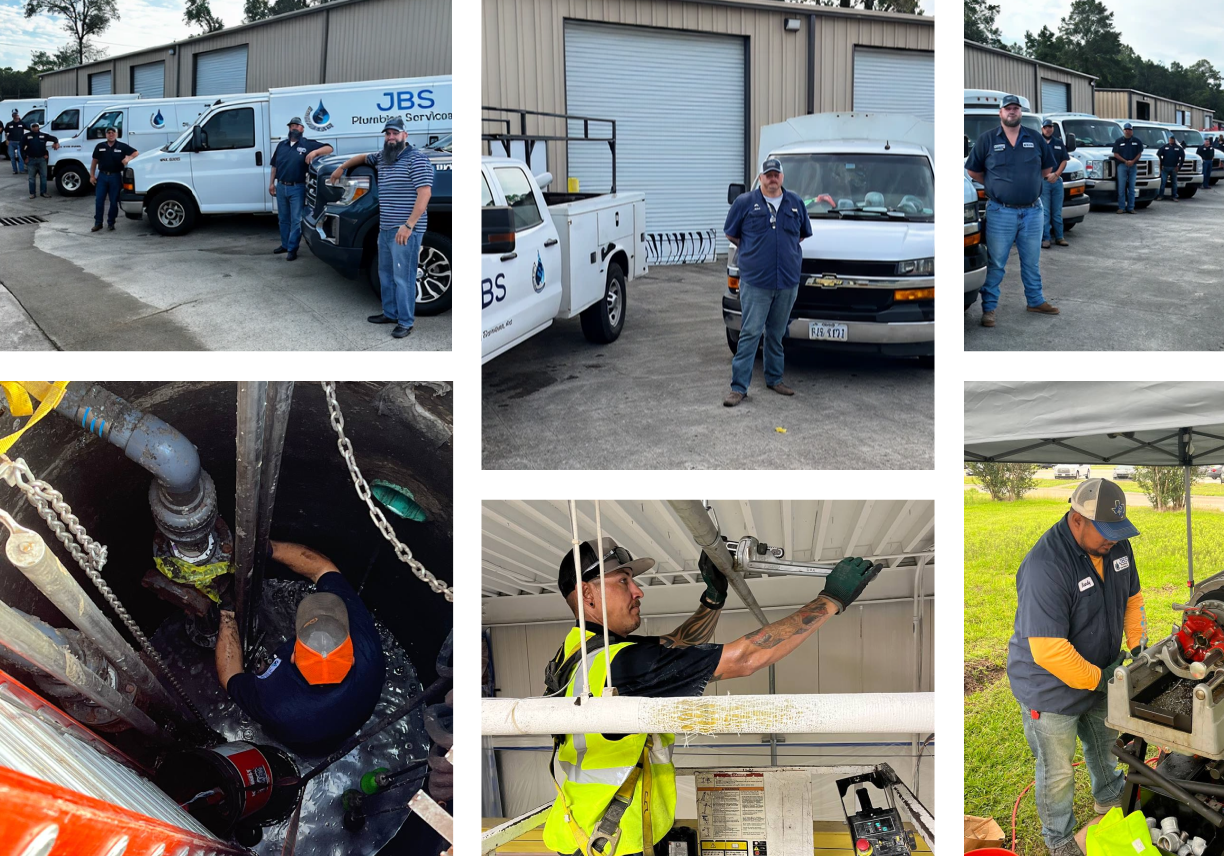
JBS Plumbing is a prime example of a contractor committed to leveraging their software investment across every part of their field service operation.
4. What are the best practices for getting the most out of the best field service software for plumbers?
Buying the platform is step one. Getting your team to actually use it — consistently and correctly — is where the value compounds.
- Run full-team onboarding before the platform goes live.
- Map your job workflows before configuring the software to match them.
- Make mobile app usage mandatory for every tech from day one.
- Audit and update your pricebook on a monthly or quarterly schedule.
- Use custom forms and required fields so techs cannot close a work order without capturing critical data.
- Automate recurring job generation from your service agreements.
- Review your reporting dashboard on a weekly cadence.
- Integrate with your accounting software before the first invoice goes out.
- Assign one internal team member to own the platform configuration and train new hires.
- Clean up duplicate records, outdated properties, and inactive agreements every quarter.
Field service software for plumbers should do one thing well: keep your office and field in lockstep.
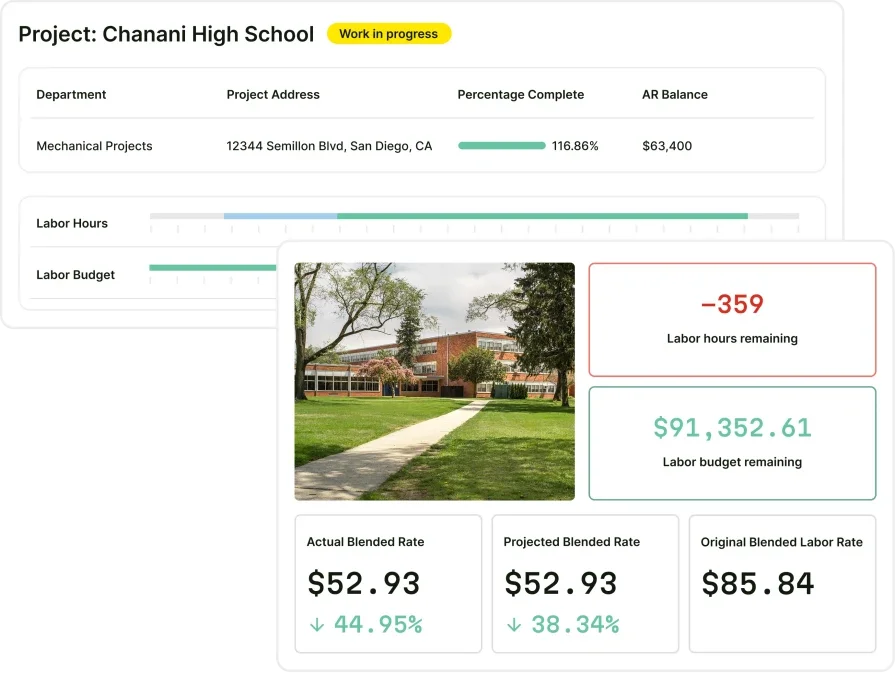
BuildOps connects dispatch, invoicing, CRM, and reporting in a single platform built for commercial plumbing. Crews capture notes once; AI turns them into clean reports and surfaces the right customer details in seconds—so jobs close faster and cash hits the books sooner.
Want to see it on your actual workflows? We’ll walk you through the live platform—no slide deck, no sales script.
See how BuildOps handles plumbing jobs
We help plumbers book more jobs, track progress, and get paid faster.