Construction risk rarely shows up all at once. It builds quietly in schedules that look solid, bids are rushed to the deadline, and compliance gaps no one catches until it’s too late. By then, the cost is locked, the delay is real, and the margin is already gone.
That's what predictive risk analysis is designed to prevent — AI-powered construction ai analytics give commercial contractors in the field service industry the ability to see where risk is forming across their operations and act before it compounds.
In this guide, we'll cover:
- 7 commercial construction risks AI can identify in your operations
- How to do predictive risk analysis for commercial construction using AI tools
Commercial construction creates huge amounts of operational data every day. Contractors who centralize that data and use AI to analyze it can spot risk sooner, keep crews productive, and protect margins. Here’s where to start.
7 commercial construction risks AI can identify in your operations
Commercial construction risk builds fast. AI analytics help teams spot issues early and stay ahead of problems. Here are seven risks AI can flag before costs rise.
1. Safety and hazard risks
One safety incident can stall a job, drive up costs, and create legal exposure. AI helps teams catch risk early—before it turns into an accident. Agentic AI tools in field service take this further by autonomously flagging high-risk scenarios and triggering safety protocols without waiting for a manual review, turning reactive safety audits into continuous, data-driven protection across every active jobsite.
2. Schedule and dispatch alignment that results in delay

Wrong tech, bad cert match, or schedule overlap can trigger costly construction delays fast. Predictive analytics helps catch dispatch conflicts early by weighing availability, skills, travel time, and job history before they impact the job. Construction platforms with AI-powered field service scheduling continuously rebalance the board so ops can see movement, spot friction, and keep crews aligned without manual coordination.
3. Estimating errors and cost overruns that add up
Small estimating errors can wipe out the project margin fast. AI helps construction teams catch risky bids early by comparing estimates to past jobs and flagging labor, material, and scope gaps before they become costly problems. These are among the top use cases for AI in field service operations, where predictive pattern recognition catches margin-killing errors that manual review consistently misses.
Did you know
A Kickstand report based on a survey of 606 contractors across the U.S. and Canada found that 78% are using AI tools on the jobsite, while 47% say one in five positions remain unfilled. That combination explains why AI workflows matter in field ops: less admin, steady output with the same team.
4. Predictive maintenance and supply chain disruption
Equipment failures stall crews and delay projects. Add supply chain issues, and small setbacks turn into costly overruns. Machine learning helps teams predict maintenance needs early, reducing downtime and keeping work on track. Contractors running a structured preventive maintenance analysis across their asset base are catching the drift from controlled to chaotic before it reaches the field, turning equipment health data into a forward-looking risk signal instead of a reactive repair ticket.
5. Contractual compliance and RFIs

Commercial contracts hide costly compliance traps—miss a document, inspection, or RFI deadline, and margin starts leaking. AI helps construction teams stay ahead by tracking obligations across jobs and flagging issues before they turn into claims, delays, or back-charges. Manage RFIs directly from drawings to tie every question to the exact plan location and version—speeding up answers, reducing risk, and creating a clear source of truth.
6. Takeoff bottlenecks that can inflate cost
Takeoff accuracy lays the financial groundwork for every commercial project, shaping material costs, labor estimates, and bid profitability from the start. Construction AI speeds up takeoffs by automating counts, checking historical pricing, and catching estimate errors people miss. Those same mistakes often lead to hidden callback costs later—pulling crews off paid work and wasting labor, fuel, and parts.
7. Monitoring project progress in real-time
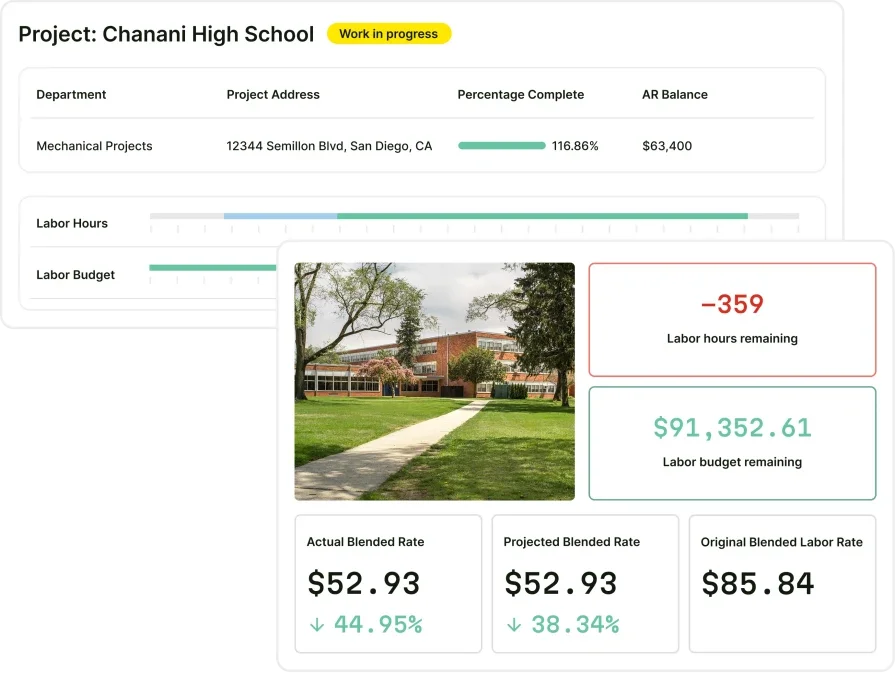
Project risk starts when teams lose sight of reality. AI predictive analytics closes that gap early by spotting schedule, labor, and cost variance before it turns into delay and overrun. Contractors who treat commercial construction project management as a real-time discipline, with live visibility into billing versus cost, labor utilization, and milestone progress, make decisions based on what's happening now, not what happened last month.
Don’t get left behind
We surveyed hundreds of North American contractors to see what the future looks like.
How to do predictive risk analysis for commercial construction using AI tools
Spot risk early. Act before it compounds. That’s how AI analysis helps commercial contractors protect margin—by turning project data into clear, early warnings across schedule, field performance, costs, and overall job health.
1. Centralize and clean your operational data

AI can’t predict what it can’t see. If scheduling, financials, and field data are scattered across different systems, risk gets missed. For predictive analytics to work in construction, everything has to live in one connected platform first.
BuildOps unifies scheduling and smart dispatching alongside time tracking and fleet data in one system, so every data point that feeds risk prediction is structured, current, and accessible to AI from day one, without manual exports or reconciliation between disconnected tools.
2. Select AI-native tools purpose-built for construction
Generic analytics miss what actually drives risk in field service. You need tools built for construction ops—where dispatch, trade coordination, and estimating all impact the outcome.
BuildOps construction AI is embedded across the platform's core workflows, from AI-powered technician assignment and smart dispatch to automated compliance tracking, so risk signals surface inside the same system your teams already use to run jobs, not in a separate reporting layer they have to check separately.
3. Map your specific risk domains before you model anything

AI risk management fails when construction teams track everything instead of the risks that actually hurt margins. Start with the biggest threats, then build data and models around those.
BuildOps service quoting captures estimating data that feeds cost-risk models, while the technician mobile app pushes real-time field conditions, asset readings, and job progress back to the office, giving each risk domain the live data it needs to generate accurate predictions instead of stale approximations.
4. Connect real-time field data to your risk models
Historical data tells you what happened. Live field data tells you what’s happening now. BuildOps turns that visibility into action—connecting field activity to real-time financial and operational insights so teams can catch variance early, before it hits the bottom line.
5. Monitor, measure, and refine continuously
Predictive risk analysis isn’t a one-time check. The best contractors review it weekly, adjust as conditions change, and use feedback to keep predictions improving.
BuildOps reporting gives leadership continuous visibility into the KPIs that matter most, from labor utilization and cost-to-complete to reactive-versus-planned work ratios, so risk analysis stays connected to real operational performance and evolves with every project your team runs.
Predictive risk analysis in construction only works when your data is live, centralized, and connected to the way your teams actually operate. When scheduling, dispatch, quoting, field activity, fleet, labor, and job costs live in separate systems, risk builds quietly and shows up too late.
OpsAI changes that. Built into the BuildOps platform, OpsAI turns connected operational data into real-time insight—helping contractors spot risk earlier, respond faster, and stay ahead of delays, cost overruns, compliance issues, and performance drift.
This is what makes AI useful in the field: not static reports or disconnected point tools, but one system that sees what’s forming across the business and surfaces it in time to act.
Unify your FSM with BuildOps
See how we connect scheduling, invoicing, and reporting in one AI-native platform.