AI is no longer optional for contractors in the HVAC service industry. When margins are tight and crews are constantly stretched, the right AI platform helps teams dispatch smarter, quote faster, and uncover new revenue without adding more burnout.
Here’s what to prioritize and which tools stand out for field service, CRM, and design.
- Top HVAC software AI features to look for & evaluate
- 6 best HVAC AI management software for field service teams
- 4 best HVAC business, CRM, & sales software with AI
- 3 best HVAC system design & simulation software with AI
- 7 benefits of using an AI HVAC management software
- How to choose the right AI-powered HVAC software for your team
- 4 important HVAC AI software FAQs answered
The real differentiator in HVAC isn’t who uses the term AI—it’s which capabilities actually drive measurable performance.
Top HVAC software AI features to look for & evaluate
HVAC AI platforms offer capabilities across three critical business areas. The features you prioritize depend on which part of your operation needs the most improvement. Here is what to evaluate in each category.
Field service management AI software features

These features drive field efficiency—from smart dispatching to automated time tracking and asset management.
- AI-powered scheduling & dispatch – Automatically matches techs to jobs based on skills, location, and availability, and adjusts assignments in real time. Look for platforms with unified scheduling and smart dispatch software.
- Mobile Access & AI Notetaking – Gives techs access to job details, history, and AI-assisted notetaking directly from the field. A strong technician mobile app speeds up report writing.
- Fleet tracking & route optimization – Monitors vehicle locations, fuel use, and driving patterns to cut travel time and reduce costs. Fleet management tools use AI to suggest faster routes and flag maintenance needs.
- Automated Time Tracking – Logs tech hours and overtime automatically using GPS and geofencing. Accurate time tracking feeds directly into payroll and job costing.
- AI-assisted documentation & workflows – Uses AI to generate reports, summarize field notes, and auto-fill forms. Platforms with built-in AI for field service turn raw notes into polished invoices and reports in seconds.
CRM, sales, & financial HVAC AI software features

These features manage the customer life cycle and financial health—from winning new contracts to ensuring fast payment.
- Field Service CRM – Organizes customer data, service history, and property hierarchies. A CRM built for field service uses AI to surface upsell opportunities based on equipment age and service patterns.
- AI Service Quoting – Generates accurate quotes faster by pulling in labor rates, material costs, and job scope. AI-enhanced quoting software reduces pricing errors and accelerates proposal delivery.
- Automated Service Agreements – Automates recurring maintenance contracts, renewal reminders, and visit scheduling. Managing service agreements digitally ensures predictable revenue.
- Integrated Invoicing & Payments – Creates invoices from completed job data and supports instant payment. Combining invoicing with integrated payments shortens the service-to-cash cycle.
- AI-Driven Reporting & Analytics – Tracks KPIs like tech utilization and first-time fix rates across your entire operation. AI-driven reporting tools flag critical trends and anomalies in real time.
HVAC system design & simulation AI features

These features support the engineering and design side of HVAC work—from calculating loads to planning duct layouts and testing system performance.
- AI-enhanced load calculation – Factors in building geometry, climate data, and occupancy patterns to determine heating/cooling requirements with greater precision than manual methods.
- Duct design & layout planning – Uses AI to optimize duct sizing, routing, and material selection for better airflow distribution and lower energy consumption.
- Simulation & troubleshooting – Models HVAC system behavior virtually, letting engineers test efficiency improvements or diagnose problems without needing physical access to the equipment.
Most HVAC solutions offer a handful of these capabilities. Few cover all of them as standard—and even fewer bake AI into each one. BuildOps does. From AI-powered dispatch and mobile notetaking to CRM, quoting, invoicing, and reporting, every feature listed above comes built into a single platform designed for commercial HVAC contractors.

6 best HVAC AI management software for field service teams
AI-powered field service software runs your whole HVAC operations—from scheduling and dispatch to job tracking, reporting, and invoicing.
1. Best for commercial field service teams: BuildOps

BuildOps is the premier AI-native software platform purpose-built for commercial HVAC dominance. It transforms complex multi-property portfolios into streamlined workflows, providing total visibility across every asset, client contact, and service history on a single, unified interface.
OpsAI embeds intelligence directly into the field, weaponizing your mobile workforce with predictive dispatching and automated documentation. By eliminating administrative friction, this platform ensures your technicians spend more time generating revenue and less time on manual data entry.
Industry Specialization: Commercial
How Pricing Works: BuildOps utilizes a value-based pricing model scaled to your team size and operational complexity, ensuring the platform grows alongside your business.
What Sets It Apart: Sophisticated customer hierarchies designed for scale. The platform maps every unit to its specific location and stakeholder, providing an elite level of organization essential for high-stakes commercial projects.
Key Platform Capabilities:
- Intelligent, real-time dispatching that optimizes assignments based on technician certification and live availability.
- Automated asset capture that extracts critical equipment data from photos to eliminate manual inventory errors.
- Seamless synchronization with enterprise ERPs like QuickBooks, Vista, and Sage, alongside deep Bluon integration.
Rating: 4.4 on Capterra from 177 user reviews
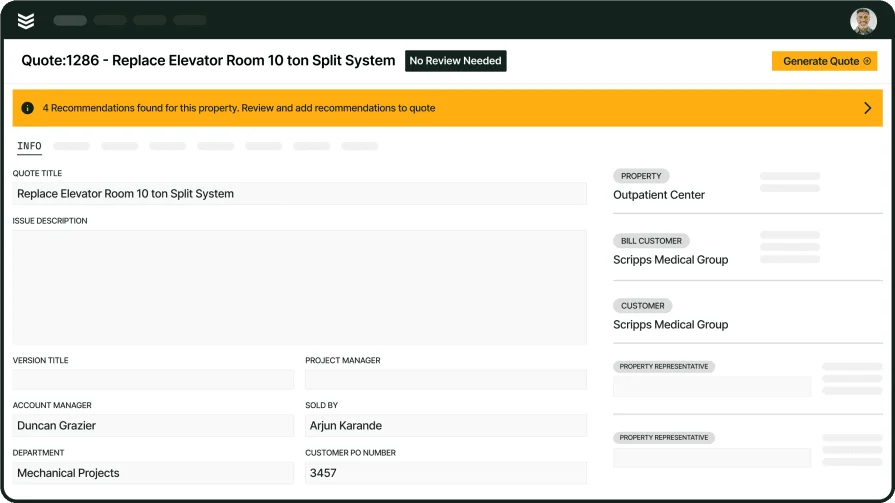
Built for the challenges of commercial HVAC
BuildOps has helped HVAC shops see 30% revenue growth + 75% quote approval rates.
2. Best for residential HVAC service teams: Jobber

Image Source: Jobber
Jobber is an HVAC software platform for residential contractors, helping them manage operations and grow their business. It automates customer follow-ups for appointments and invoices, and seamlessly syncs timesheets for payroll, customer management, and payment—creating a unified workflow.
Jobber’s AI focuses on basic automation (scheduling, follow-ups, templates) and may lack the depth contractors need for complex commercial or multi-property work.
Industry Specialization: Residential
How Pricing Works: Monthly subscription based on the number of users and features
What Sets It Apart: Exclusively geared towards residential contractors and home services
Key Features for Residential HVAC Teams:
- Customers can easily book jobs online, with Jobber automating the scheduling process.
- Build intuitive job forms and checklists to ensure all tasks are completed on time for clients and your team.
Rating: 4.6 on Capterra from 1456 user reviews
3. Best for general contractors that offer HVAC services: Service Fusion

Image Source: Service Fusion
Service Fusion is an FSM software designed for both residential and commercial businesses. It allows you to manage jobs and track your entire fleet with GPS, providing added visibility to reduce fuel costs and maximize fleet efficiency.
Service Fusion handles scheduling, dispatch, and fleet tracking well, but its AI features lag behind platforms with built-in machine learning—an important factor if AI-driven automation is a priority.
Industry Specialization: Residential and Commercial
How Pricing Works: Monthly subscription based on included features
What Sets It Apart: GPS tracking for advanced fleet management
Key Features for HVAC General Contractors:
- Easily schedule construction jobs from a single dashboard and dispatch crews when the project starts.
- Track vehicles with GPS to analyze downtime and fuel efficiency, maximizing the utility of your fleet.
Rating: 4.3 on Capterra from 308 user reviews
4. Best for small and medium-sized HVAC service businesses: Sera

Image Source: Sera
Sera is an HVAC software solution built to help small and medium-sized contractors streamline operations. It offers simple yet powerful scheduling, dispatching, fleet management, invoicing, and financial functions. Fast, hands-on customer service ensures quick onboarding, allowing you to spend more time succeeding with the platform and less time learning it.
Sera handles the fundamentals well for smaller teams, but its AI capabilities are minimal—contractors looking for machine learning–driven dispatching, predictive analytics, or AI-assisted documentation will find the software limited in those areas.
Industry Specialization: Residential
How Pricing Works: $399/month for a team of up to 4 technicians, additional tech seats can be purchased for $149/month
What Sets It Apart: Fast and easy onboarding with dedicated training, data migration, and business coaching support
Key Features for HVAC:
- Batch invoicing, automated customer appointment reminders, and custom client contact templates.
- Plenty of available integrations for added functionality while keeping the base software lean
Rating: 4.4 on Capterra from 23 user reviews
5. Best for managing subcontractors: Tradify

Image Source: Tradify
Tradify covers the essentials of HVAC field service management: inquiries, quotes, scheduling, job tracking, invoicing, and receiving payments. Higher price tiers offer handy functions like integrating subcontractor schedules or instantly digitizing invoices via photo. Tradify can even help you build a platform-connected website in minutes.
Tradify is solid for coordinating subcontractors and keeping basic workflows organized, but it lacks AI-driven features like smart dispatching, predictive reporting, or automated documentation — areas where AI-native platforms pull ahead.
Industry Specialization: Commercial
How Pricing Works: Tier-based monthly per-user subscription, and free trial available
What Sets It Apart: Pro and Plus tiers have dedicated tools for coordinating subcontractors' schedules
Key Features for HVAC Subcontractors:
- Integrates with Google Calendar, simplifying schedule alignment.
- Cloud-based software provides instant access to necessary job information for your entire team, anywhere.
Rating: 4.7 on Capterra from 152 user reviews
6. Best for home services: mHelpDesk

Image Source: mHelpDesk
mHelpDesk is an FSM software solution designed for a wide array of residential field services. It intuitively schedules service, manages job dispatch, and maintains communication with customers about their appointments.
mHelpDesk covers a wide range of home services, which makes it versatile but also means its HVAC-specific depth is limited. AI features are largely absent — there's no smart dispatching, AI-powered notetaking, or predictive analytics built into the platform.
Industry Specialization: Residential
How Pricing Works: Contact them for a private quote
What Sets It Apart: Supports a wide range of home-related field services, including landscaping and cleaning
Key Features for HVAC & Home Services Contractors:
- Lead management enables you to close more leads and take on more projects, maximizing outreach efforts.
- Job quotes provide more accurate estimates for projects, using pre-built templates for easy creation.
Rating: 4.3 on Capterra from 824 user reviews
4 best HVAC business, CRM, & sales apps with AI
CRM and sales apps handle the customer-facing side of your HVAC operation — finding new clients, managing existing relationships, and closing deals faster. These picks offer some of the strongest features for those functions, with varying levels of AI built in.
7. Best for sales management: Buildertrend

Image Source: Buildertrend
Buildertrend is a customer and sales management app for construction professionals, designed to help them capture and close leads. Craft customized proposals that help you nurture leads and get closer to greenlighting your proposals. Connect with prospects with targeted email marketing efforts that show them you understand — and can help them accelerate — their business. Keep homeowners involved in the process with clear lines of communication, helping you maintain a great relationship with clients and helping them achieve results.
Buildertrend is strong in lead nurturing and proposals, but its AI is basic and lacks predictive analytics, AI upsell tools, and intelligent customer segmentation.
Industry Specialization: Home builders & Remodelers
How Pricing Works: Monthly subscription model (starting at $499/mo)
What Sets It Apart: Nurture lead funnels with email marketing and targeted proposals
Key Features for Sales Teams:
- CRM hub connects you with everything you need to create, capture, and track leads
- Draft contract proposals and execute outreach using email marketing
- Daily logs allow techs to track construction job progress with a record of the work
Rating: 4.5 on Capterra from 2485 user reviews
8. Best CRM for residential contractors: Housecall Pro

Image Source: Housecall Pro
Housecall Pro is a CRM and sales solution built for residential contractors and home service businesses. It specializes in HVAC, plumbing, electrical, and cleaning services. The platform offers advanced reporting, invoice tracking, and accounting tools that make it easy to manage all aspects of the customer relationship.
Housecall Pro automates pipelines and follow-ups, but its AI is basic, lacking advanced dispatching, predictive insights, and AI-assisted quoting for complex commercial work.
Industry Specialization: Residential Contractors
How Pricing Works: Monthly subscription based on the number of seats you'll use
What Sets It Apart: Features that cater towards residential contractors
Key Residential CRM Features:
- Use pipeline management to intake and manage customers more effectively, automating the process from estimate through to invoice
- Creates engaging sales proposals that lead to more closed contracts
- Boosts upsell success to increase job ticket sizes
Rating: 4.7 on Capterra from 2739 user reviews
Make sure to check out our comparison of Housecall Pro vs BuildOps right here to see which one is the better fit for your HVAC team.
9. Best for tender management: Procore

Image Source: Procore
Procore is an FSM platform designed for general contractors and specialty subcontractors. Among its notable features are pre-construction tools that facilitate accurate and professional-looking proposals. Make bidding for jobs — and transitioning from bid management to project management — easier with financial integrations, templates, filters, and AI automations.
Procore uses AI mainly for pre-construction bidding and estimating (like filtering, counts, and document formatting), with minimal AI for field service, dispatching, and CRM.
Industry Specialization: General and Specialty Contractors
How Pricing Works: Contact them for a custom quote
What Sets It Apart: Financial features and integrations make shift from estimates to proposals to budgets easy
Key Features for Tender Management:
- Integrates with over 15 accounting integrations (and over 500 apps in total) to get sales & CRM tasks done faster and easier without needing separate platforms
- Use AI and filtering tools to properly count items, view material/labor rates, and format documents so you can move between pre-project phases quickly and seamlessly
Rating: 4.5 on Capterra from 2657 user reviews
10. Best for inventory management: ServiceTrade

Image Source: ServiceTrade
ServiceTrade is an end-to-end FSM solution that helps commercial contractors with office coordination, sales management, and inventory management. Increase visibility into jobs for all team members, from office admin to field service technicians, ensuring everyone is in the loop. ServiceTrade improves operational efficiency and effectively manages your inventory so you always have the parts you need, and your technicians aren't waiting for parts they need to complete jobs.
ServiceTrade handles inventory and job tracking for commercial contractors, but offers little AI for dispatching, CRM insights, or documentation.
Industry Specialization: Commercial
How Pricing Works: Subscription pricing based on the number of seats you need
What Sets It Apart: Inventory management solutions that ensure your technicians always have the parts they need
Key Features for Inventory Management:
- Tracks jobs with absolute precision using timecards, helping you limit unnecessary office visits and estimate future jobs with even better accuracy
- Forecasts the parts you'll need so you can keep your inventory fully stocked, without running into overstock issues and limiting available storage
Rating: 4.6 on Capterra from 341 user reviews
3 best HVAC system design & simulation apps with AI
Design and simulation apps handle the engineering side of HVAC — load calculations, duct layouts, energy modeling, and system troubleshooting. These picks offer some of the strongest tools for those functions, with varying levels of AI built in.
11. Best for HVAC drafting and drawing: Tejjy

Image Source: Tejjy
Tejjy is a leading property and facility management company in the architecture, engineering, and construction (AEC) sector. They offer MEP (mechanical, electrical, and plumbing) drafting and drawing for HVAC, electrical, and fire protection. They can also do BIM consultation services, including modeling, fabrication, assembly, and installation.
Tejjy offers strong BIM and MEP drafting for visualization and documentation, but its AI-driven automation is limited, favoring traditional CAD workflows over intelligent design tools.
Industry Specialization: Architectural Design & Engineering
How Pricing Works: Contact them directly for a quote
What Sets It Apart: Specialization in BIM consultation and design services
Key Features for Drafting & Drawing:
- Get precise mechanical, electrical, plumbing, and fire protection drawings that help with HVAC fabrication, assembly, and installation
- In-house 3D scanning
- Create MEP designs that account for variable conditions in residential, commercial, and infrastructure projects
Rating: 4.8 on Goodfirms from 3 user reviews
12. Best for HVAC design and planning: Flatworld Solutions

Image Source: Flatworld
Flatworld Solutions specializes in HVAC design for both residential and commercial industries, servicing homes, buildings, commercial properties, and hotels. With HVAC modeling and duct design services, they find the right fit for your space by accurately calculating the load and fitting the ideal unit. This gives you adequate air control without overspending.
Flatworld offers solid, energy-efficient design and planning, but its AI is minimal, lacking ML-based load optimization, automated duct layouts, and predictive simulation.
Industry Specialization: Residential & Commercial
How Pricing Works: Contact them to request a quote
What Sets It Apart: Focus on delivering high-efficiency HVAC installations through cutting-edge designs
Key Design & Planning Features:
- Services a range of commercial HVAC installations, emergency repairs, and routine maintenance
- Specializes in designing residential heating and cooling systems that deliver reliable, consistent results
Rating: 4.7 on Clutch.co from 23 user reviews
13. Best for HVAC engineering: TrueCADD

Image Source: TrueCADD
TrueCADD is a leading CAD company that specializes in CAD engineering services and BIM design and 3D modeling. As part of their service offerings, they provide HVAC design and development, load calculation, 2D drawings, 3D modeling, and duct sizing & layout planning.
They provide end-to-end HVAC engineering (load calculations through duct sizing) but rely on traditional CAD/BIM and offer no AI features like automated design, predictive energy modeling, or intelligent clash detection.
Industry Specialization: Industrial
How Pricing Works: Contact them to request a quote
What Sets It Apart: Multidisciplinary engineering company that specializes in BIM and mechanical engineering
Key HVAC Engineering Features:
- Spatially plan the assembly, fabrication, and piping to ensure you install the best layout for the HVAC assembly
- Design and draft schematics for heating and cooling systems
- Create final documentation and specifications for finalizing equipment development
Rating: Not yet rated on any popular software rating websites
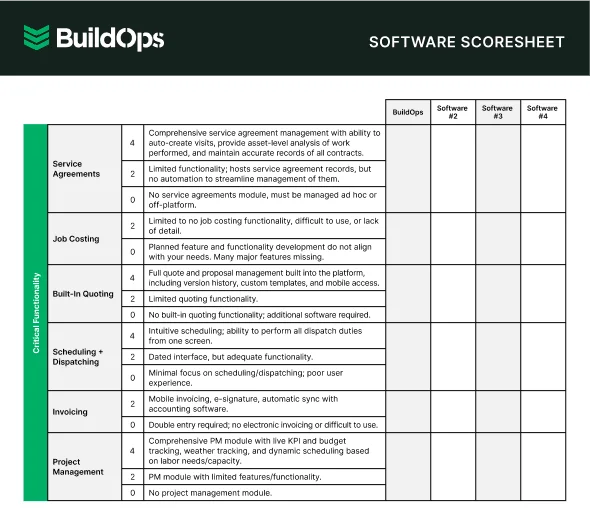
Get the software scoresheet
Compare top tools at a glance with this easy-to-use scoresheet.
7 benefits of using an AI HVAC management software
AI-powered HVAC software delivers measurable returns across field operations, from faster dispatching to tighter cash flow. Here are the top ways contractors see ROI when AI is woven into their daily workflows.
1. Faster, smarter scheduling & dispatch
AI matches techs to jobs based on skills, certifications, and proximity, adjusting assignments in real time. Contractors using AI-powered HVAC scheduling optimization report tighter turnaround times and fewer service gaps.
2. Less time on paperwork, more time on jobs
Generative AI instantly converts voice notes, photos, and readings into complete service reports. Techs eliminate manual note-taking, speeding up on-site field service closeouts with clean documentation delivered to the office the moment the job closes.
3. Stronger first-time fix rates
AI surfaces equipment history, failure points, and diagnostic steps before the tech arrives. This context means fewer return trips, less wasted labor, and customers see problems resolved on the first visit, a pattern AI-native HVAC companies use to achieve superior service quality.
Did you know
A Kickstand report based on a survey of 606 contractors across the U.S. and Canada found that 78% are using AI tools on the jobsite, while 47% say one in five positions remain unfilled. That combination explains why AI-backed workflows matter in field ops: they reduce admin load and help teams keep output steady with the headcount they have.
4. Tighter route efficiency and lower fuel costs
AI routing software sequences work orders by job priority and live traffic, ensuring the fastest path for every call. The system instantly recalculates routes for emergencies, minimizing windshield time and preserving billable hours.
5. Faster quoting and shorter service-to-cash cycles
AI-powered quoting generates accurate, on-site estimates instantly, integrating labor and material costs. Automated invoicing and payment collection shorten the service-to-cash cycle, maintaining predictable cash flow with the help of HVAC service platforms.
6. Predictive maintenance that prevents emergency calls
AI software analyzes equipment runtime and service history to predict failures before they happen. This allows contractors to schedule repairs proactively, eliminating emergency scrambles and converting reactive service into predictable, recurring maintenance revenue.
7. Clearer visibility into operations and margins
AI-driven reporting tracks critical KPIs—like tech utilization and first-time fix rates—across your entire operation. Leadership gains real-time visibility to spot margin leaks and productivity gaps, empowering HVAC dispatch and operations teams to execute with data, not guesswork.

Get the HVAC top shop business growth report
See how real leading HVAC pros are able to grow and scale their businesses faster.
How to choose the right AI-powered HVAC software for your team
AI-powered HVAC software fits different business sizes, with features that scale from basic automation to advanced tools like predictive maintenance, smart dispatching, and automated quoting.
To figure out which AI-powered HVAC software is the right fit, here are some questions to ask yourself:
- Cost – How is the AI functionality priced? Are advanced AI features included or sold separately? Is there a difference between monthly and annual pricing? Can you test the software through a demo, trial, or pilot before making a commitment?
- Complexity – How easy is the AI software for technicians and office staff to use every day? How much training will your team need to confidently use the AI features? Are the insights clear and practical, or too complex for day-to-day operations?
- Onboarding and system integration help – How much support does the vendor provide during setup and implementation? Can they connect the software to your existing systems? Do they help ensure your data is clean and accurate so the AI performs reliably over time?
- Reviews – What are other HVAC companies saying about the software’s AI capabilities? Are there reviews from businesses similar to yours in size, services, and market? Do customers point to real operational improvements from using the AI?
- Features – Which AI capabilities will actually help your team right now? Is the software missing any functionality that would be important to your workflow? Will the value of those AI features justify the investment?
4 important HVAC AI software FAQs answered
Here are answers to a few other key questions about AI-powered HVAC software.
1. What is HVAC AI software & how does it work?
HVAC software with AI capabilities helps contractors run smarter by automating the work that slows teams down. It uses your business data to improve dispatching, tighten estimates, catch design issues early, and support faster troubleshooting—whether in the office or the field.
2. What does a typical job workflow look like with HVAC AI software?
HVAC AI runs on a shared platform, providing real-time data visibility. Calls flow into an AI CRM that surfaces history and suggests issues, while AI dispatch selects the best technician. The mobile interface guides the tech on-site with smart checklists and automated documentation.
The software instantly converts field data into quotes, workflows, invoices, payments, and live job dashboards.
3. Is HVAC AI software worth the cost?
HVAC software already pays for itself by reducing errors. AI software goes further by speeding up diagnostics, optimizing routes, predicting maintenance, and cutting callbacks, often more than covering its subscription cost and driving real profit growth.
4. What are the best practices for getting sustained value from AI HVAC software?
AI HVAC software delivers long-term value when your team uses the platform consistently and feeds it quality data.
- Use AI dispatch to assign techs by skills, certifications, and location.
- Keep customer, site, and equipment data clean and up to date.
- Have techs log all notes, photos, time, and sign-offs in the mobile interface.
- Connect the platform to your accounting system from day one.
- Review AI performance and margin reports every month.
- Enable automated customer texts and emails for ETAs, status, and invoices.
- Tie inventory and parts to work orders so AI can flag missing materials.
- Use AI quote insights quarterly to tune pricing and close more work.
- Run regular training so office and field teams use the latest AI features.
- Review and update AI dispatch and workflow rules as your business evolves.
AI in commercial HVAC should not sit on the edges of the business. It should improve the core operation by turning every dispatch, service visit, and closeout into clean, connected job data. That is the standard BuildOps is built for.
If you’d like to see how AI would handle your specific routes, PM agreements, and closeout standards, you can walk through a free demo as part of your evaluation.
AI-powered HVAC FSM software
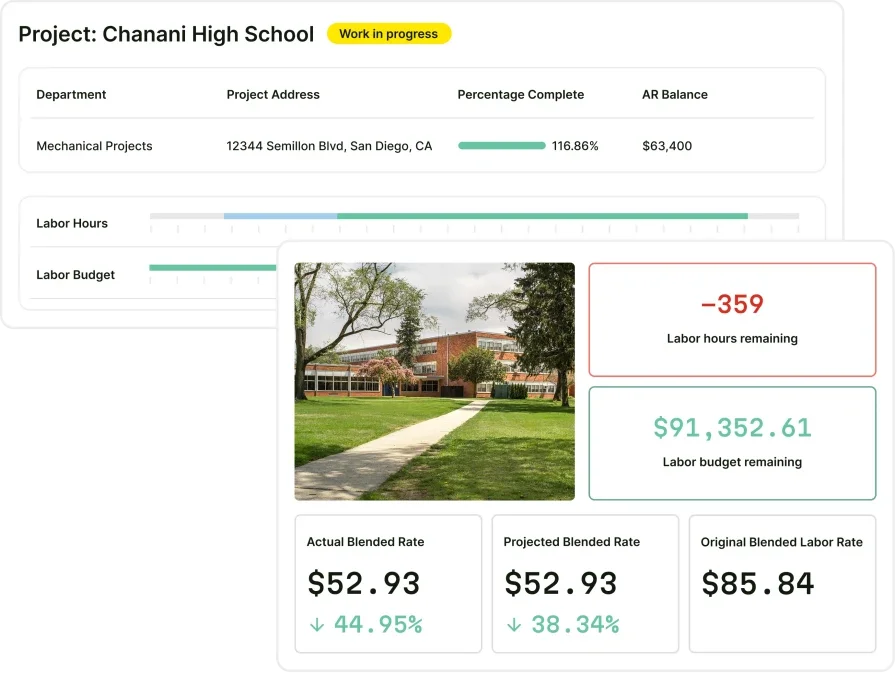
See how we connect scheduling, invoicing, and reporting in one AI-native platform.