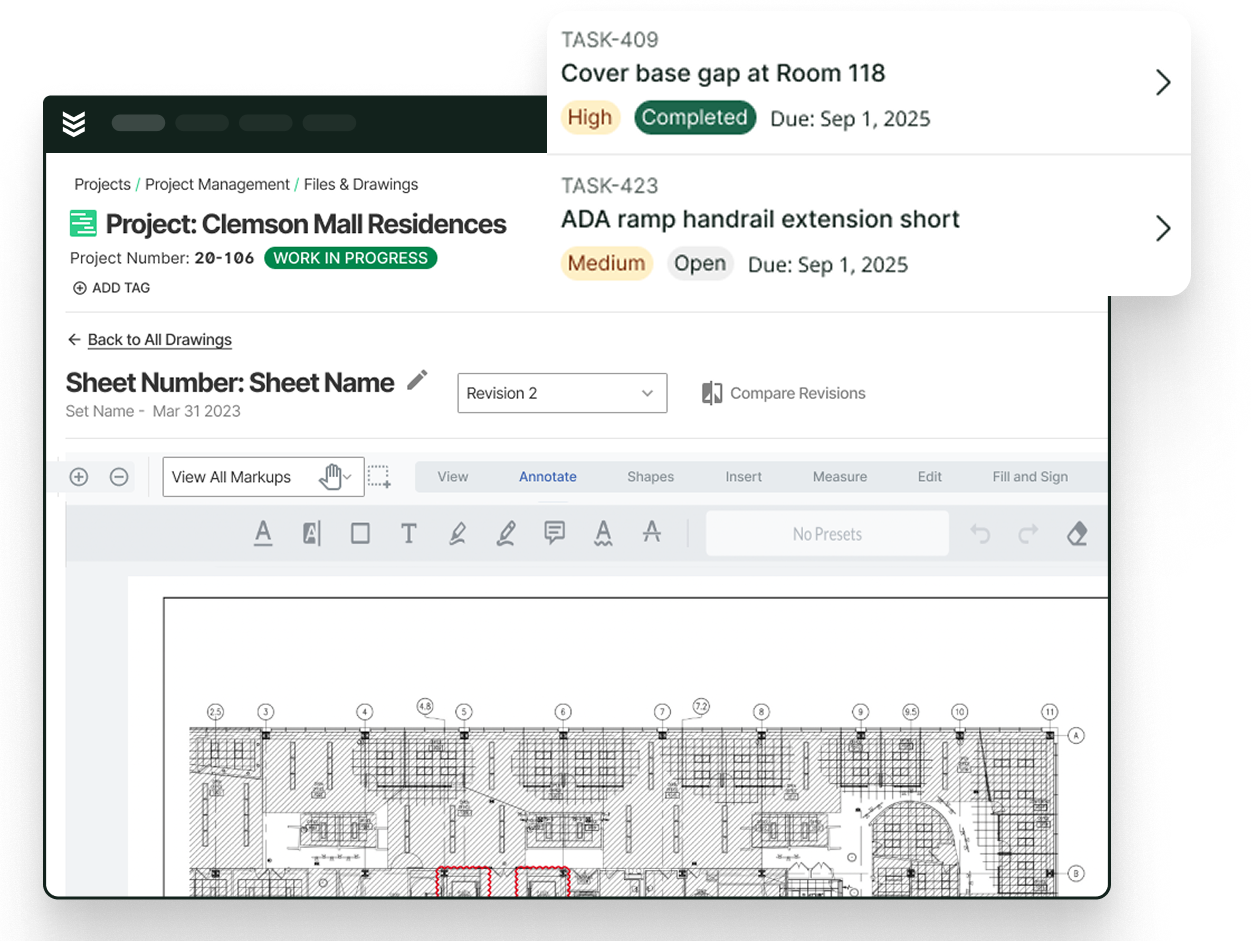
Here's a question most project managers can answer in about two seconds: Where does your project data live?
And here's why the answer is a problem: it's never one place.
RFIs are in email. Drawings are in the GC's Procore instance. The budget's in Excel. Photos sit in camera rolls. Change order conversations happened in a text thread three months ago, and nobody saved them. Submittals went through a portal you may or may not still have access to.
Individually, none of that feels dangerous. Your team knows where to find things. You've made it work for years.
But when a GC disputes a scope change in month fourteen — or retainage gets held because someone can't prove what was agreed to — that scattered data stops being an inconvenience and starts being a liability.
This is how projects unravel. Not in one dramatic failure, but in a slow accumulation of small gaps between what happened, what was documented, and what you can prove.

The GC portal problem
Most specialty contractors we talk to use the GC's system for project communication. Makes sense — Procore or whatever the GC runs is where the coordination happens.
But here's the part nobody talks about: when that project ends, where does your data go?
If the GC pulls your license, your project history stays in their system. Your RFIs, your submittals, your change order trail — all of it lives in someone else's account. You don't own it. You can't search across it. And you definitely can't compare it to your last five projects to see patterns.
One contractor told us they lost access to two years of project documentation overnight when a GC relationship ended. They had no independent record of what they'd submitted, what they'd been asked to change, or what the original scope even said.
That's not a technology problem. That's a business risk.
What a trade-first system changes
The fix isn't complicated, but it does require a different approach: keep your own record.
Not a duplicate of what the GC has. Your record. Your RFIs tracked from creation to response. Your submittals with status, dates, and follow-ups attached. Your change orders connected to actual cost impact — not buried in a folder somewhere.
When your project documentation lives in the same system where you plan labor, track costs, and manage field execution, something shifts. You stop managing documents and start managing the job.
And when something goes sideways — when a GC pushes back on a change order, or a scope dispute surfaces six months after the work was done — you have a clear, time-stamped, connected story of what happened. Not a pile of emails to sort through.
Where AI changes the math
Here's where it gets interesting. A record that lives in one connected system isn't just easier to find — it's something AI can actually work with.
Scattered data across 10 tools is invisible to any intelligent system. But structured project data — RFIs linked to phases, submittals tied to procurement, field notes connected to daily reports — that's a foundation OpsAI can use to surface patterns, flag risks, and help your team act before small problems become six-figure disputes.
The contractors who are growing into bigger, more complex work aren't just better at running projects. They're better at keeping a record that protects them and gets smarter over time.
The question isn't whether you can find the document. It's whether your system can find the pattern.