Bidding in construction often breaks down under pressure: rushed takeoffs, buried scope gaps, and tiny estimating errors that can wipe out margin before the job even starts. In the construction field service industry, the bidding process remains the cornerstone of success, yet it’s still too often long, complex, and vulnerable to costly mistakes.
AI-powered bidding software changes the game by automating tedious work like takeoffs and estimating, turning slow manual processes into faster, more accurate, data-backed bids. Contractors can move quicker, cut costly mistakes, and spend more time pursuing the right projects and protecting margin.
Here’s what we’ll cover:
- Top features to look for in AI construction bidding software
- 6 best AI bidding software to power your pre-construction process
- 7 benefits of using an AI-powered bidding software
- Questions to ask when choosing an AI bidding tool for your team
- 4 important FAQs about AI bidding software & tools
Let's start by breaking down the most important features you need to evaluate when choosing a platform that works for your team.
Top features to look for in AI construction bidding software
AI transforms construction bidding from a manual risk into a data-driven process. By leveraging AI to optimize estimates, contractors not only win more bids but also seamlessly link pre-construction data to live field operations, ensuring project profitability from day one. These AI-powered features keep estimation precise and connected to the wider field team.
1. Real-time scheduling and labor optimization

AI-driven estimating is fully integrated with real-time scheduling and smart dispatch software. This means AI-backed estimates automatically adjust cost assumptions and timelines when the schedule shifts, routing crews optimally based on skills and location. This keeps labor budgets aligned with the promised bid.
2. Mobile bidding and field data capture
Having an AI-powered technician mobile app allows crews to update estimates directly from the job site. Foremen can capture quantities, adjust assemblies, and apply updated pricing rules on the fly, feeding real-time data back into the bidding system to generate instant change orders or final bids.
3. Integrated quoting, invoicing, and payments
The bidding process flows straight into revenue management. An AI-optimized quote converts instantly into a finalized invoice and facilitates secure payments. This integration carries tax, burden, and alternates through from the bid, streamlining the financial handoff and allowing crews to lock in materials and labor immediately upon client approval.
4. AI for predictable service and recurring program pricing

For service work, AI leverages historical data to establish reliable service agreements and program pricing. Estimators can clone templates, apply current labor rates, and auto-populate recurring visits into the dispatch schedule, making estimates for repeat work accurate and fast.
5. Time tracking and actual labor cost comparison
Accurate time tracking is crucial for protecting margins identified in the bid. Hours logged by field crews flow directly to job cost codes, allowing project managers to immediately see variance against the estimated labor cost. This seamless sync enables quick change orders backed by actual hours worked.
6. Centralized cost control and AI reporting

AI-powered reporting and centralized job history provide total visibility. Every estimate, revision, and change order is tracked, giving leaders instant access to audit trails. This data is used to analyze win rates, optimize estimator productivity, and compare bid variance against project actuals, constantly improving future bids.
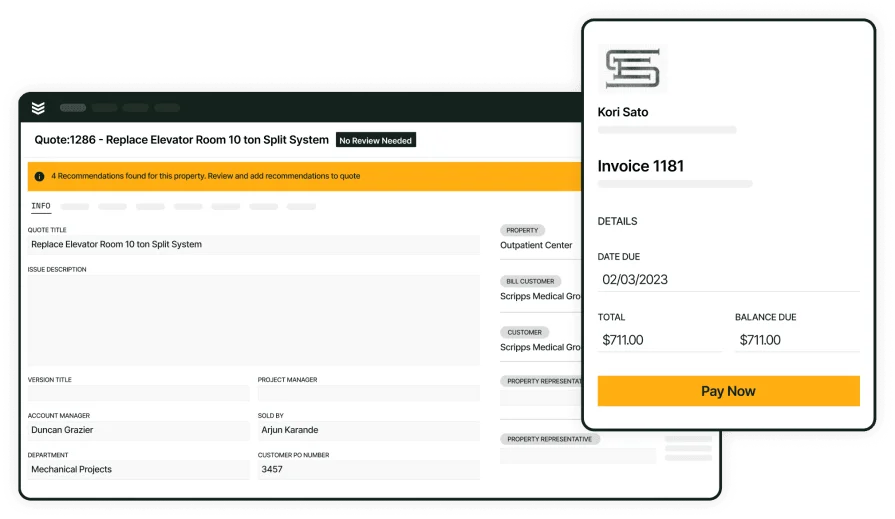
Quote faster, win more jobs
Build accurate estimates that sync with scheduling, dispatch, and billing.
Other notable features to look for in simple construction estimating software
These capabilities strengthen bid strategy, protect margins, and ensure a smooth transition from proposal to project execution.
- Pipeline management — Track leads, proposals, and stages using a practical construction CRM. Forecasting helps prioritize high-value bids that align with resource capacity.
- Route and labor optimization — Use integrated fleet management tools to factor optimized travel costs and scheduling directly into labor assumptions for the bid.
- Centralized document control — Attach all documentation, including takeoffs, RFIs, and revisions, to the estimate. Searchable history and comprehensive audit trails reduce disputes and speed up compliance.
6 best AI bidding software to power your pre-construction process
We’ve rounded up AI-powered construction bidding platforms that help simplify preconstruction—from faster takeoffs to smarter bid management, cost control, and risk visibility—so your team can find the right fit to estimate better and win more work.
1. BuildOps: best for commercial field service teams

BuildOps unifies estimating, project cost control, and field operations in one platform built for commercial service contractors running multi-trade crews across multiple jobsites. The system uses historical data to automatically generate accurate cost estimates and labor assumptions, ensuring every bid is profitable and resource-aligned. Bid managers can instantly convert approved estimates into active projects, syncing material lists and labor budgets with field teams to protect margins from day one.
How Pricing Works: BuildOps provides weekly live demos and an opportunity to arrange a personalized session to help you explore features and choose a solution that suits your needs.
Features Beyond Bidding:
- Real-time scheduling and resource allocation that protects estimated labor costs
- AI-powered job assignment based on necessary skills, location, and availability to fulfill bid requirements
- Advanced customer hierarchy management for multi-location clients during the proposal phase
- Technician mobile app for real-time field data capture and instant change order generation
What Sets It Apart for Commercial Service Teams: BuildOps keeps your pre-construction data connected to the field in real time, coordinating multi-location, multi-trade projects by ensuring bid estimates are accurately executed—from installs to maintenance to emergency service.
Rating: 4.4 on Capterra from 177 user reviews
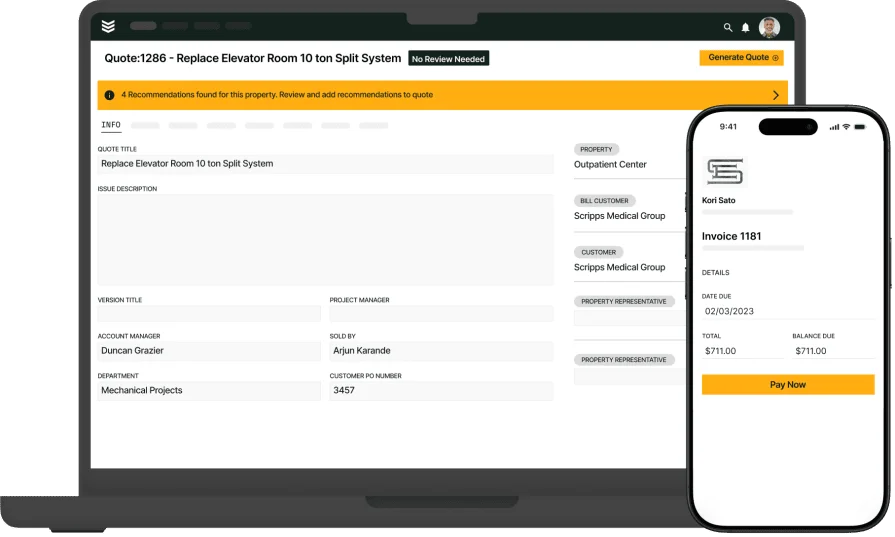
See how AI keeps your crews on track
Coordinate bids and schedules for your field ops from one AI-native platform.
2. Kickserv: best for residential teams

Image Source: Kickserv
Kickserv works well for residential service contractors who need straightforward tools to manage proposals and estimating for smaller crews. It emphasizes customer-facing features like a self-service portal where homeowners can approve estimates, review job history, and track upcoming project phases.
Estimating and scheduling are easy for office staff to use, but they lack the advanced AI and assignment capabilities commercial teams need to scale across complex jobs and multiple trades.
How Pricing Works: Kickserv offers tiered pricing, with key features like payment processing and customer management available at higher tiers.
Features Beyond Bidding:
- Customer self-service portal for easy estimate approval and interaction
- Integration with payment systems like Stripe and QuickBooks for fast invoicing
- Simplified proposal generation and job scheduling for smaller-scale teams
What Sets It Apart for Residential: Its customer portal streamlines communication between office staff and homeowners, accelerating estimate approval and reducing administrative back-and-forth on residential service bids.
Rating: 4.4 on Capterra from 387 user reviews
3. Procore: best for general contractors

Image Source: Procore
Procore is designed for general contractors overseeing complex, multi-phase projects. It combines centralized bid management with comprehensive project management, supporting everything from pre-construction planning to daily jobsite coordination. Its bidding module allows contractors to solicit bids from subcontractors at scale, giving project managers visibility into timelines and budgets across an entire build.
Its focus on large-scale construction oversight may make it too feature-heavy for service contractors, while lacking the routing, dispatching, and reassignment tools they need.
How Pricing Works: Procore's pricing is customized based on company size and project scope, making it suited for large-scale operations.
Features Beyond Bidding:
- Comprehensive project management tools to execute on awarded bids
- Collaboration features for teams and subcontractors during the solicitation phase
- Detailed reporting and analytics for historical bid performance and project cost control
What Sets It Apart for General Contracting: Procore excels at giving general contractors a high-level view of subcontractor bidding and overall project timelines across diverse trades and large-scale construction builds.
Rating: 4.5 on Capterra from 2657 user reviews
4. FieldPulse: best for small teams

Image Source: FieldPulse
FieldPulse provides a lightweight, easy-to-navigate platform suited for small field service teams that need basic estimating and proposal generation without a complex setup. Its interface keeps things simple, allowing office staff to create and track estimates, assign jobs, and manage invoices from one dashboard.
If you manage multiple projects across service areas or need advanced estimating features like automated takeoffs and predictive cost modeling, FieldPulse may feel limiting as your needs grow.
How Pricing Works: FieldPulse offers flexible pricing tailored to smaller businesses, with a focus on affordability.
Features Beyond Bidding:
- Built-in time tracking for accurate labor cost comparison against the estimate
- Simple invoicing and payment processing after bid award
- Task delegation tools to keep your project execution on track
What Sets It Apart for Small Teams: FieldPulse keeps small field service teams productive with a streamlined, no-frills interface that focuses on core proposal generation and operational needs without overwhelming users with advanced features.
Rating: 4.6 on Capterra from 439 user reviews
Check out our breakdown of how FieldPulse stacks up when compared to BuildOps.
5. ServiceFusion: best for fleet management

Image Source: ServiceFusion
ServiceFusion pairs estimating with built-in fleet management tools, allowing bid managers to accurately factor vehicle coordination into project costs. Its GPS tracking and real-time vehicle insights help estimators calculate precise drive-time labor costs, optimize routes, and reduce fuel costs across projected service runs, ensuring the bid's labor assumptions are protected.
However, it doesn't offer the deep AI-powered estimating capabilities, like automated symbol detection for takeoffs or predictive cost modeling, that larger or faster-growing service operations need to stay competitive.
How Pricing Works: ServiceFusion offers straightforward, tiered pricing plans with features expanding at higher levels.
Features Beyond Bidding:
- GPS fleet tracking for monitoring technician locations relative to estimated routes
- Route optimization to save time and fuel, protecting bid margins
- Vehicle maintenance tracking for better fleet performance planning
What Sets It Apart for Fleet Management: ServiceFusion gives field service businesses direct visibility into their fleet operations alongside estimating, helping teams reduce drive time and precisely account for vehicle costs within the bid.
Rating: 4.3 on Capterra from 308 user reviews
6. ServiceTitan: best for growing teams

Image Source: ServiceTitan
ServiceTitan is a platform that serves both residential and commercial service contractors across a wide range of trades, including HVAC, plumbing, electrical, and roofing. It centralizes estimating, proposal creation, and field communication with tools for call booking, marketing, reporting, and accounting.
However, contractors needing deep AI estimating features—like automated takeoff generation, predictive risk analysis, or automated subcontractor bid comparison—may find it broad but not purpose-built for advanced estimating intelligence.
How Pricing Works: ServiceTitan offers custom pricing based on business size and selected products, with optional Pro add-ons like Dispatch Pro, Scheduling Pro, and Fleet Pro available at additional cost.
Features Beyond Bidding:
- Call booking and marketing tools tied to customer acquisition
- Integrated accounting and invoicing workflows post-proposal acceptance
- Customer experience portal for self-service access to historical quotes and proposals
- Service agreement management for recurring revenue forecasting and program pricing
What Sets It Apart for Residential: ServiceTitan connects the full residential service cycle—from lead management through proposal generation, field work, invoicing, and follow-up—giving residential contractors a single platform to manage customer relationships and daily operations across multiple trades.
Rating: 4.3 on Capterra from 327 user reviews
See how BuildOps and ServiceTitan compare directly right here.
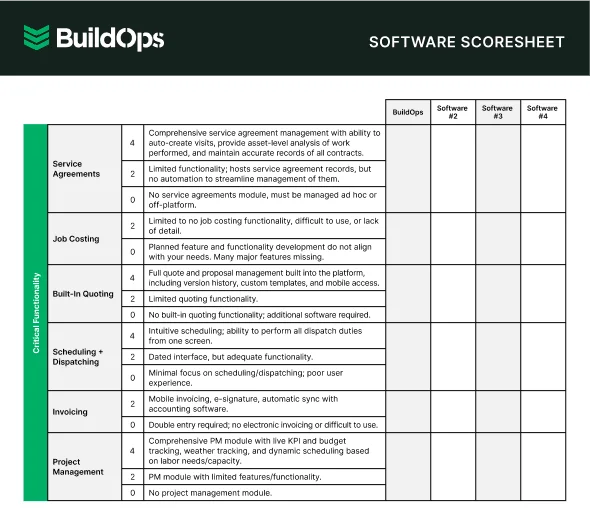
Get the software scoresheet
Compare top tools at a glance with this easy-to-use scoresheet.
7 benefits of using an AI-powered bidding software
AI-powered bidding software helps contractors bid more accurately, protect margins, and make smarter decisions using automation and past project data.
1. Accelerated bid-to-award cycle
AI reads plans and specs and turns them into early estimates in minutes. That means your team can bid sooner, win approval faster, lock pricing earlier, and keep crews moving without admin drag.
2. Predictive cost accuracy and margin protection
AI uses past project data and current market signals to sharpen forecasts for labor, material, and overhead costs. The result is a more grounded estimate that helps protect margin and reduce expensive misses.
3. Audit-proof bids and greater client transparency
AI-driven takeoffs and standardized calculations help reduce errors and create a clear record of every revision. With itemized estimates and a documented history, clients get more transparency and your team builds more trust.
Did you know
A Kickstand report based on a survey of 606 contractors across the U.S. and Canada found that 78% are using AI tools on the jobsite, while 47% say one in five positions remain unfilled. That combination explains why AI-backed workflows matter in field ops: they reduce admin load and help teams keep output steady with the headcount they have.
4. AI-aligned team collaboration
AI centralizes real-time bid data (quotes, scope notes, and schedule context). This ensures PMs, estimators, and field leads work from the latest figures, tightening collaboration and avoiding errors, especially when integrated with systems such as CRM for construction.
5. Dynamic project planning linked to execution
Estimates automatically drive dynamic schedules and resource allocation. When labor or quantities tied to the bid change, AI ensures updates ripple through the plan immediately, preventing rework and keeping the field aligned with the latest scope.
6. Automation eliminates manual data entry

AI automates repetitive tasks like takeoffs and calculations, reducing double-entry. This frees up estimators for strategic work and allows field teams to use a practical contractor estimate and invoice app to capture site data instantly.
7. Predictive risk assessment and performance reporting
AI uses historical data to generate predictive insights on win rate, variance, and margins. This visibility identifies cost overrun risks and enables strategic decisions to improve future bids. An overview of construction invoice software shows how billing data completes the estimating feedback loop.

Questions to ask when choosing an AI bidding tool for your team
Choosing an AI construction bidding software platform affects your win rate, profit margins, and ability to execute. Here are the critical factors to evaluate before making your decision.
- AI speed and auditability — How does the platform handle takeoffs and estimates? Can it automatically detect symbols and calculate quantities with verifiable accuracy, or does it require extensive manual cleanup? Can your estimators easily audit and adjust the AI's recommendations?
- Compatibility with your existing workflows — Will the platform seamlessly integrate AI-powered estimating into your existing bid preparation process, or will it force a complete and complex rebuild? Can the data flow cleanly from takeoff to proposal generation?
- Scalability for bid volume and data handling — As your bid volume and project complexity grow, will the platform keep up without performance issues? Does the software support both residential and commercial project complexity?
- Training and onboarding support — How quickly can your estimators and project managers get up to speed? Does the vendor offer hands-on implementation support and accessible technical help when a bid deadline is approaching?
- Features that connect bidding to wider field operations — Does the platform link the finalized estimate directly to project management, scheduling, and invoicing? Can labor budgets and material lists flow instantly to the field teams without re-entry?
The answers to these questions will point you toward a platform that delivers measurable accuracy and a lasting competitive edge in the bidding process.
4 important FAQs about AI bidding software & tools
For estimators and preconstruction teams, the AI conversation usually comes down to a few core things: value, adoption, and how it actually fits into the bid process. These four points cover what matters most.
1. What is AI construction bidding software?
AI bidding software speeds up pre-construction by automating takeoffs, cost benchmarking, and risk detection—helping estimators spot patterns, avoid surprises, and bid with more confidence.
2. How does AI ensure bid accuracy and protect margins?
AI improves estimate accuracy by pulling quantities straight from plans and using historical project data to predict costs more precisely—helping contractors avoid overbidding or underbidding.
3. Is AI construction bidding software a worthwhile investment?
Yes. AI-driven bid matching and predictive scoring can improve win rates while saving up to 20 hours a week on admin work. And with automated takeoffs cutting prep time by as much as 85%, teams can bid more, faster, and with better ROI.
4. What are the best practices for adopting AI construction bidding software?
Pros get results by treating the AI platform as part of daily operations, not an add-on. Keep data current, lock process, and measure outcomes so estimates match field reality.
- Standardize templates and assemblies so AI can recognize project patterns.
- Align cost codes with job costing for better labor and payroll predictions.
- Set markup and margin rules by project type to improve bid scoring.
- Update vendor pricing through integrations for real-time cost forecasting.
- Capture takeoff quantities on site to refine AI plan assumptions.
- Require version control and approvals to keep historical data clean.
- Link estimates to schedules so AI can optimize resources and reduce rekeying.
- Review the estimate vs. actual weekly to audit AI and spot estimator variances.
- Use alternatives and options so AI can model scope changes automatically.
- Train estimators to audit AI outputs and control decision logic.
Commercial contractors don’t lose bids because they lack hustle. They lose because their estimating process is fragmented, reactive, and too dependent on manual effort to scale.
When bidding runs on spreadsheets and scattered tools, mistakes follow: missed scope, inconsistent pricing, slower turnarounds, and tighter margins.
BuildOps is the AI-powered platform built for commercial contractors—connecting estimating, CRM, scheduling, service, and financials in one system, with OpsAI helping teams move faster, work smarter, and win more.
The result: tighter estimates, faster bid turnaround, stronger win rates, and more profitable work, without adding overhead to the preconstruction team.
Want to see how AI can help your team bid with more speed and confidence? Book a demo built for commercial contractors.
Run tighter projects with BuildOps
One platform to quote, schedule, dispatch, purchase, and track time.