Nearly 80% of contractors are already testing artificial intelligence (AI) tools, and 80% say AI will be essential within three years, according to The Pivot Point: AI and The Future of Commercial Contracting, a survey of 606 contractors across the U.S. and Canada from BuildOps and Kickstand.
AI systems can increase operational efficiency for many facets of construction, helping them run better, more efficient businesses and make the most out of their workforce. “Most companies are thinking about AI wrong,” said Harvard Business School Professor Chris Stanton at BuildOps Forge 2025. “This isn’t going to be about replacing people … it’s about enhancing productivity.”
AI is quickly becoming a must-have in construction, and teams that fail to adopt it risk falling behind. We’ve outlined the top applications of AI in construction, grouped by the core business functions where they can improve operations most.
Here’s what we’ll cover:
- Top use cases of AI for construction operations
- AI for office & admin work for construction companies
- AI for construction CRM
- AI for construction marketing & content creation
- Special AI use cases for different construction project types
Let’s dive into the top ways AI is transforming construction business operations, starting with the immediate impact on site and field activities.
Top use cases of AI for construction operations
These use cases optimize recurring work, helping save you critical time that really adds up when you consider how frequently you need to perform these tasks.
Scheduling
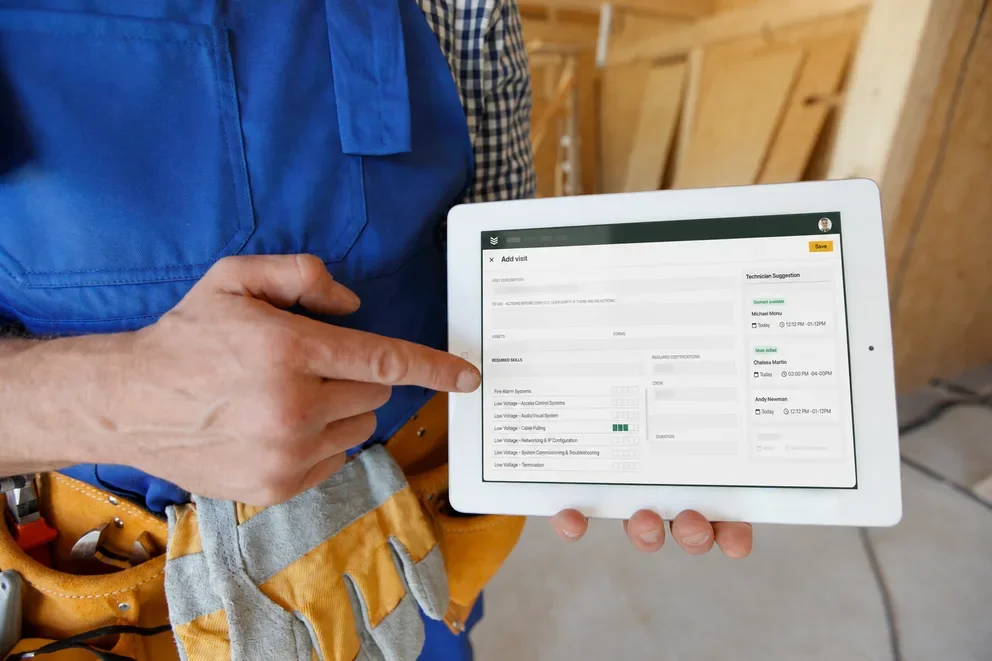
AI tools enable field service scheduling that connects the best crew members or specialized equipment to each project phase based on required skills, workload, and certifications. AI-powered software, including smart dispatch software, can instantly reassign or reschedule tasks when project conditions change, such as weather delays or a job running long. Optimizing resource allocation by assigning the right crews and equipment to the right construction task keeps projects on track and improves overall site efficiency.
Field route optimization
AI for fleet management optimizes the movement of crews and equipment. Construction AI optimizes routes by comparing jobsite locations, travel time, traffic patterns, and route efficiency with crews' or specialized equipment's locations. This helps reduce unnecessary time spent on the road, saves fuel costs, and increases workforce productivity by ensuring construction personnel spend more time on site and less time in transit.
Real-time decision support in the field
Even the most highly trained and experienced crew member doesn't always know all the answers. Utilizing an AI software for construction teams provides the support they need on the jobsite to make smarter decisions, offering remote diagnostics, improved on-site problem-solving, and avoiding unnecessary trips back to the office or delays waiting for a supervisor.
AI for office & admin work for construction companies
Nearly 40% of contractors surveyed by BuildOps and Kickstand report using AI for admin and recordkeeping. That’s no surprise, because AI improves the workflow across the jobsite and the office by reducing labor-intensive administrative work, improving accuracy, and streamlining processes.
Did you know
Workforce efficiency is vital, as nearly half of contractors reported 20% to 25% of roles are unfilled in their companies. Compounding the issue: nearly 70% see burnout among employees rising, and not just in the field.
“The office teams are being stretched thin,” said Customer Success Leader Chappell Brock during BuildOps’ webinar The Pivot Point. “One customer told me she taps out at 11 hours a day. That’s not sustainable.” Any tools that can reduce the workload are invaluable to contractors operating in today's workforce shortage.
Efficient invoicing and payment processing
Make invoicing more efficient with AI-powered tools that can turn site log data, photos, and crew input into clean and complete invoices that match factors like labor, materials, and scope to the right line item.
“If AI can clean up a tech’s notes or translate their voice so the back office doesn’t have to–those 10 seconds add up fast,” said Customer Success Leader Thurain Hlaing during the BuildOps’ webinar.
AI software makes sure every minute spent on the project and every material used is tracked and included on the invoice. And it can flag missing charges and likely add-ons based on similar projects–improving the bottom line for construction companies.
Automated project closeout and documentation
Increase workforce productivity and accuracy using tools that automate project documentation. AI-powered tools can provide job site data by pre-filling summaries, pulling equipment history and service records, suggesting likely parts needed for follow-up, and generating clear recaps from voice or photo input, which saves site supervisors and management time and frustration in the office.
Rapid quoting and accurate estimation
Deliver faster, more accurate quotes with AI-powered construction management software. It scans project docs and site observations to pinpoint materials, labor hours, and likely add-ons—so your quotes match the real scope, without the delays and mistakes of paper-based processes. The result: fewer surprises, less scope creep, and happier customers.
Smarter materials and inventory management
Use project history and seasonal trends to forecast material needs before crews ask for them. That keeps jobs moving, cuts delays, and gives ops teams a clear view of what’s actually worth stocking—so less cash sits on shelves collecting dust.
AI for construction CRM

AI-powered construction CRM helps contractors stay organized, respond faster, and deliver a better customer experience from the first call to the final follow-up. With the right CRM, every lead, job, and customer interaction stays connected.
Smarter lead and inquiry management
AI helps capture inbound inquiries, route them to the right team, and keep follow-up moving fast. It can also summarize conversations, qualify leads, and suggest next steps so opportunities don’t slip through the cracks. For a deeper look at what matters in a CRM for construction, the biggest value is simple: faster responses and better first impressions.
Better coordination across jobs and customer touchpoints
A construction CRM should do more than store contact info. It should connect customer history, job details, estimates, and service records in one place. With a strong field service CRM, AI helps teams find the right context quickly, communicate clearly, and keep customers informed at every stage.
Clearer post-job communication and follow-up
AI can turn technician notes, site photos, and work details into polished customer updates that are easy to understand. That makes it easier to explain completed work, flag issues, and recommend next steps without creating confusion. As more contractors look at modern construction CRM tools, the real advantage is stronger trust after the job is done.
AI for construction marketing & content creation
AI gives construction companies a faster way to turn field activity into strong marketing.
Content marketing
AI helps construction marketers turn everyday project data into useful sales and marketing content. Information from schedules, budgets, safety records, workforce performance, and jobsite updates can be used to build project profiles, case studies, capability sheets, and proposal content that clearly show experience and results.
It can also strengthen a construction company’s website. It can help write clearer portfolio copy, improve project descriptions, and enhance jobsite photos by cleaning up visuals, adjusting lighting, straightening lines, and creating before-and-after images that better showcase completed work.
Content creation
Construction companies can use AI to create content that builds credibility in the market. Jobsite data, technician notes, work orders, inspection reports, and asset information can be turned into articles, social posts, and thought leadership on topics like project risk, budgeting, supply chain challenges, and value engineering.
This helps construction businesses market their expertise more consistently and position themselves as trusted partners, not just service providers.
Special AI use cases for different construction project types
AI is becoming a practical advantage across construction. It helps teams reduce errors, improve documentation, make faster decisions, and keep work moving in the field.
Residential
In residential construction, AI helps teams move faster by organizing photos, tracking progress, spotting quality issues early, and streamlining takeoffs, estimates, and communication across repeatable jobs.
Commercial
In commercial construction project management, AI helps teams navigate the constant complexity of coordinating trades, schedules, budgets, and field activity. It can identify drawing conflicts before they lead to rework, turn daily reports into concise updates, track crew productivity in real time, and surface risks early enough to protect both timelines and margins.
These capabilities are becoming an increasingly important part of commercial construction project management, where tighter coordination and better visibility can make the difference between staying on track and falling behind.
Industrial
In industrial construction, AI supports complex, high-stakes work by analyzing equipment data, flagging installation issues, improving troubleshooting, and helping teams reduce downtime.
Institutional
For institutional projects, AI helps teams stay ahead of compliance by organizing documentation, tracking specs, and managing inspections and closeout with greater accuracy.
Infrastructure or heavy civil
On infrastructure and heavy civil projects, AI helps teams process field data faster, track progress, identify safety risks, and plan more effectively around crews, equipment, and site conditions.
Mixed-use
In mixed-use construction, AI helps connect information across project types and phases, making scheduling, handoffs, and stakeholder coordination easier to manage.
AI is helping construction businesses cut through the operational drag that slows work down.
From scheduling and dispatch to job costing, technician support, invoicing, and customer communication, BuildOps helps contractors move faster, stay aligned, and make smarter decisions across every part of the business. The result is less manual work, greater visibility, and a smoother experience for both teams and customers.
Check out the full report for more insights, or set up a demo with BuildOps today to see how OpsAI helps construction businesses run more efficiently.

The AI Pivot Point
Check out the full report for more insights on how field teams are using AI.