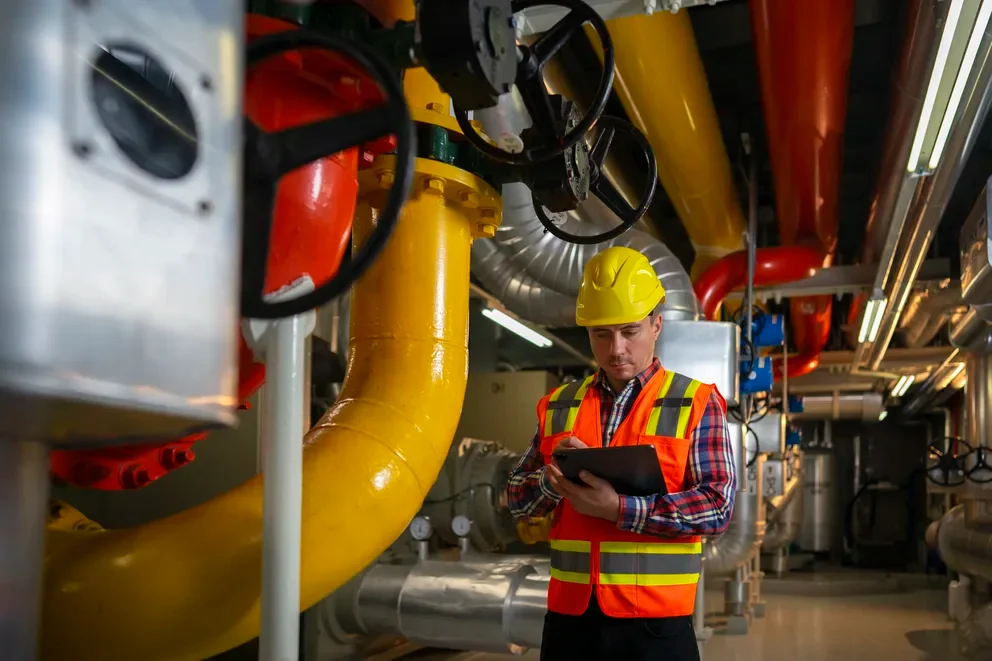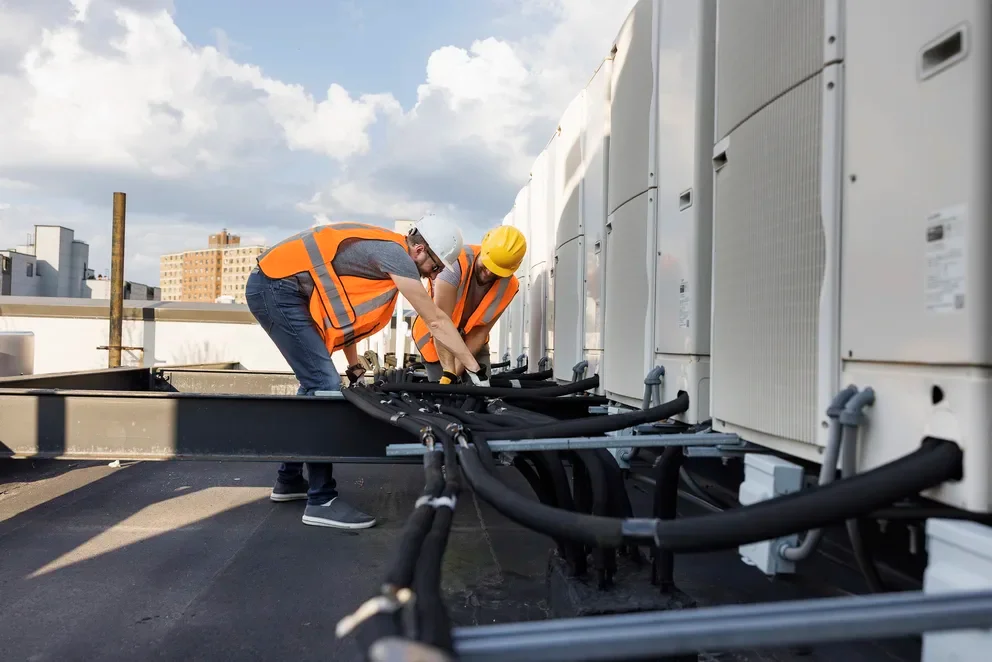
If reactive service is the only engine driving business, commercial HVAC maintenance contractors are always chasing the next call, a risky arrangement that can disrupt business operations.
A strong commercial HVAC preventative maintenance program for HVAC system efficiency changes that equation. Contractors build structured service programs that result in well-maintained HVAC systems their customers rely on every day, creating a stable and scalable revenue engine.
In this article, we’ll cover:
- Why build out a commercial HVAC preventive maintenance program for your customers?
- Key preventative maintenance program components for commercial HVAC systems
- What could preventive maintenance contracts for commercial HVAC equipment be worth?
- How to track the effectiveness of your commercial HVAC maintenance program
Let’s jump into why doing this is so important for commercial HVAC teams.
Why build out a commercial HVAC preventive maintenance program for your customers?
Commercial HVAC preventative maintenance programs are a strategic shift in how a commercial HVAC maintenance business operates.
1. Predictable revenue replaces unpredictable demand
Reactive service for HVAC systems is inherently volatile. When temperatures are mild and equipment holds together, call volumes drop. When weather spikes or aging systems start failing, work piles up overnight. Regular maintenance smooths that curve for many commercial HVAC systems.
Scheduled service visits create a steady stream of work that doesn’t depend on emergencies. That consistency allows commercial contractors to forecast revenue more accurately and plan labor needs months in advance.
For commercial HVAC maintenance companies looking to grow, this stability is essential. Predictable regular maintenance work provides the financial foundation that supports hiring technicians, expanding service territories, and investing in new capabilities.
2. Maintenance programs for HVAC systems expand service opportunities
Regular maintenance visits rarely stay limited to inspection checklists. Technicians working through routine maintenance often uncover developing issues long before they become catastrophic failures, like failing air conditioning systems, the need to replace air filters, worn belts, dirty coils, loose electrical connections, deteriorating insulation, or airflow imbalances.
Each of those discoveries identifies real operational risks early, documents them clearly, and gives customers the chance to fix small problems before they become large and expensive, improving energy efficiency and system performance. Over time, those incremental repairs and upgrades, instead of emergency repairs and costly breakdowns, represent a significant portion of service revenue generated through regular maintenance programs.
3. Commercial HVAC system knowledge becomes a competitive advantage
HVAC systems are complex, and many facilities contain indoor and outdoor units installed over decades. When commercial contractors maintain those systems regularly, they develop a deep understanding of the equipment and system performance across each facility, and that knowledge is incredibly valuable.
- Technicians arrive on site already familiar with the equipment
- Service managers can diagnose HVAC unit problems faster
- Capital planning conversations with customers become more informed because the contractor understands the lifecycle of each system
Commercial HVAC preventive maintenance turns equipment data into institutional knowledge, and institutional knowledge into a competitive advantage.
4. Customer relationships shift from transactional to strategic
Instead of only appearing when systems fail, commercial contractors become regular participants in keeping buildings operational. Technicians interact with facility teams throughout the year, building trust and familiarity with the site.
Over time, those relationships evolve. The contractor stops being the company that shows up during emergencies and becomes the partner responsible for keeping mission-critical systems running with improved reliability and energy efficiency. That shift is where long-term revenue stability begins.
5. Improved air quality becomes a business advantage
HVAC units are the lungs of a building. Indoor air quality problems don’t always announce themselves with alarms. They show up in subtler ways: fatigue in office staff, comfort complaints from tenants, hot spots that never seem to go away, or humidity levels that creep slowly upward until equipment is working twice as hard as it should.
"The HVAC system is really the breath, the lungs of a building. It's how you get air into and out of a building and how you condition a building and how you make people comfortable in a building,” said Co-founder and President of Heavy Metal Summer Experience Angie Simon during a recent episode of BuildOp’s Commercial Grade.
A strong preventive maintenance program keeps indoor air quality issues from taking root. By ensuring regular air filter replacement occurs on schedule, coils stay clean, sensors read accurately, airflow is balanced, and air conditioning systems achieve peak performance, contractors can help building owners deliver healthier, safer, and more productive environments with enhanced indoor air quality.
Facility managers are under increasing pressure to validate air quality performance, ensuring proper airflow and cleaner air. When contractors can measure, document, and maintain indoor air quality as part of a structured HVAC maintenance schedule, they become a partner in risk management, employee well-being, and operational credibility.
eBook: From Reactive to Proactive
Review the data behind why commercial contractors can't afford to find problems late.
Key preventative maintenance program components for commercial HVAC systems
A successful commercial HVAC preventive maintenance program requires structure, repeatable processes, and clear operational discipline.
1. Create detailed HVAC system inventories

Every proper maintenance plan begins with a complete understanding of the assets being maintained. That means documenting every piece of HVAC equipment at each facility.
For each asset, commercial contractors should capture:
- Equipment type and manufacturer
- Model and serial numbers
- Installation date or estimated age
- Service history
- Maintenance intervals recommended by the manufacturer
This asset-level inventory becomes the backbone of the entire maintenance plan. Without it, maintenance visits become guesswork rather than structured service.
2. Build standardized HVAC system maintenance workflows

Once equipment inventories are established, the next step is defining repeatable maintenance procedures. Each equipment type should have a structured maintenance checklist that technicians follow during every visit to ensure consistency across technicians and service teams.
Standardized workflows help maintain quality across hundreds or thousands of service visits each year. They make training new technicians easier and reduce the chance that critical steps get skipped.
3. Schedule HVAC system maintenance strategically throughout the year

One of the most overlooked parts of preventive maintenance programs is how visits are distributed across the calendar. If all maintenance visits are scheduled during peak cooling or heating seasons, technicians will already be overwhelmed with emergency calls. Instead, successful commercial contractors stagger maintenance visits across the year.
Cooling equipment maintenance typically happens in the spring before summer demand arrives. Heating systems are serviced in the fall before winter temperatures drop. By aligning maintenance schedules with seasonal equipment cycles, contractors reduce emergency breakdowns while smoothing technician workloads.
4. Document every service visit

Preventive maintenance only creates long-term value if service data is captured and organized. Each visit should produce a documented record that includes:
- Work performed
- Equipment condition observations
- Recommended work to prevent costly repairs
- Parts replaced
- Photographs of equipment conditions
Over time, this documentation builds a historical record that helps technicians diagnose problems faster and gives customers visibility into how their systems are performing and whether they're achieving optimal energy efficiency to lower energy bills.
In many commercial environments—such as hospitals, laboratories, and manufacturing facilities—this documentation is essential for regulatory compliance.
5. Turn HVAC system maintenance data into operational insight

Preventive maintenance programs generate an enormous amount of equipment data. The real value comes from analyzing that information.
Service teams should review maintenance data regularly to identify patterns:
- Which equipment fails most frequently
- Which facilities generate the most repair work
- Which systems may be approaching replacement cycles
These insights allow commercial contractors to advise customers on long-term equipment planning and ways to improve energy efficiency while also identifying opportunities for future service work.
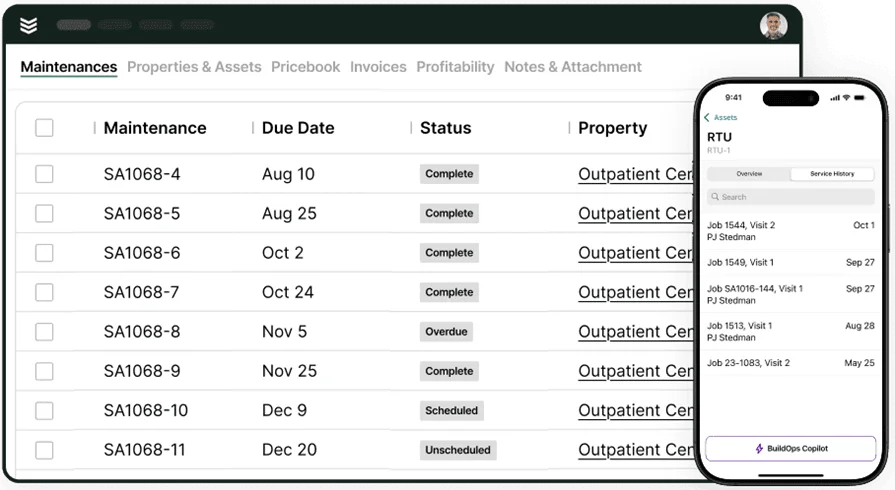
Automate recurring revenue with BuildOps
Our Service Agreements features are built to handle commercial-scale HVAC projects.
What could preventive maintenance contracts for commercial HVAC equipment be worth?
Preventive maintenance programs represent one of the most dependable revenue streams available to HVAC contractors. Across the commercial service industry, maintenance agreements often generate between 30% and 50% of total service department revenue for established commercial contractors.
The math behind that growth is straightforward.
A contractor maintains 25 commercial facilities. Each facility contains an average of five HVAC assets. Those facilities require two to four maintenance visits per year.
Even at modest service pricing, those recurring visits generate hundreds of scheduled work orders annually. But the real financial impact extends beyond those visits. Preventive maintenance programs also generate:
- Work discovered during inspections to prevent costly repairs
- HVAC system upgrades and retrofits
- Replacement projects when aging systems reach end-of-life
When structured correctly, preventive maintenance contracts create a flywheel effect: maintenance drives insight, insight drives repairs, repairs lead to larger system upgrades and replacements, and increased system performance improves relationships with customers.
How to track the effectiveness of your commercial HVAC maintenance program
A preventive maintenance program only works by establishing clear metrics that track operational performance, customer value, and revenue growth.
1. Preventive Maintenance Completion Rate
The completion rate measures how consistently scheduled maintenance visits are performed on time. Missed or delayed visits reduce program effectiveness and increase the likelihood of unexpected equipment failures.
A high-performing program typically maintains completion rates above 90%.
How To Calculate & Measure: Preventive Maintenance Completion Rate = Completed Maintenance Visits ÷ Scheduled Maintenance Visits × 100
2. Maintenance-driven Repair Revenue
One of the most important indicators of program effectiveness is the amount of repair work identified during maintenance visits. Preventive maintenance should uncover developing issues early, allowing commercial contractors to address them before they become major failures.
Tracking this metric helps contractors understand how maintenance programs contribute to overall service revenue.
How To Calculate & Measure: Maintenance-Driven Repair Revenue = Total Repair Revenue Originating from Maintenance Visits
3. Equipment Uptime Score
Preventive maintenance exists to reduce unexpected system failures. Tracking equipment uptime across maintained facilities provides a clear measure of program impact.
Higher uptime rates indicate that maintenance programs are successfully preventing disruptions.
How To Calculate & Measure: Equipment Uptime Percentage = Total Operational Hours ÷ Total Available Hours × 100
4. Planned Work Technician Utilization
Preventive maintenance programs should increase the portion of technician time spent on scheduled work rather than emergency calls.
Higher utilization levels indicate better workforce planning and more predictable operations.
How To Calculate & Measure: Planned Service Utilization = Scheduled Maintenance Hours ÷ Total Technician Service Hours
BuildOps: an effective tool to build your commercial HVAC preventative maintenance program
Leveraging the right operational platforms is essential to running a preventive maintenance program across hundreds or thousands of assets successfully.
BuildOps was designed specifically for the complexity of commercial and field service contracting, where service, projects, and maintenance often intersect across large facilities and multi-location customers.
“BuildOps was designed, basically, by mechanical contractors for mechanical contractors. The things I see in BuildOps, I don’t see anywhere else.”—TK from Earl Mechanical, Ohio-based HVAC contractor.
For commercial HVAC contractors building preventive maintenance programs, that means several critical advantages.
- Asset-centric service management that allows commercial contractors to track each piece of equipment across every facility they maintain. Service histories, maintenance records, and repair notes remain connected to the asset, giving technicians full visibility before they arrive on site.
- Schedule and manage recurring maintenance visits at scale by automating maintenance workflows so the right work orders are generated at the right time.
- Real-time operational insight into service performance through dashboards that provide metrics to help leaders understand how their maintenance programs are performing across all business operations.
- Document maintenance visits directly in the field using mobile tools designed for real jobsite conditions that allow technicians to capture photos, service notes, and recommendations.
“We’ve seen an increase in day-to-day operations efficiencies that’s going to add up to significant savings in time and energy over the course of a year,” said President of Dormatech Mechanical Systems Mark Mulholland. “I would strongly recommend BuildOps to other companies in field service. We see BuildOps as a strategic partner that can provide a backbone for our company and a platform for growth.”
As mission control for commercial contractors, BuildOps brings service operations, asset data, scheduling, and performance insights into a single platform designed specifically for the realities of commercial work.
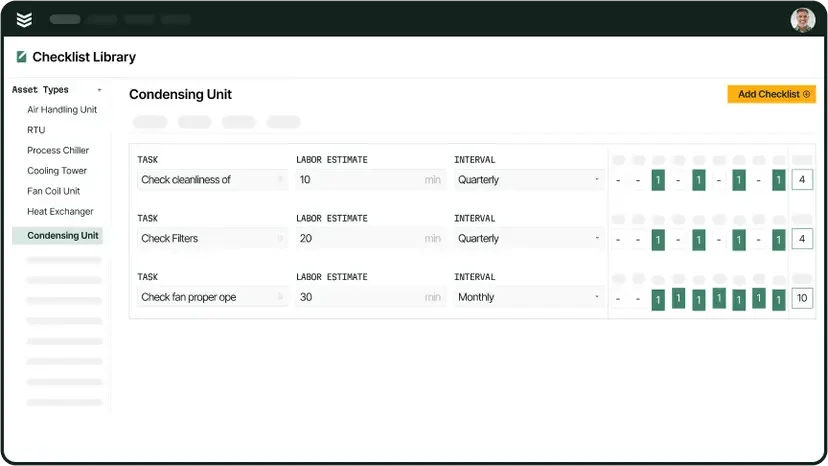
Automated proactive service agreement revenue
Use BuildOps to make on-site recos and template your service agreements.