


Key Takeaways
- One of the most important features to look for in low voltage estimating software is connectivity between other operations
- Choosing the right software depends on what scale of work you do: commercial, residential, or other work types
- Using a software to automate this process from quote to invoice can really cut down on admin work
Getting the numbers right is non-negotiable in low voltage work. Whether you're quoting structured cabling, access control, or fire alarm systems, one small miscalculation can cut into your margins—or lose the job entirely.
Estimating by hand or using general tools slows you down and leaves too much room for error. Low voltage estimating software is designed to tackle the unique demands of contractors in the electrical trade. It factors in labor, materials, and specialized components so your bids come out fast, clear, and accurate.
And because estimating is just one part of the job cycle, many contractors are pairing their tools with systems that support the full scope of operations—from quoting through to invoicing and everything in between. That’s where understanding how field service management fits into your workflow helps create a more connected, efficient business.
Here’s what we’ll break down in this guide:
- 5 key features to evaluate in a low voltage estimating software
- 5 best low voltage estimating software for electrical service contractors
- 7 benefits of using estimating software for low voltage service work
- How to choose the right low voltage estimating software for your work type
- 4 important low voltage estimating software FAQs to help with service work
Let’s start with the most important features to look for in a low voltage estimating software as you do your research.
Important
While BuildOps doesn’t currently offer low voltage-specific estimating software, we do offer a powerful estimating tool built for the trades. It’s designed with commercial contractors in mind, helping teams quote jobs faster and more accurately.
We’re always exploring new tools and technologies that move the industry forward—which is why we’re talking about it here
5 key features to evaluate in a low voltage estimating software
Low voltage contractors require quotes with a level of detail that most trades don’t touch. Quotes include system specs, cabling paths, device zones, and integration requirements. That means your low voltage estimating software needs to do more than crunch numbers, and needs to support fast, accurate quotes across different job types, clients, and sites.
Here are the top features you should look out for, and make sure are built into the core of any tool you use for low voltage work quoting.
1. Mobile-friendly app accessible to field teams

Most of your estimates don’t actually take place in the office, so why would you use a tool that only builds quotes on a desktop? With a mobile field service app, techs can build, adjust, and send quotes from the job site, even while walking a project.
During a site walk for a camera retrofit, your tech updates the estimate in real time as changes are made—no delays, no notes lost in the truck. Great mobile quoting tools will also offer you the ability to add images to quotes, which can really increase the chances of work getting approved.
2. Connection between the quotes and your CRM
Tying estimating into your field service CRM lets you pull customer history, job specs, and site pricing straight into your quotes. This cuts down manual entry and makes estimates more accurate for repeat or multi-site clients.
Let’s say your tech is quoting a badge access expansion for a corporate client. With past install data already tied to the account, your estimate can pull in compatible hardware and labor hours in minutes—no need to rebuild from scratch.
3. Quotes synced to scheduling & dispatching
When a quote gets signed, a link from that estimate that can connect to your field scheduling and field dispatching tools lets you assign the right crew immediately—without copying over data, which keeps jobs moving without back-and-forth, and helps get materials, scope, and timelines in front of the field team fast.
Say your estimator wraps a quote for 60 data drops at a university. The job’s already mapped out—so assigning a tech with fiber certs and setting the start date takes seconds, not hours and multiple discussions.
If your dispatcher sees a service estimate approved for a 12-door access system, because it’s synced, they already know what gear is needed and how long the install should take—and can schedule accordingly.
4. A field to invoice link that enables automated invoicing and payments
Invoicing and payment systems that tie into estimates can really speed up cash flow. You’re not just quoting—you’re closing jobs and billing faster, all from the same workflow and without having to enter details twice.
For example, when a small fire alarm install wraps, your tech marks it complete and the estimate converts to an invoice on the spot—no waiting on office handoffs.
A field to invoice solution is what enables this, taking details right from the initial quote, turning them into field notes, and then turning those into invoice summaries. This is what that looks like in BuildOps:

5. Reporting and cost visibility
Clear field reporting tools help you spot where estimates go off-track. Low voltage bids often hinge on accurate labor and cable length assumptions, so service cost reporting gives insight into where you were winning, and where you were bleeding on your margins.
If a string of projects all go over on labor, your team can trace back the assumptions made during estimating that led to those issues, and update them going forward.
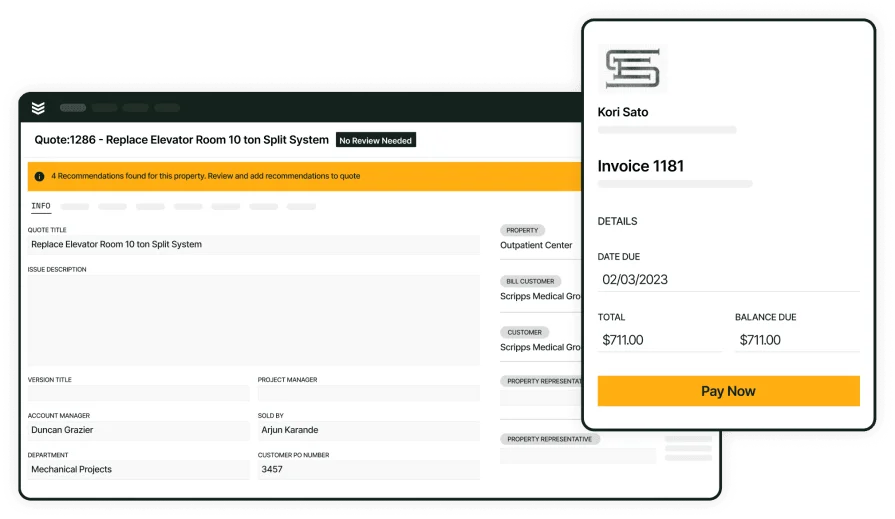
Check out BuildOps estimating tools
Precisely estimate electrical projects, resulting in faster job completion and invoicing
Valuable features outside for estimating for low voltage service teams
Beyond estimating, field service contractors in the low voltage space need tools that keep operations moving—especially when juggling installs, service calls, and client changes. Whether you’re deploying techs across a city or coordinating large project phases, cloud-based features can make a major difference in daily performance and long-term profitability.
Here are three other key features that work alongside estimating that can strengthen business operations:
- Integrated time tracking - Time tracking and estimating go hand in hand, as your electrical contractor’s time makes up a big portion of the cost you put together for a service estimate. Getting this wrong can make or break a project’s margin. Time tracking tools that are built into your workflow ensure hours are logged accurately, right down to the task or jobsite. For low voltage contractors, this means better labor forecasting, tighter job costing, and less time spent fixing timesheet errors at the end of the week.
- Fleet tracking and routing - For low voltage teams handling multiple daily stops—like camera maintenance or badge access repairs—vehicle coordination matters. With fleet management tools, you can track vehicle locations, monitor fuel usage, and optimize technician routes. That keeps your crews efficient, reduces travel costs, and helps ensure the right tech gets to the job site on time.
- Service Agreement tracking - Many low voltage contractors rely on recurring maintenance contracts—especially in security, fire alarm, or structured cabling environments. Service agreement software lets you manage renewals, deliverables, and scheduled tasks in one place. This helps you stay ahead of client expectations while keeping revenue consistent and predictable.
Used together, these tools let field service teams go beyond quoting and scheduling. They help low voltage contractors stay in control of every moving part—from techs and trucks to contracts and hours worked.
Used together, these tools let field service teams go beyond quoting and scheduling. They help low voltage contractors stay in control of every moving part—from techs and trucks to contracts and hours worked.

5 best low voltage estimating software for electrical service contractors
To get the most value out of a low voltage estimating software, you need to pick the option that fits the way your team works. Whether you're quoting structured cabling in a high-rise, retrofitting a fire alarm system in a school, or managing badge access installs across multiple sites, the right platform can make or break your job flow.
Below, we’ve outlined five top solutions—each with strengths suited to specific contractor types—and noted where they might fall short depending on your business needs.
1. Best for commercial electrical contractors: BuildOps

BuildOps is built for commercial contractors across the trades—including electrical teams—who manage complex jobs at scale. While it doesn’t specifically cater to low voltage contractors, its estimating and quoting tools are designed to support high-volume, detail-driven workflows common across industries.
BuildOps is a strong option for low voltage teams working in commercial environments who need to manage bids, scheduling, and invoicing in one connected system, usable by all team members from field to office.
How pricing works: BuildOps offers a customized pricing model based on business size, scope, and required features
Features beyond estimating:
- Real-time cost tracking and job costing
- Automated labor and material calculations
- Seamless integration with scheduling and invoicing
What sets it apart for commercial: BuildOps simplifies how commercial contractors handle quoting and project handoffs, which is ideal for low voltage firms bidding on multi-phase jobs that need coordination across teams
Rating: 4.5 on Capterra from 149 user reviews
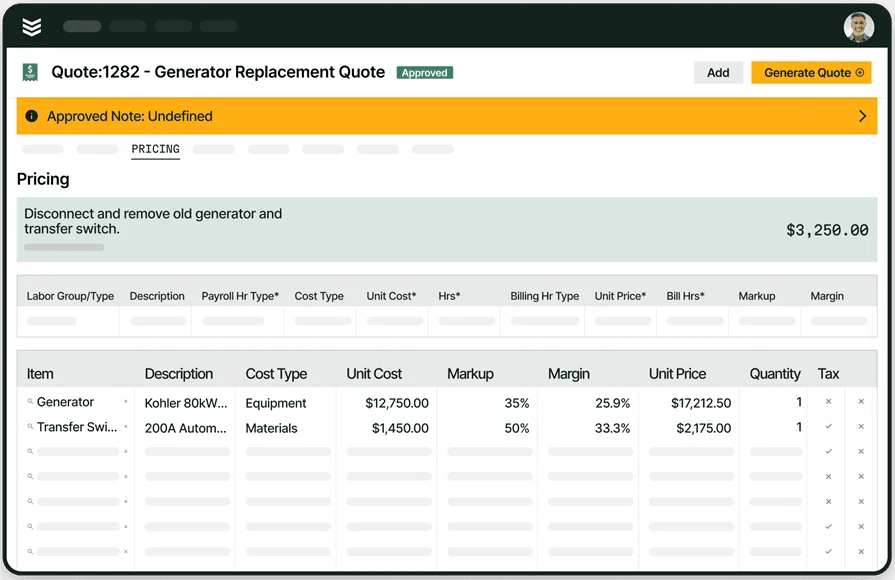
Explore BuildOps estimating tools
We help commercial electrical teams manage margins from first quote to closeout
2. Best for residential contractors: McCormick Systems
McCormick Systems offers a specialized estimating module for Automated Building Systems, giving low voltage contractors the ability to quote security, fire alarm, and access control projects with accuracy. It includes detailed takeoff tools, pre-built assemblies, and customizable labor databases—making it a strong option for residential and light commercial installers.
While great for detailed estimates, McCormick’s interface and learning curve may be too complex for small shops or contractors looking for mobile-friendly quoting.
How pricing works: McCormick operates on a one-time license model, with pricing based on modules and user access
Features beyond estimating:
- Detailed takeoff and assembly libraries
- Fire alarm, access control, and security modules
- Scalable add-ons for job costing and project tracking
What sets it apart for residential: Designed with specialized low voltage systems in mind, McCormick brings estimating depth and trade-specific tools for contractors who focus on high-detail jobs
Rating: 4.4 on Capterra from 94 user reviews
3. Best for detailed cost breakdowns: ConEst
ConEst Intellibid offers robust estimating tools specifically tailored for the low voltage industry, including cost databases and labor units for cabling, voice/data, and alarm systems. Its graphical takeoff features help teams visualize and quantify installs in advance.
While powerful, it may not be the best fit for contractors who need simple, mobile-based quoting or integrated scheduling tools.
How pricing works: ConEst follows a licensing model with optional cloud hosting and customization depending on your company’s size
Features beyond estimating:
- Integrated material and labor databases
- Takeoff tools with visual plan overlays
- Electrical and low voltage package options
What sets it apart for cost-focused teams: ConEst shines for teams that rely on precise labor factoring and material tracking, especially when bidding on competitive installs
Rating: 4.6 on Capterra from 24 user reviews
4. Best for jobsite collaboration: Fieldwire
Fieldwire supports low voltage teams through its mobile-friendly jobsite management platform. While it’s not a traditional estimating tool, it helps organize field workflows, markups, and plan coordination that supports estimating accuracy—especially on design-build or phase-heavy projects.
However, contractors looking for true estimating features like material pricing or automated takeoffs may need to use Fieldwire alongside another software.
How pricing works: Fieldwire offers subscription tiers based on users and project size, with a free version for smaller teams
Features beyond estimating:
- Plan viewing and markup in the field
- Task tracking with priority levels
- Issue logging and version control
What sets it apart for collaboration: Fieldwire adds value by helping estimators, PMs, and techs stay aligned across changing project scopes and install details
Rating: 4.6 on Capterra from 95 user reviews
5. Best for outsourced estimating: Electrical Estimators
Electrical Estimators is a service-based solution where licensed professionals handle the estimating for you. For low voltage contractors who don’t have in-house estimating capacity—or want to scale quickly without hiring—it offers quick turnaround on quotes across voice/data, security, access, and fire alarm systems.
Since it’s a service, not software, it lacks direct integration with field tools or workflows.
How pricing works: Pricing is quote-based depending on project size, type, and turnaround time
Features beyond estimating:
- Full-service estimating and quote delivery
- CAD and plan review available
- Access to NICET-certified estimators
What sets it apart for lean teams: This option is great for contractors who need to outsource estimating without building out internal staff—but it doesn’t provide long-term workflow control
Rating: No rating on Capterra
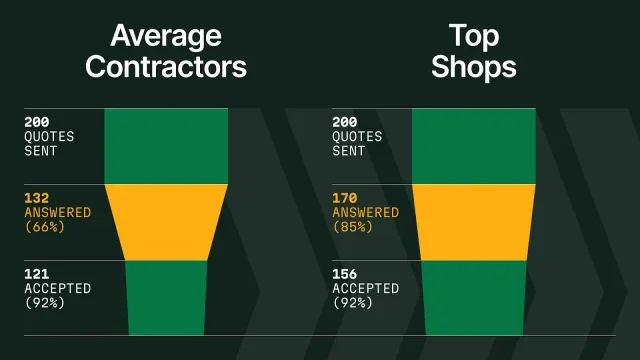
Learn how the Top Shops quote better
A ready-to-use, 3-step follow-up plan to bring clarity and urgency to your quoting system
7 benefits of using estimating software for low voltage service work
Many of the benefits of optimizing your field service management process start with better estimating, because a strong quote sets the stage for everything that follows. Here are some of the ways you might see immediate ROI when investing in a low voltage estimating software:
1. Faster quoting turnaround
Every day your bid sits unsubmitted, another contractor could win the job. Estimating software helps generate accurate quotes quickly by automating calculations, storing common assemblies, and cutting out repetitive entry. Speed gives you a competitive edge—especially when bidding high-volume or fast-moving low voltage scopes.
2. More control over profits and margins

Manually-built quotes often miss hidden labor time, markup inconsistencies, or changes in material pricing. With the right tools, you can build profit into every job with consistent costing logic.
When paired with real-time insights from your field service dashboards, you stay aware of your margins before work even starts. This is especially important for teams that do commercial work, as the small inconsistencies in quoting over the duration of a larger project can really lead to bigger problems when assessing project profitability.
3. Standardized estimates across your team
Most electrical service quotes require a site visit, which means all of your contractors are out there providing quotes to customers. When multiple people quote jobs, you see more inconsistencies, but estimating software helps with this problem.
You can set up custom checklists, templates, standardized inventory costs, and pricing rules, so whether a junior estimator or a PM builds the quote, the building blocks they’re using to build the quote are the same.
Cleaning up these kinds of inconsistencies and standardizing quotes keeps your pipeline forecast of incoming work more accurate, and removes a lot of errors that lead to overages on individual jobs.
4. Smoother handoffs from the sales team to contractors doing the work
Once a quote is approved, your field crew needs the exact specs on the scope of the work, not a vague breakdown. Software that connects estimating with operations ensures all details move into scheduling and execution cleanly, reducing errors and missed scope in the field.
5. More accurate labor forecasting

Low voltage labor is technical, and estimating software helps break down hours by task or system. That means smarter schedules and fewer surprises during installs. Used with a solid field service workflow process, it improves how you allocate techs based on skill and availability.
6. Necessary quote adjustments in the field can be made in real-time
Change orders and client requests don’t wait. Cloud-based estimating software allows your team to update pricing, quantities, or components instantly—keeping jobs moving without paperwork delays.
Mobile-accessible software also enables your contractors to make on-the-spot recommendations, which can get approved by the office while the contractor is still on site, enabling them to complete the work right away rather than wait for a separate visit to be approved.
7. Easier job closeout and billing

Final invoicing is easier when your quote already includes everything from parts to labor. Estimating software gives you a solid paper trail, making billing smoother and reducing the risk of disputes or forgotten line items. That’s especially useful on multi-phase jobs with a mix of service and install work.
We’ve made it pretty clear that low voltage jobs aren’t one-size-fits-all. Some are high-volume service calls, while others require complex, multi-system installs. The right estimating software for your crew needs to match how your team works and how detailed your quotes need to be. Let’s get into a quick breakdown of how you choose the tool that’s the right fit.

How to choose the right low voltage estimating software for your work type
Low voltage work brings its own set of estimating challenges. You’re not just counting parts—you’re planning for device zones, control panels, cable runs, terminations, and system integration. These jobs require more precision than most trades, and that means your estimating process needs to match.
The software you choose should support the unique variables that come with fire alarm systems, access control installs, structured cabling, and security integrations. Here’s are some questions to ask yourself that will help you make the decision:
- Workflow fit – Can you build and adjust quotes without wading through menus or extra steps? Does it support fast updates to labor and material costs for common low voltage systems? How quickly can your team turn around estimates during busy bid seasons or tight deadlines?
- Pricing flexibility – Can you adjust labor rates by job type, region, or tech certification level? Does it allow markups and discounts based on project scope or customer profile? How easily can you update your material database when supplier costs shift?
- Project type versatility – Does it support quoting both small service calls and large multi-system installs? Are there templates for commonly bid low voltage setups (e.g., data drops, alarm zones)? Can you switch between time & materials, flat-rate, or phase-based estimating models?
- Accessibility for field and office – Can techs or sales reps build, update, or send estimates right from the field? Is it cloud-based so project managers can collaborate remotely on revisions or approvals? Will the tool work on mobile devices without dropping core functionality?
- Automation features – Are there preloaded templates tailored for low voltage installs? Does it automate labor, materials, and markup calculations? Can you create branded, professional proposals with optional add-ons and notes?
Bring these questions to any demos you set up with a potential low voltage estimating software provider, and make sure they can provide answers that fit your unique team’s scope of work.
4 important FAQs about estimating software for low voltage work
Still figuring out if low voltage estimating software is worth it? Whether you're running a tight crew, expanding into multi-site installs, or just tired of updating spreadsheets by hand, these common questions can help clear things up.
Here’s what contractors like you ask most when considering estimating tools built for the field.
1. What is low voltage estimating software?
Low voltage estimating software is a digital tool that helps contractors build accurate, detailed quotes for specialized systems like structured cabling, access control, CCTV, and fire alarms. It automates material takeoffs, labor inputs, and pricing—saving time and improving consistency.
Unlike general estimating tools, this low voltage estimating software is set up to account for unique needs like cable runs, device zoning, panel configurations, and integration requirements. That makes it a better fit for contractors quoting tech-heavy jobs across multiple scopes.
2. How much does low voltage estimating software cost?
Pricing for low voltage estimate software can vary significantly, depending on the platform, company size, which features you need, and whether the tool has add-ons that increase the price.
Here's a breakdown of the most common low voltage estimating software pricing models:
- Subscription-based (monthly or annual): Ideal for small to mid-sized teams. Expect costs to range from $50–$200 per user/month, depending on functionality.
- License-based (one-time fee): Often used by legacy systems or larger operations that want offline access. Can range from $2000–$10,000 upfront.
- Custom enterprise pricing: For companies needing integrations, custom tool builds, ongoing support, and user roles across departments. Typically requires a demo or consultation to quote.
3. What kinds of roles get the most value from using a low voltage estimating software?
Low voltage projects involve multiple team members across design, installation, and coordination, and software helps each role stay aligned—whether you're quoting a new system or revising an existing scope. Here's who benefits most from using it:
- Low voltage estimators – Build fast, detailed quotes with labor, cabling, and device data already built in
- System designers – Reference estimates to match layouts with budget and material requirements
- Project managers – Track job scope, phases, and cost breakdowns from approved estimates
- Field technicians – Use estimates to understand what’s been sold, where equipment goes, and what’s included
- Operations leads or owners – Monitor quoting trends, approval rates, and profit per job across the team
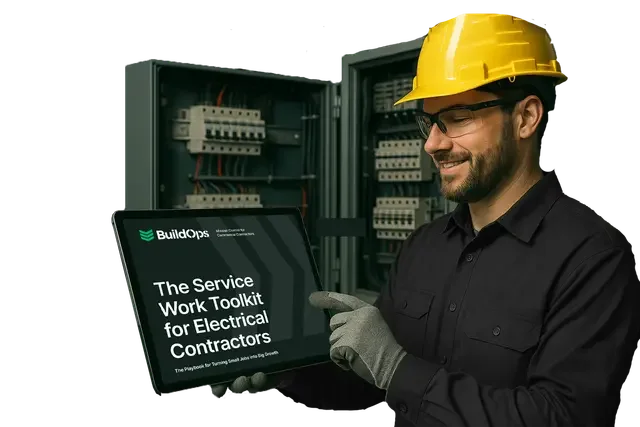
Get the electrical service work toolkit
Optimal processes and ready-made templates that help you execute better on your jobs
4. What are some best practices when using low voltage estimating software?
To get the most out of your software investment, here are proven practices that keep your quotes fast, accurate, and ready to execute:
- Set up labor rates and markups before you build your first estimate
- Use templates for common system types (like CCTV or badge access)
- Sync your estimates with job costing or scheduling tools
- Keep your material and pricing database updated weekly or monthly
- Train both office and field staff on how to review and use estimates
- Review won/lost quotes regularly to improve accuracy
- Build approval workflows so estimates don’t stall in inboxes
- Customize reports to track average margins, turnaround time, and quote volume
Did you know
BuildOps has many success stories of electrical services companies seeing significant improvements in their operational efficiency thanks to the features built right into our software. Check out their stories:
- Classic Electric: Scaled growth 300%
- Dane Electric: Cut invoicing time by over 30%
- Jolma Electric: A 50% leap in efficiency
Quoting low voltage jobs isn’t as simple as counting outlets or cables. You’re estimating labor for tech-certified installs, integrating devices across multiple systems, and balancing speed with precision. Manual tools, excel sheets, or general software not built to integrate quoting with other operations just don’t give you the control or clarity needed to compete in this field.
Whether you’re handling structured cabling, access control, fire alarms, or security systems, the right low voltage estimating software brings consistency to your quotes and momentum to your operations. And if your team operates in commercial spaces or manages multiple scopes under one roof, having everything—estimating, scheduling, invoicing—in one platform like BuildOps helps eliminate disconnects that slow down the job.
See how BuildOps eliminates spreadsheets
Quote faster, sync with other tools, and get more work approved