

Running a plumbing business without AI is like showing up without your tools. The right software streamlines scheduling, sharpens estimates, and cleans up reporting—so you save time, avoid mistakes, and protect your margins. The plumbing service industry is changing fast, and AI tools now come in many flavors. The key is picking the one that actually fits how your shop runs, because in this space, “one size fits all” doesn’t exist.
We’ll help you choose the right plumbing AI tool, evaluate key features, and review today’s top options. Here’s what we’ll cover:
- How to choose the right AI plumbing tools for your business type
- Top AI features to look for in plumbing tools
- 6 best AI plumbing tools for field service teams
- 4 best plumbing business, CRM, & sales software with AI features
- 3 best AI plumbing system design architecture & simulation software
- 7 benefits of using AI tools for plumbing service management
- 4 important plumbing AI tools FAQs answered
Pick plumbing software based on how well its AI actually powers your day-to-day field work—from dispatching techs to sending final invoices—so you end up with tools your team genuinely wants to use.
How to choose the right AI plumbing tools for your business type
AI-powered plumbing software tends to focus on specific operational areas, and not every tool is designed for every type of contractor. Before committing to a platform, here are some questions worth asking when evaluating your options:
- Cost – How much does the software cost per user, per month? Does pricing change based on annual vs. monthly billing? Is there a free trial or live demo available before you commit?
- Complexity – How steep is the learning curve for your office staff and field techs? Can your team realistically adopt it without weeks of downtime? Are there extra onboarding fees?
- Market specialization – Does the platform handle commercial plumbing work, or is it geared toward residential service calls? Can it manage multi-property accounts and long-term service agreements, or is it limited to one-off jobs?
- Onboarding and support – How hands-on is the vendor during setup and data migration? Do they offer ongoing coaching or just a help desk? Will they build custom workflows that match how your plumbing operation actually runs?
- Reviews – What are other plumbing contractors saying about the software on review sites? Are the complaints about things that would affect your day-to-day? How recent and credible are those reviews?
- Company size – Is the platform priced and featured for a five-person crew, a 50-tech operation, or both? Can you scale your subscription up or down as your headcount changes?
- AI capabilities across field operations – Does the AI actually connect to your dispatching, reporting, and invoicing workflows, or does it sit in a silo? Can it turn a tech's field notes into an estimate or invoice without manual re-entry? Does it factor in tech skills, location, and availability when suggesting dispatch assignments? How does it use job data over time to surface patterns — like recurring equipment failures or slow-paying accounts — that help you make better decisions across the business?
Top AI features to look for in plumbing tools
Evaluating AI plumbing platforms can be overwhelming, since they can handle everything from dispatch to invoicing. Some focus on a single task, while others bundle field management, CRM, and finances. To make comparison easier, we’ve grouped the key features into three categories, which we also use to rank the top AI tools for plumbers below.
Field service management & project management plumbing software features

Plumbing field service management handles day-to-day calls and dispatch, while project management software handles longer jobs like repipes and buildouts with multiple crews, materials, and milestones.
The features below make it easier to run both types of work with fewer gaps and less manual effort.
- AI-powered field operations – AI trained on commercial contracting workflows can refine field notes into clean summaries, scan nameplates and invoices, translate text for multilingual crews, and assist with real-time troubleshooting while a tech is on site. Platforms with embedded AI for field service reduce data-entry hours in the office, cut callbacks from incomplete documentation, and speed up turnaround from job completion to billing.
- Scheduling & dispatch – Plumbing software with field service scheduling and smart dispatching tools should give dispatchers a real-time board view of every tech's availability, certifications, and location. AI-assisted dispatch suggests assignments based on skill match, drive time, and current workload so your board stays balanced without constant manual adjustment.
- Technician mobile app – A dedicated technician mobile app puts dispatch details, customer history, asset records, and documentation tools in your techs' hands so they can receive assignments, write notes, capture photos, collect signatures, and push updates back to the office without returning to HQ.
- Invoicing & payments – Software with built-in invoicing and payment processing lets your office team or techs generate an invoice from completed work orders and offer customers multiple ways to pay on the spot. AI can auto-populate line items, labor hours, and material costs from a tech's field notes, cutting the gap between job completion and invoice delivery.
- Reporting & analytics – Best plumbing AI tools with strong reporting and analytics capabilities should track technician utilization, average service call value, first-time fix rate, time-to-invoice, and revenue by job type. AI-driven reporting surfaces patterns — like callback spikes at a specific property or a tech whose completion times are trending slower — so you can act on data instead of assumptions.
- Fleet tracking – Track vehicle locations in real time with fleet management software, which can also monitor fuel consumption, flag maintenance needs before breakdowns happen, and help dispatchers route the nearest available truck to an emergency call. That visibility translates to lower fuel costs, fewer missed appointments, and better estimated arrival times.
- Time tracking – Time tracking tools capture clock-in and clock-out at each job site — ideally through GPS or geofencing — so you know exactly how long each tech spent on every call, in transit, and on break. That data feeds directly into payroll calculations, overtime monitoring, and job costing.
CRM & sales plumbing software features

Sales and CRM software helps you win new plumbing customers and keep existing ones. Sales tools target property managers, GCs, and facility owners, while CRM tools store contacts, service history, property details, and communication logs so your team finds what they need in seconds.
- Field service CRM – Commercial plumbing customers often manage multiple properties, each with different contacts, access requirements, and service histories. A field service CRM lets you see customer hierarchies at a glance — which properties belong to which account, who to call at each location, and what work has been done where.
- Service quoting – Service quoting software lets your team build professional proposals from standardized pricing, material costs, and labor rates — then send them for approval without bouncing between multiple tools. AI can pull relevant data from past jobs with similar scope and pre-fill line items so your estimator refines a draft instead of starting from scratch.
- Service agreements – Service agreement management tools help you build, track, and renew maintenance contracts — automatically scheduling preventive visits, sending renewal reminders, and flagging agreements about to lapse. For plumbing contractors managing dozens of commercial accounts, that automation prevents contracts from falling through the cracks and keeps recurring revenue predictable.
Plumbing system design, architecture, & simulation features

System design and simulation software lays out plumbing, sizes fixtures, and models performance before work starts—especially valuable on new builds, major retrofits, and complex commercial jobs where design mistakes are costly.
- Flow & pressure calculation – Determining water flow rates, pressure drops, and pipe sizing for a building is foundational to plumbing system design. Software should account for fixture count, building height, supply pressure, pipe material, and local code requirements so your engineers can validate designs before installation begins.
- Pipe layout & routing – How supply and waste lines are routed through a structure affects material costs, labor hours, and long-term serviceability. Design tools that let you visualize pipe runs in 2D or 3D help catch conflicts with other trades early — before a plumber is cutting into a wall that an electrician already ran conduit through.
- Material & inventory planning – Once a design is finalized, you need to know exactly what fittings, pipe lengths, valves, and fixtures are required — and whether you have them in stock. Software that compares a bill of materials against your current inventory helps prevent mid-job supply runs that kill productivity.
- Simulation & troubleshooting – Being able to model how a plumbing system behaves under different conditions — peak demand, partial blockages, temperature swings — lets you test designs for efficiency and diagnose problems remotely. That capability reduces truck rolls for diagnostic-only visits and helps your team show up with a plan instead of a question mark.
Your role in plumbing should drive your software choices: service plumbers might skip advanced design or simulation tools, while commercial construction bidders often rely on them—so focus your budget on the features you’ll actually use.
6 best AI plumbing tools for field service teams
Field service and project management software streamline plumbing operations—from scheduling and dispatch to estimates, coordination, and invoicing. Here are the top AI tools for plumbers and field service teams.
1. Best for commercial field service teams: BuildOps

BuildOps is the only field service platform built exclusively for commercial plumbing contractors. From complex portfolios to multi-site service agreements, every feature is designed to help you manage the unique demands of commercial clients. Easily search and organize all assets across every property under a single customer, and instantly see who the point of contact is at each location so your team always knows exactly who to call and where to go.
In the field, the BuildOps mobile app keeps your techs moving. Real-time dispatching gets the right plumber on the right job fast, while AI-powered notetaking eliminates time wasted on paperwork. OpsAI—our embedded AI engine trained specifically on commercial contracting workflows—understands dispatch strategies, service billing rules, and project profitability out of the box. It turns rough field notes into clean summaries, reads nameplates and invoices, translates for multilingual crews, and even assists with on-site troubleshooting so your techs can stay focused on fixing the problem, not fighting the software.
Industry Specialization: Commercial
How Pricing Works: BuildOps pricing is based on the size of your team and the features your business needs, so you only pay for what you actually use.
What Sets It Apart: Built-in customer hierarchies that organize and display assets split between multiple properties managed by the same customer, knowing what work needs to be done, on which property, and who needs to be notified about it, which is especially useful for commercial-scale and larger projects.
Key Features for Commercial Plumbing Teams:
- AI-powered, real-time, Smart Dispatching that makes suggestions based on tech skills availability
- Nameplate scanner lets you snap a photo of a plumbing unit, and the app will fill in the serial number and other details for you
- Integrates with Enterprise ERP tools like Quickbooks, Vista, and Sage
Rating: 4.5 on Capterra from 151 user reviews
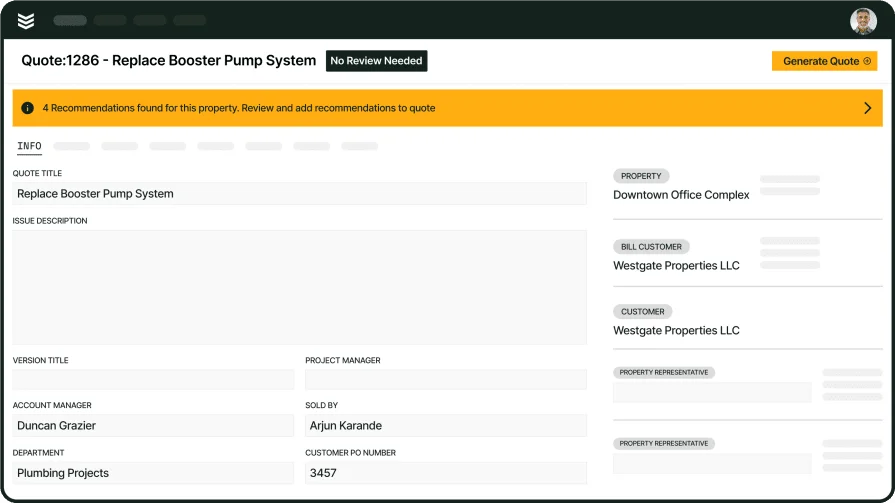
Commercial plumbing, done faster with AI
Quote, schedule, and bill every job in one AI-native system, with BuildOps
2. Best for residential plumbing service teams: Jobber

Image Source: Jobber
Jobber is a plumbing software system for residential contractors, helping them manage their operations while growing their plumbing business. You can automatically follow up with customers to get quick responses about appointments and invoices, and easily sync timesheets for payroll, customer management, invoicing, and payment — so everything is working together. Among the best plumbing AI tools geared toward residential work, Jobber keeps the interface simple while covering the scheduling, quoting, and payment workflows that smaller crews rely on daily.
Industry Specialization: Residential
How Pricing Works: Monthly subscription based on the number of users and features
What Sets It Apart: Exclusively geared towards residential contractors and home services
Key Features for Residential Plumbing Teams:
- Customers can easily book jobs with you online, with Jobber doing the rest of the scheduling work
- Whether they're for your clients or just your team, build intuitive job forms and checklists to make sure you finish all tasks on time
Rating: 4.6 on Capterra from 1420 user reviews
3. Best for general contractors that offer plumbing services: Service Fusion

Service Fusion is an all-in-one FSM software designed for both residential and commercial businesses. It enables you to manage your jobs, as well as your entire fleet with GPS tracking. This gives you added visibility over your vehicles so you can reduce fuel costs and maximize the efficiency of your fleet at all times. For plumbing contractors who also handle other trades or general contracting work, Service Fusion consolidates dispatching, estimates, and fleet management into a single dashboard.
Industry Specialization: Residential and Commercial
How Pricing Works: Monthly subscription based on included features
What Sets It Apart: GPS tracking for advanced fleet management
Key Features for Plumbing General Contractors:
- Easily schedule your construction jobs from a single dashboard, and then dispatch them when it's time to start the project
- Don't just track which job site your vehicles are at with GPS tracking, but actually analyze downtime and fuel efficiency to get the most out of your fleet
Rating: 4.3 on Capterra from 290 user reviews
4. Best for small and medium-sized plumbing service businesses: Sera

Image Source: Sera
Sera is a newer plumbing software platform that was built to help small and medium-sized contractors streamline operations without being overwhelmed by too many program features. It offers simple yet powerful scheduling, dispatching, fleet management, invoicing, and financial functions. Hands-on customer service gets you started quickly, so you spend less time learning how to use the software and more time learning how to be successful with it. That said, Sera's feature set is geared toward residential crews, so commercial plumbing contractors managing multi-property accounts or large-scale projects may find it lacks the depth they need.
Industry Specialization: Residential
How Pricing Works: $399/month for a team of up to 4 technicians, additional tech seats can be purchased for $149/month
What Sets It Apart: Fast and easy onboarding with dedicated training, data migration, and business coaching support
Key Features for Plumbing Teams:
- Batch invoicing, automated customer appointment reminders, and custom templates for contacting clients
- Plenty of available integrations for added functionality while keeping the base software lean
Rating: 4.4 on Capterra from 23 user reviews
5. Best for managing subcontractors: Tradify

Image Source: Tradify
Tradify covers the essentials of plumbing field service management: inquiries, quotes, scheduling, job tracking, invoicing, and receiving payments. It also has some handy functions at higher price tiers, such as integrating subcontractor schedules into your master calendar, or instantly digitizing invoices by taking photos of them. Tradify can even help you build a website that can connect to their platform in minutes. However, Tradify lacks embedded AI capabilities and advanced reporting, which means plumbing contractors looking for AI-driven dispatching or automated document creation will need to look elsewhere.
Industry Specialization: Commercial
How Pricing Works: Tier-based monthly per-user subscription, and free trial available
What Sets It Apart: Pro and Plus tiers have dedicated tools for coordinating subcontractors' schedules
Key Features for Plumbing Subcontractors:
- Integrates with Google Calendar to make lining up your schedules easy
- Cloud-based software gives anyone on your team access to the information they need, anywhere
Rating: 4.7 on Capterra from 152 user reviews
6. Best for home services: mHelpDesk

Image Source: mHelpDesk
mHelpDesk is an FSM solution designed for a series of residential field services, including plumbing, home cleaning, landscaping, painting, and even computer repair. Intuitively schedule service for your customers and manage dispatch for those jobs. Stay in contact with customers by communicating with them about their appointments. Because mHelpDesk spreads its focus across many home service verticals, plumbing contractors who need trade-specific features — like asset tracking across commercial properties or AI-powered field notes — may find the platform too generalized for their operation.
Industry Specialization: Residential
How Pricing Works: Contact them for a private quote
What Sets It Apart: Supports a wide range of home-related field services, including landscaping and cleaning
Key Features for Plumbing & Home Services Contractors:
- Lead management enables you to close more leads and take on more projects, as well as maximize your outreach efforts
- Job quotes provide more accurate estimates for the projects you're working on, and pre-built templates make them easy to create
Rating: 4.3 on Capterra from 823 user reviews
4 best plumbing business, CRM, & sales software with AI features
CRM & sales software focuses on the customer-oriented aspects of your plumbing company: how do you get new clients, and how do you offer exceptional service to keep the ones you already have? The options below have some of the best features for those two purposes.
7. Best for sales management: Buildertrend

Image Source: Buildertrend
Buildertrend is a customer and sales management software for construction professionals, designed to help them capture and close more leads. Craft customized proposals that help you nurture leads and get closer to greenlighting your proposals. Connect with prospects with targeted email marketing efforts that show them you understand — and can help them accelerate — their business. Keep homeowners involved in the process with clear lines of communication, helping you maintain a great relationship with clients and helping them achieve results. However, Buildertrend is primarily geared toward home builders and remodelers, so plumbing contractors managing commercial service contracts or high-volume dispatch operations may find it lacks the trade-specific depth they need.
Industry Specialization: Home builders & Remodelers
How Pricing Works: Monthly subscription model (starting at $499/mo)
What Sets It Apart: Nurture lead funnels with email marketing and targeted proposals
Key Features for Sales Teams:
- CRM hub connects you with everything you need to create, capture, and track leads
- Draft contract proposals and execute outreach using email marketing
- Daily logs allow techs to track construction job progress with a record of the work
Rating: 4.5 on Capterra from 2483 user reviews
8. Best CRM for residential contractors: Housecall Pro

Image Source: Housecall Pro
Housecall Pro is a CRM and sales solution built for residential contractors and home service businesses. It specializes in HVAC, plumbing, electrical, and cleaning services. The platform offers advanced reporting, invoice tracking, and accounting tools that make it easy to manage all aspects of the customer relationship. That said, Housecall Pro is designed around residential workflows, so commercial plumbing contractors managing multi-property accounts or complex asset hierarchies may find the platform too limited for their operation.
Industry Specialization: Residential Contractors
How Pricing Works: Monthly subscription based on the number of seats you'll use
What Sets It Apart: Features that cater towards residential contractors
Key Residential CRM Features:
- Use pipeline management to intake and manage customers more effectively, automating the process from estimate through to invoice
- Creates engaging sales proposals that lead to more closed contracts
- Boosts upsell success to increase job ticket sizes
Rating: 4.7 on Capterra from 2737 user reviews
Make sure to check out our comparison of Housecall Pro vs BuildOps right here to see which one is the better fit for your HVAC team.
9. Best for tender management: Procore

Image Source: Procore
Procore is an FSM platform designed for general contractors and specialty subcontractors. Among its notable features are pre-construction tools that facilitate accurate and professional-looking proposals. Make bidding for jobs — and transitioning from bid management to project management — easier with financial integrations, templates, filters, and AI automations. For plumbing subcontractors competing on commercial bids, Procore's AI-assisted takeoff and filtering tools help move between pre-project phases quickly. However, Procore is built primarily for general contractors and large-scale construction management, so plumbing companies focused on day-to-day service calls and dispatching may find the platform overly complex for their needs.
Industry Specialization: General and Specialty Contractors
How Pricing Works: Contact them for a custom quote
What Sets It Apart: Financial features and integrations make shift from estimates to proposals to budgets easy
Key Features for Tender Management:
- Integrates with over 15 accounting integrations (and over 500 apps in total) to get sales & CRM tasks done faster and easier without needing separate platforms
- Use AI and filtering tools to properly count items, view material/labor rates, and format documents so you can move between pre-project phases quickly and seamlessly
Rating: 4.5 on Capterra from 2656 user reviews
10. Best for inventory management: ServiceTrade

Image Source: ServiceTrade
ServiceTrade is an end-to-end FSM solution that helps commercial contractors with office coordination, sales management, and inventory management. Increase visibility into jobs for all team members, from office admin to field service technicians, ensuring everyone is in the loop. ServiceTrade improves operational efficiency and effectively manages your inventory so you always have the parts you need, and your technicians aren't waiting on materials to complete jobs. While ServiceTrade handles commercial workflows well, it lacks embedded AI capabilities for automated notetaking, smart dispatching, or document generation — features that many of the best AI tools for plumbers now include as standard.
Industry Specialization: Commercial
How Pricing Works: Subscription pricing based on the number of seats you need
What Sets It Apart: Inventory management solutions that ensure your technicians always have the parts they need
Key Features for Inventory Management:
- Tracks jobs with absolute precision using timecards, helping you limit unnecessary office visits and estimate future jobs with even better accuracy
- Forecasts the parts you'll need so you can keep your inventory fully stocked, without running into overstock issues and limiting available storage
Rating: 4.6 on Capterra from 339 user reviews
3 best AI plumbing system design architecture & simulation software
Design and simulation software helps plan plumbing systems and ensure they work properly, from layout and flow calculations to troubleshooting—with top AI tools supporting these tasks.
11. Best for plumbing drafting and drawing: Tejjy

Image Source: Tejjy
Tejjy is a leading property and facility management company in the architecture, engineering, and construction (AEC) sector. They offer MEP (mechanical, electrical, and plumbing) drafting and drawing for plumbing, HVAC, electrical, and fire protection. They can also do BIM consultation services, including modeling, fabrication, assembly, and installation. For plumbing contractors involved in new construction or major retrofits, Tejjy's BIM-driven approach helps catch coordination conflicts with other trades before they become costly rework on site.
Industry Specialization: Architectural Design & Engineering
How Pricing Works: Contact them directly for a quote
What Sets It Apart: Specialization in BIM consultation and design services
Key Features for Drafting & Drawing:
- Get precise mechanical, electrical, plumbing, and fire protection drawings that help with fabrication, assembly, and installation
- In-house 3D scanning
- Create MEP designs that account for variable conditions in residential, commercial, and infrastructure projects
Rating: 4.8 on Goodfirms from 3 user reviews
12. Best for plumbing design and planning: Flatworld Solutions

Image Source: Flatworld
Flatworld Solutions specializes in plumbing and HVAC design for both residential and commercial industries, servicing homes, buildings, commercial properties, and hotels. With plumbing modeling and pipe layout design services, they find the best fit for your space by accurately calculating flow requirements and fitting the ideal system. This gives you adequate water distribution without overspending. However, Flatworld Solutions operates as a design services firm rather than a software platform, so plumbing contractors looking for AI-driven automation or field service integration will need to pair it with a separate operational tool.
Industry Specialization: Residential & Commercial
How Pricing Works: Contact them to request a quote
What Sets It Apart: Focus on delivering high-efficiency plumbing installations through cutting-edge designs
Key Design & Planning Features:
- Services a range of commercial plumbing installations, emergency repairs, and routine maintenance
- Specializes in designing residential plumbing systems that deliver reliable, consistent results
Rating: 4.7 on Clutch.co from 23 user reviews
13. Best for plumbing engineering: TrueCADD

Image Source: TrueCADD
TrueCADD is a leading CAD company that specializes in CAD engineering services and BIM (building information modeling) design and 3D modeling. As part of their service offerings, they provide plumbing design and development, load calculation, 2D drawings, 3D modeling, and pipe sizing & layout planning. They help teams choose plumbing systems that are compliant with code, energy-efficient, and suitable for the building & use case. Like Flatworld, TrueCADD is an engineering services provider rather than a field operations platform, so it lacks embedded AI for dispatching, notetaking, or invoicing — capabilities that many of the best plumbing AI tools now offer as standard.
Industry Specialization: Industrial
How Pricing Works: Contact them to request a quote
What Sets It Apart: Multidisciplinary engineering company that specializes in BIM and mechanical engineering
Key Plumbing Engineering Features:
- Spatially plan the assembly, fabrication, and piping to ensure you install the best layout for the plumbing system
- Design and draft schematics for water supply and drainage systems
- Create final documentation and specifications for finalizing equipment development
Rating: Not yet rated on any popular software rating websites
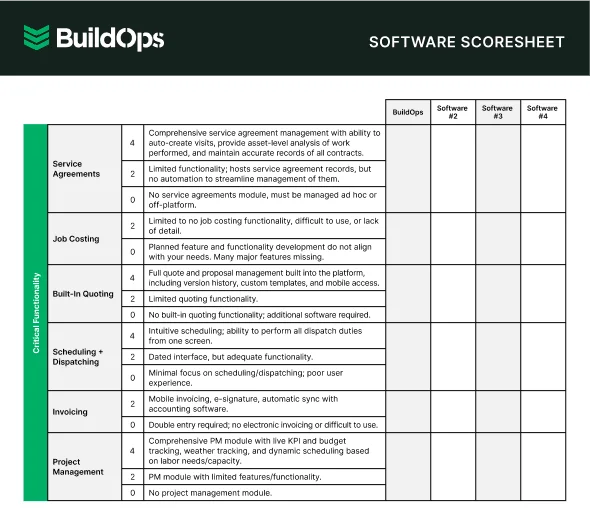
Get the software scoresheet
Compare top tools at a glance with this easy-to-use scoresheet.
7 benefits of using AI tools for plumbing service management
Here are some of the top ways you stand to see ROI on an investment in AI-powered plumbing software.
1. Increased productivity
AI-powered plumbing software replaces error-prone paper and spreadsheets, streamlining your operations so you spend less time on admin and more time completing jobs and winning new business. Contractors looking to scale with AI and automation in field service management are seeing measurable gains in how many jobs their teams complete per week without adding headcount.
2. More efficient scheduling & dispatching

Scheduling and dispatching must balance workloads and match qualified techs to each job. AI plumbing tools automatically assign work based on skills, certifications, location, and capacity to keep your schedule balanced. An AI field service assistant can reshuffle the entire day's schedule in seconds when an emergency call comes in or a customer cancels, without your dispatcher picking up the phone.
3. Faster, more accurate invoicing
AI plumbing software turns techs’ notes into draft invoices in minutes, so you get paid faster. Contractors who tighten up their plumbing invoicing process and send invoices within seven days of job completion get paid up to 70% faster than those who wait longer.
4. Better customer relationships

Plumbing software with CRM tools keeps customer info organized and accessible, so you can respond faster, troubleshoot better, and plan tailored maintenance. A CRM for plumbers that tracks service history and automates follow-ups keeps your pipeline full and ensures repeat customers never feel forgotten.
5. Stronger quoting and proposal workflows
Winning work depends on getting accurate quotes to customers quickly — and AI can speed that up significantly. Plumbing quoting software lets your team build professional proposals from standardized pricing and send them for approval in one place, with AI pre-filling line items from similar past jobs so estimators refine instead of start from scratch.
6. Broader visibility into business performance
A central source of information lets you analyze company-wide metrics like technician utilization, average ticket value, time-to-invoice, and revenue by job type. Among the best AI tools for plumbers, platforms that leverage agentic AI in field service spot hidden trends—like callback spikes or slowing techs—so you can act on data, not assumptions.
7. Reduced operational costs
Most plumbing software isn’t free, but it can save you more than it costs. AI-powered tools track inventory, optimize routes, and streamline dispatch to cut waste in equipment, fuel, and labor—then keep improving as they learn your operation.
4 important plumbing AI tools FAQs answered
If we haven't answered all of your questions yet, here are answers to a few other key questions that will hopefully give you the information you need.
If we haven't answered all of your questions yet, here are answers to a few other key questions that will hopefully give you the information you need.
1. What is AI-powered plumbing software & how does it work?
AI-powered plumbing software is a field service platform built to run your operations end to end — scheduling, dispatching, estimating, invoicing, reporting, and CRM — with embedded intelligence that automates decisions and eliminates busywork across your workflow.
Some solutions focus on a single workflow, while others bring field operations, customer management, and financials together in one connected system. The right fit depends on your team’s size, mix of services, and whether you focus on residential, commercial, or both.
2. What does a typical job workflow look like in an AI-powered plumbing platform?
AI-powered plumbing software runs on a central desktop and mobile platform, so techs, dispatchers, and office staff can work from anywhere.
Here’s what the typical workflow looks like:
- New customer details are captured in the CRM.
- Dispatch assigns a tech, who records notes and photos on-site.
- Office generates and sends a quote; once approved, the job is scheduled.
- Fleet tracking and route optimization get the tech to the job on time.
- The tech follows custom checklists and workflows in their mobile app.
- Field notes are automatically converted into an invoice summary and sent to the customer with payment options.
- Custom dashboards update in real time so leadership can review performance and improve operations.
3. Is AI-powered plumbing management software worth the cost?
AI tools for plumbers usually pay for themselves fast by automating manual work and reducing errors in scheduling, invoicing, and reporting.
Pricing typically depends on:
- How many employees need access (often priced per user)
- Which tier you choose (basic vs. advanced features like AI dispatching and custom workflows)
- Whether you add premium support such as onboarding, data migration, or ongoing coaching
4. What are the best practices for getting the most out of AI tools in a plumbing operation?
Installing the platform is easy; rolling it out across your whole team takes intention. Plumbing AI only delivers full value when everyone uses it as designed. Here are 10 best practices to make that happen:
- Consolidate your tools into one platform before adding AI.
- Automate the biggest time drains first: dispatching, invoicing, field reports.
- Train dispatchers and office staff on AI workflows before techs.
- Turn on AI dispatching from day one for skill- and location-based assignments.
- Require the mobile app for all field notes, photos, and signatures.
- Tie automated invoicing to completed work orders for same-day billing.
- Give each role a custom dashboard with their key metrics.
- Review AI insights monthly and fix issues before they hit margins.
- Integrate your plumbing platform with accounting early to avoid double-entry.
- Use your vendor’s support as a strategic partner for reports and workflows.
AI-powered plumbing software can overhaul everything from scheduling and dispatch to design and customer management. The right platform depends on your work mix, crew size, and how much you want to automate.
The best plumbing AI tools all do the same thing: cut manual busywork, surface real-time data, and connect your field and office so nothing slips between a work order and the final invoice.
If you run commercial service or project work, BuildOps is the only platform built specifically for commercial contractors — with AI baked into dispatching, field reports, invoicing, and CRM so your whole operation runs on one system.
Want to see it in action for a crew like yours? Book a demo and we’ll walk you through it.
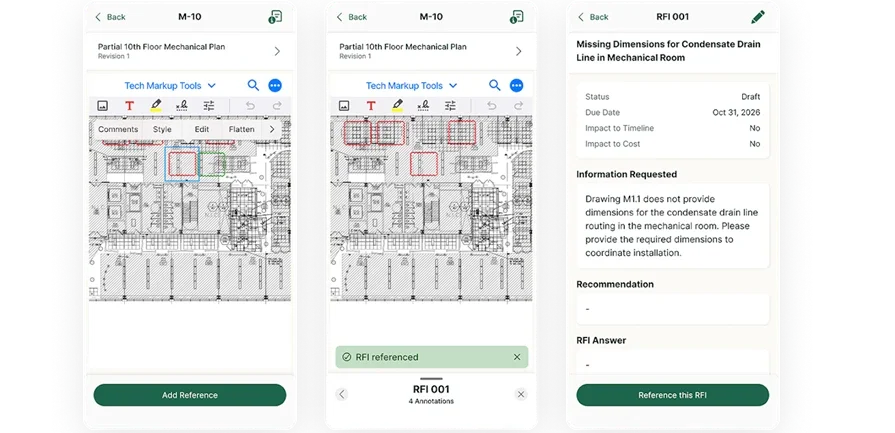
Plumbing service unified in one AI-native platform
See how we tie scheduling, mobile, assets, and billing into a single AI-native workflow