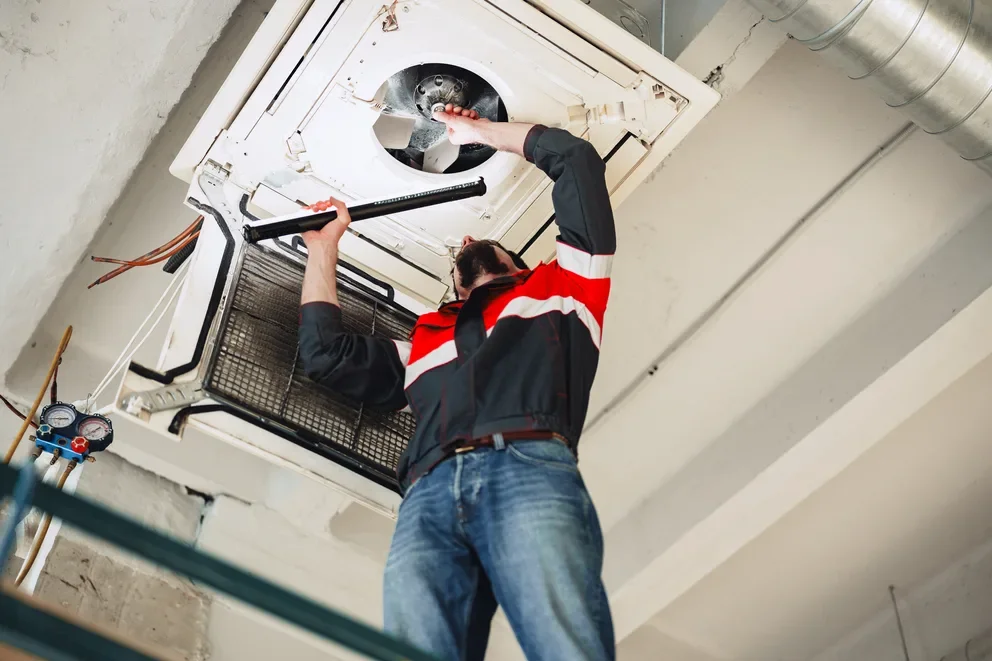
You know the drill: a customer calls about an unexpected equipment failure and you scramble schedules to get a tech on site.
Reactive maintenance work keeps the lights on, but it’s unpredictable. Staffing needs change daily and your cash flow depends on the next emergency call.
Selling service agreements changes that.
Instead of waiting for breakdowns, you build a structured preventive maintenance system with a clear maintenance schedule that keeps critical equipment running and turns unpredictable service calls into scheduled maintenance.
In this guide, we’ll show you how to build and sell a preventative maintenance contract so you can lock in day-to-day stability and generate recurring, high-margin revenue. We'll cover:
- Understanding preventive maintenance programs: the essentials
- 3 types of preventive maintenance you can sell to your customers
- How to develop and implement an effective preventive maintenance program
- 5 preventive maintenance strategies, best practices, & tips to optimize your program
- How to track the ROI of your preventive maintenance program
- How to sell more preventive maintenance contracts to your customers
- Using tools to help with your preventive maintenance program
Understanding preventive maintenance programs: the essentials
If you want to sell maintenance contracts consistently, you need a clear structure behind them. That starts with understanding what a proactive maintenance strategy actually includes.
What is a preventive maintenance program?
A preventive maintenance program is a planned, repeatable system for inspecting, servicing, and replacing parts before equipment fails.
It's built around several key elements:
- Assets – the equipment your team is maintains
- Maintenance schedules – when service visits happen
- Preventive maintenance tasks – the specific work performed during each visit
- Service intervals – how often inspections and maintenance occur
- Documentation – records of work performed and equipment condition
- Follow-up actions – repairs, parts replacement, or upgrades identified during maintenance
The goal is straightforward: reduce downtime, catch issues early, extend equipment life, improve safety, and make service work more predictable for both you and your customer.
When done right, that structure turns routine service into long-term customer relationships and a steady stream of pull-through work.
Preventive vs preventative vs proactive vs predictive maintenance programs

Terms like preventive, predictive, and proactive maintenance are often used interchangeably, which can create confusion. They all aim to prevent failures, but each approach works a little differently and relies on different levels of data, monitoring, and planning. Understanding the differences helps you explain your services and pricing tiers to customers clearly.
- Preventive / preventative maintenance – These terms mean the same thing. Both refer to scheduled service performed at regular intervals (such as inspections, testing, and part replacements) to prevent failures and extend asset life.
- Predictive maintenance – Maintenance triggered by equipment condition data, inspections, or monitoring that anticipate equipment failures and detect early warning signs before breakdowns occur.
- Prescriptive maintenance – Advanced analytics or AI recommend the specific corrective maintenance task and timing needed to prevent a failure.
All of these approaches fall under the umbrella of proactive maintenance strategies because they aim to prevent failures before they disrupt operations.
Most service teams use a combination of them: preventive maintenance provides the foundation, while predictive monitoring, prescriptive insights, and root-cause improvements add deeper protection for critical equipment.
What is the purpose of a preventive maintenance program?
For your customer, the goal of preventive maintenance work is simple: avoid expensive surprises. Instead of waiting for equipment failure and emergency repairs, regular maintenance keeps systems running and problems manageable.
The exact scope of what the contract covers will depend on the facility type and equipment, but these are some common preventive maintenance examples:
- HVAC inspections and seasonal tune-ups
- Electrical systems inspection and thermal scans
- Generator testing and backup power checks
- Fire and life-safety system inspections
- Pump and motor lubrication or alignment checks
- Filter, belt, and other wear-part replacements
There are many benefits of preventive maintenance, and one of the biggest is reducing unplanned downtime. Preventive maintenance processes can cut unplanned downtime by 30–50%, helping facilities avoid costly interruptions.
It also catches issues earlier. Fixing a worn component during a scheduled visit is quick and inexpensive, but waiting until it runs to failure requires costly emergency repairs that run 50–100% higher than normal service rates.
Over time, preventive maintenance can also extend equipment lifespan by up to 40%, improve compliance, reduce safety risks, and make operating costs far more predictable.
Why selling preventive maintenance contracts to your customers is important
Service and maintenance are where long-term revenue really lives. Selling a preventive maintenance contract helps you capture more of that spend by turning one-time jobs into ongoing service relationships.
A strong preventive maintenance plan creates several advantages for your business:
- Predictable recurring revenue – A preventive maintenance contract gives you planned work, steadier cash flow, and more reliable service income instead of depending on emergency repairs and reactive maintenance.
- More repair and replacement work – Scheduled visits, inspections, and preventive maintenance tasks help your team catch issues early. Those documented deficiencies turn into repair quotes, and maintenance customers often generate additional service work over time. In many cases, every $1 of maintenance contract value generates $1–$3 in additional repair revenue.
- Better customer retention – A consistent preventive maintenance schedule keeps you in front of the customer, strengthens trust, and makes it easier to win follow-up repair, replacement, and service work.
- Higher business value – Contractors with structured service divisions can see up to 3× higher profit margins, and a strong base of preventive maintenance contracts increases the long-term value of the business.
Did you know
As Fred Sargent, president of Great Service Forums, explains: “Over a lifetime of a building, there’s 4x as many dollars spent on the service and maintenance of it as there was in the original construction.”
3 types of preventive maintenance you can sell to your customers
Not every customer needs the same approach. The right strategy depends on the equipment, type of facility, and how costly downtime would be for that operation.
Most commercial service agreements combine several types of preventive maintenance rather than relying on just one.
1. Time-based maintenance (calendar-based)
Time-based maintenance follows a fixed schedule such as monthly, quarterly, or annual visits. Service happens at set intervals regardless of equipment usage. This is the most common starting point because it’s easy for customers to understand and simple to manage.
2. Usage-based maintenance (meter-based)
Usage-based maintenance triggers service based on runtime or operating activity rather than calendar dates. Maintenance happens after a certain number of hours, cycles, or miles. This works well when equipment wear depends more on how often it runs than how much time has passed.
3. Condition-based maintenance
Condition-based triggers service when inspections or monitoring show signs of wear or declining performance. Instead of servicing equipment on a fixed schedule (which can lead to over maintenance), technicians act when the equipment condition indicates a potential issue.
How to develop and implement an effective preventative maintenance program
Building a strong preventive maintenance offering takes more than scheduling a few service visits. The sections below cover the basic steps in developing a preventive maintenance agreement that keeps equipment reliable, avoids costly repairs, and keeps service operations organized as your customer base grows.
1. Start with your current customer base
The easiest place to start selling preventive maintenance is with customers you already work with. You have a 60–70% probability of selling to an existing customer and a 5–20% of selling to a new customer.
Why? Your current and past customers already trust your team and rely on you to keep their systems running. That makes it easier to position a service contract as a cost effective way to reduce maintenance costs, prevent failures, and protect the asset life of their equipment.
Review your existing accounts and look for patterns that signal opportunity. Customers with aging equipment, frequent repair calls, or buildings where your team installed new systems are strong candidates for a maintenance agreement.
Once you identify those accounts, offer a site walk or asset review to evaluate the equipment and identify maintenance needs, then propose a starter maintenance agreement based on what you find.
2. Build a complete asset list

Every effective preventive maintenance contract starts with a complete asset inventory. It's important to make this comprehensive. Missing equipment leads to underpriced contracts, skipped inspections, and inefficient scheduling. That can kill your margins and also make customers less likely to renew contracts with you.
To build and maintain a good asset inventory:
- Perform a site walk to identify all maintainable assets in the facility
- Document equipment details (see list below)
- Capture photos to reduce entry errors
- Organize assets by building area or system type to simplify scheduling
- Store asset data in a centralized system accessible to maintenance teams
- Update the inventory whenever equipment is added, replaced, or removed
These are the details your team needs to inspect and maintain each piece of equipment:
- Asset type (HVAC unit, electrical panel, generator, pump, etc.)
- Manufacturer and model/serial numbers
- Equipment location within the facility and the area it serves
- Installation date or approximate equipment age
- Maintenance history and recommended service frequency
- Specific maintenance tasks required
- Estimated labor hours per inspection
- Required consumables or parts (filters, belts, lubricants)
- Key performance readings (voltages, pressures, temperature splits)
3. Focus maintenance where failure actually matters
Not every piece of equipment needs the same level of attention. Some systems have a direct impact on safety, operations, or compliance, while others cause minimal disruption if they fail. Treating every asset the same can over maintenance in some areas and leave higher-risk systems exposed.
Start by identifying and prioritizing critical assets. These systems should receive deeper inspections or more advanced monitoring, while lower-risk equipment can stay on a simpler, time-based schedule.
From there, focus on optimizing maintenance schedules. Start with manufacturer guidance, then adjust based on service history, operating conditions, and technician input.
4. Define the scope of work
A preventive maintenance contract only works if the scope is clear. The customer needs to understand what they’re paying for, and your maintenance personnel need a consistent set of tasks they can perform every visit. When the scope is vague, contracts can turn into margin killers because extra work gets folded into routine service.
Define exactly what the maintenance includes. That means outlining the specific maintenance tasks performed, how often visits occur, and which materials are included. It should also explain what is not covered—such as repair work, major component replacement, or after-hours service—so there’s a clear line between included maintenance and billable repairs.
5. Standardize tasks with checklists and SOPs

Standardization is what turns preventive maintenance from “whatever that tech remembered to do” into a consistent, repeatable process. When every technician follows the same preventive maintenance checklist, the quality of the work stays consistent and customers get the service they expect.
Create checklist templates for each equipment type your team services. Include step-by-step procedures, safety notes, and the specific maintenance tasks technicians need to do during each visit. Record the same readings, photos, and notes every visit so inspections stay consistent and easy to review.
6. Build the pricing model
Preventative maintenance pricing shouldn’t be guesswork. The price needs to reflect the actual cost to deliver the service and still leave room for your target margin.
When building your pricing model, account for:
- Labor hours required per visit
- Visit frequency per year
- Materials included (filters, belts, lubricants, etc.)
- Administrative time for scheduling, reporting, and communication
- Target margin for the agreement
You can structure pricing in several ways:
- Flat monthly or annual contract – Best when visits happen on a predictable schedule and the customer wants stable budgeting.
- Per-visit pricing – Useful for smaller agreements or when the number of visits varies year to year.
- Tiered plans – Works well when offering multiple service levels, such as basic inspections versus predictive maintenance.
7. Create the agreement itself
The maintenance agreement should clearly spell out how the service works. If the details are vague, misunderstandings show up later when work starts happening in the field.
At a minimum, the agreement should define:
- Term length
- Billing cadence
- Scope of work
- Exclusions
- Service level expectations
- Response times
- Renewal terms
- Customer responsibilities
- Documentation and reporting commitments
Before signing, walk through the agreement with the customer and review the details together. That way everyone knows exactly what’s included and how the service will run.
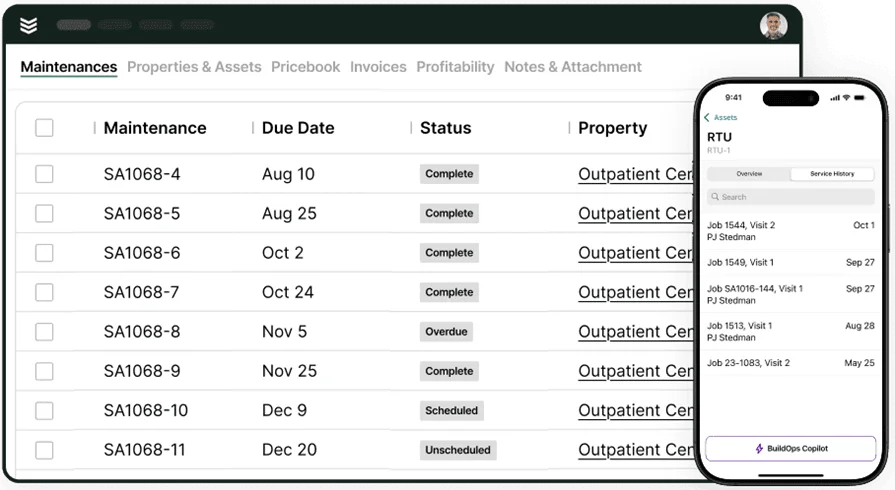
Automate recurring revenue with BuildOps
Our Service Agreements features are built to handle commercial-scale recurring projects.
5 preventive maintenance strategies, best practices, & tips to optimize your program
Preventative maintenance agreements work best when you actively refine them over time. The strategies below focus on improving performance, showing customers the value of the work, turning inspections into repair opportunities, and keeping contracts renewing year after year.
1. Show customers the value of the work
Customers renew maintenance agreements when they clearly see what they’re getting. If the work happens quietly in the background with little documentation, customers overlook the value.
After each visit, send a short report showing the work completed, key readings, and recommended next steps. Over time, these reports create a record that shows how regular maintenance prevents failures and keeps systems running.
You can strengthen that message by tying the work directly to the problems the customer cares most about. Their priorities usually depend on the type of facility they have:
- Healthcare – Emphasize how maintenance protects uptime, redundancy, and life-safety systems that cannot fail
- Education – Highlight work your team completes during shutdown windows and how it prepares buildings for the next semester
- Hospitality – Show how maintenance protects guest comfort and prevents disruptions that affect reviews and brand standards
- Manufacturing – Connect the work to production uptime and avoiding costly downtime
Provide annual equipment summaries or asset health reviews to reinforce the value. Show the inspections your team performed, the issues they caught early, and the equipment that may need attention next so customers can plan repairs and budgets ahead of time.
2. Turn maintenance visits into profitable repair work
Preventative maintenance visits often uncover far more work than the inspection itself. In many service businesses, contractors see roughly a 3:1 ratio for pull-through revenue.
In practical terms, that means a $2,000 maintenance contract can typically generate around $6,000 in related repair work. Capturing that value requires a clear system for turning field findings into approved jobs.
To lock in that pull-through work:
- Document deficiencies clearly with photos, readings, and technician notes so the customer understands the issue.
- Create quotes immediately on site so the repair gets lined up before the technician leaves the job.
- Make approval easy with digital signatures so the customer can approve the quote and issue a PO quickly.
3. Focus on contract renewals
Renewals don’t happen automatically just because the service went well. If you want contracts to continue year after year, you need a clear process for tracking agreements and closing renewals before they expire.
Start by structuring the contract to support renewal. Many contractors include automatic renewal terms with a defined cancellation window—usually 30 to 60 days before expiration—so agreements don’t quietly lapse while everyone is focused on day-to-day service work.
Then build a simple renewal workflow. About 90 days before the agreement expires, send the customer a one-page summary that shows the visits completed, issues caught early, and the overall condition of the equipment.
Don't overwhelm them with technical details. The goal is to remind them, at a glance, why the maintenance agreement is worth keeping in place
4. Train technicians to spot early failure signs
Field techs are often the first people to notice when equipment behavior starts to change. A slight temperature increase, unusual vibration, or abnormal pressure reading can signal a developing issue long before a failure occurs.
Train your maintenance teams to document these warning signs during routine visits. Encourage them to record unusual readings, note abnormal wear patterns, and flag equipment that appears to be trending toward failure. With this information, your team can spot problems earlier and track asset condition over time.
5. Review and refine the program every year
A maintenance program shouldn’t stay static. One of the most effective best practices for optimizing preventive maintenance is reviewing the program each year to see what’s actually working in the field and where adjustments will improve results.
Start by looking at maintenance history, repair trends, and the pull-through work tied to each agreement. When your preventive service software links repair jobs directly to the maintenance contract that uncovered them, it's easy to spot patterns across assets, buildings, and service tasks.
For example, you may notice trends like:
- Assets getting unnecessary service: If certain equipment rarely shows issues during inspections, extend the service interval and cut unnecessary maintenance.
- Tasks that consistently uncover repair work: If thermal scans regularly catch electrical system issues, include them in more agreements.
- Equipment approaching end of life: If the same assets keep generating repairs, shift the conversation toward replacement instead of continuing corrective maintenance.
Annual reviews like this help you optimize maintenance schedules, reduce wasted labor, and keep agreements profitable for your business and valuable for your customers.
eBook: From Reactive to Proactive
Review the data behind why commercial contractors can't afford to find problems late.
How to track the ROI of your preventive maintenance program
If you’re investing time and labor into preventative maintenance, you need to know whether it’s actually paying off. Tracking the right KPIs shows whether the program is improving efficiency, increasing revenue, and creating more predictable service work.
Focus on metrics like:
- Preventive vs. reactive maintenance analytics to see how much work is shifting into planned maintenance
- Technician utilization rate to measure how much time techs spend on billable work
- First-time fix rate and repeat visit rate to track service quality
- Equipment uptime to show whether maintenance is reducing failures
- Service call profitability and average service call value to measure financial return
- Contract attachment rate and customer retention rate to track recurring revenue growth
Our article Top 9 Preventive Maintenance KPI Metrics To Track covers the most essential preventive maintenance KPIs and how to measure them properly.
How to sell more preventive maintenance contracts to your customers
The core approach to selling preventive maintenance agreements stays the same across trades: start with customers you already serve, focus on the operational risks they care about, and build the agreement around the systems in their facility.
But the details change by industry. The equipment, compliance requirements, and failure risks are different for HVAC, electrical, plumbing, refrigeration, and fire & life safety systems.
Learn how to sell maintenance agreements in specific trades:
Using tools to help with your preventive maintenance program
Manual systems work when you have a few service agreements, but once your contract base grows, spreadsheets, whiteboards, and email reminders don't work.
Preventive maintenance software keeps service work organized, consistent, and profitable.
Look for tools that help you:
- Schedule recurring visits automatically so nothing slips through the cracks
- Keep asset history in one place so technicians can see past service and equipment details
- Use digital checklists to keep inspections and maintenance tasks consistent
- Track materials and consumables used during each visit
- Store field notes, photos, and readings so they’re easy to find later
- Manage agreements, service history, dispatch, and billing in one system
Scale your preventive maintenance operation with BuildOps
BuildOps was built specifically for commercial contractors managing complex service operations. It connects asset history, automated maintenance scheduling, field documentation, dispatch, and billing in one system so your team can run preventive maintenance as a structured, scalable service line.
“BuildOps has empowered us to expand our service agreements and instantly track the revenue impact.”
— Page Rosenlund, Jolma Electric
With real-time visibility into service work and recurring agreements, BuildOps helps you keep maintenance schedules on track, capture repair opportunities, and grow a predictable service business without adding operational chaos.
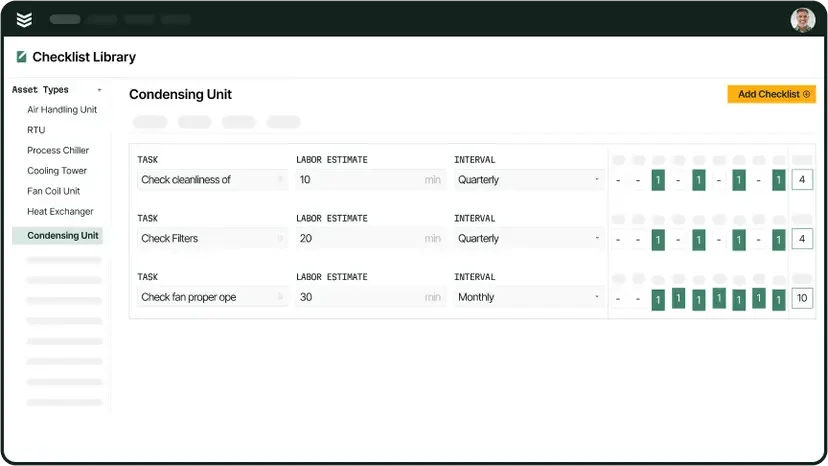
Automate service agreements with BuildOps
Let our AI-powered platform unlock new sources of revenue for you.