

Managing large construction projects means juggling crews, sites, subs, deadlines, and costs—all at once. When details slip, delays stack up, and profits disappear. That’s why more contractors now lean on AI to keep every phase tight, coordinated, and on track.
For a closer look at how the construction field service management landscape is evolving, we put together a dedicated breakdown worth reading alongside this guide.
We'll cover everything contractors need to know about AI tools for construction project management, including:
- Key features to look for in AI tools for construction project management
- 8 best AI tools for construction project management
- 7 benefits of using AI tools for construction project management
- Questions to ask when choosing AI tools for construction PM
- 4 important construction project management AI tool FAQs answered
Before we get into specific tools, let's walk through what to look for and how to evaluate your options.

Key features to look for in AI tools for construction project management
The features baked into your platform determine whether it actually saves time in the field or just adds another layer of software to manage. Here are the capabilities that matter most when evaluating AI tools for construction project management.
1. AI-powered project intelligence
AI should do more than automate — it should surface risks, flag schedule conflicts, and help teams make faster decisions across active builds. Construction AI analyzes job data in real time, identifying patterns that would take a project manager hours to catch manually. For contractors running multiple job sites simultaneously, this kind of intelligence keeps timelines tight and prevents small issues from snowballing.
2. Real-time scheduling and dispatching

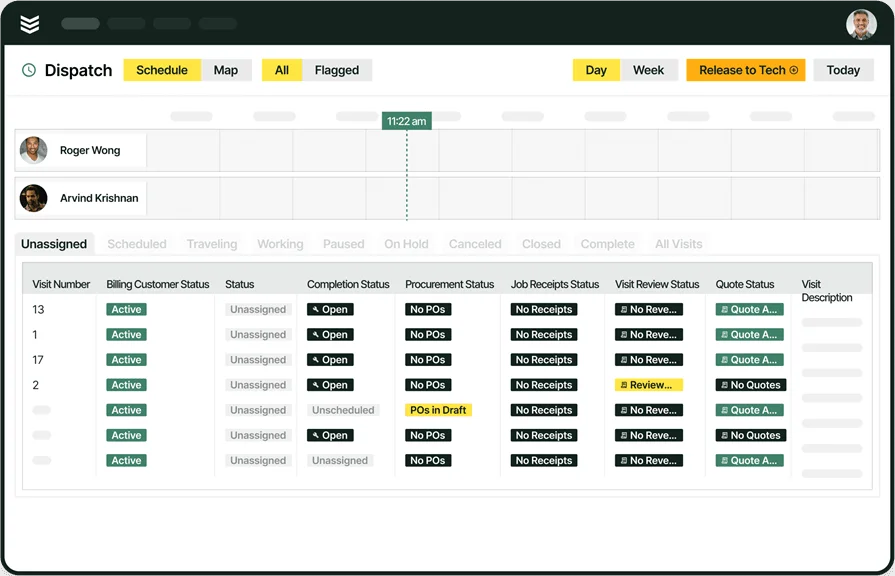
Coordinating crews across job sites requires instant visibility into who's available, where they are, and what's next on the board. Scheduling and dispatch software lets dispatchers assign, reassign, and reroute crews on the fly — keeping labor productive even when timelines shift mid-day.
3. Mobile access for field crews

Field teams need job details, plans, and updates without calling the office or driving back for paperwork. A technician mobile app gives crews access to work orders, site documents, and reporting tools directly from the job site — so nothing gets lost between the field and the back office.
4. Automated invoicing and payments
Slow billing kills cash flow. Automated invoicing and payment processing tools generate invoices as soon as work is completed and process payments faster, cutting down on the lag between finishing a job and getting paid.
5. Advanced reporting and analytics
Knowing where time and money are going across every project is what separates profitable contractors from the rest. Construction reporting tools track labor costs, job performance, and budget variances in real time — giving leadership the data they need to course-correct before margins erode.
Want to see how we can help?
Give your project managers the tools to keep every build on track and on budget.
Other notable features to look for in AI tools for construction project management
Beyond the core capabilities above, a few additional features add serious operational value for construction contractors managing complex field operations.
- Service quoting — Fast, accurate quotes keep the sales pipeline moving. Service quoting software lets teams build and send professional quotes from the field or the office, reducing turnaround time and improving close rates.
- Customer and project relationship management — Tracking client history, project details, and communication in one place prevents things from falling through the cracks. A field service CRM centralizes every interaction so teams can manage relationships without digging through emails or spreadsheets.
- Fleet tracking and management — Knowing where trucks and equipment are at all times reduces wasted trips and improves response times. Construction fleet management software provides real-time GPS tracking, maintenance alerts, and utilization data across your entire fleet.
- Service agreements and recurring work — Managing ongoing maintenance contracts manually leads to missed visits and lost revenue. Service agreement management tools automate scheduling, renewals, and reminders so no contract obligation slips.
- Automated time tracking — Manual timesheets create payroll headaches and compliance risks. Construction time tracking software logs hours automatically based on job check-ins, keeping labor records accurate without extra admin work.
With the right features locked in, the next step is knowing which platforms actually deliver on them. Let's break down the best AI tools for construction project management and what each one brings to the table.
8 best AI tools for construction project management
AI only matters on the jobsite if it tightens schedules, cleans up field docs, and gives PMs a clear view of costs and timelines. Here are eight tools contractors and field teams use from first dispatch to final closeout.
1. BuildOps: best for commercial construction teams

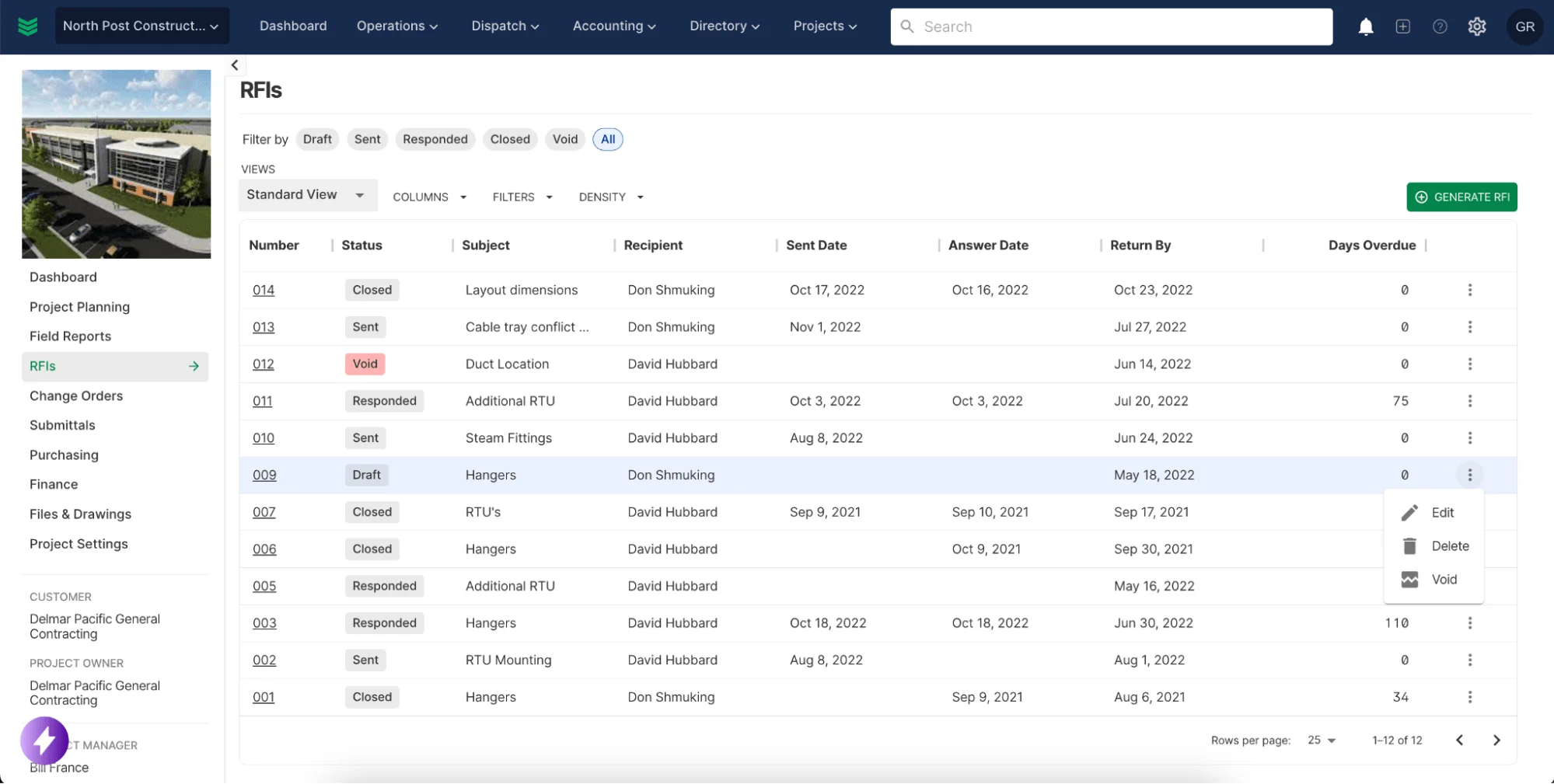
BuildOps connects AI directly to the field workflows that drive construction project management forward — from dispatch adjustments and technician documentation to asset capture and invoicing — all feeding into a single job record that the office can act on without chasing updates.
OpsAI turns messy field inputs — crew notes, photos, receipts — into clean, trusted data your back office can act on. From emergency break-fix calls to tenant improvements and large HVAC retrofits, every job runs with the same operational discipline, so nothing slips between the field and the office from first dispatch to final closeout.
AI Features: AI powers Smart Dispatch that recommends the best tech for every job in real time — based on skills, workload, and location. Nameplate capture builds asset records from a single photo. Field notes write themselves from quick bullets or voice. And invoice scanning pulls in line items and catches what's missing before you bill.
Features Beyond AI: The platform covers scheduling and dispatch workflows, quoting and approvals, customer and job history with multi-property hierarchies, invoicing and payments, reporting dashboards for utilization and performance, service agreements for recurring work, fleet tracking, and time tracking tied to cost codes for payroll accuracy and job costing.
How Pricing Works: BuildOps prices based on team size, user count, and the capabilities your operation needs, quoted per user per month with options scaled for larger construction teams.
What Sets It Apart for Commercial Construction Teams: BuildOps links every phase of construction project management — dispatch, field documentation, asset tracking, invoicing, and reporting — inside one platform. For commercial contractors managing many assets across multiple properties, that eliminates data silos and keeps field and office teams working from the same job record at every stage.
Rating: 4.5 on Capterra from 151 user reviews
Want to see BuildOps in action?
We bring office and field tech together—so nothing slips through the cracks.
2. ServiceTrade: best for field documentation cleanup

Image Source: ServiceTrade
ServiceTrade centers on job documentation and customer-ready wrap-ups, which matters when construction techs are closing out tickets from the field and the office needs polished records before the next phase of work begins. Its AI leans into converting what crews capture during a visit — notes, photos, equipment details — into consistent, usable job data, especially across teams where documentation quality varies from tech to tech.
They are best for recurring maintenance or multi-visit work; not ideal for teams needing one platform for complex dispatch, layered approvals, and large construction projects.
AI Features: ServiceTrade's AI capabilities focus on converting technician audio into text, refining raw job notes into professional-grade language, generating consolidated job summaries from full ticket histories, scanning nameplate details into asset records, and surfacing operational answers from historical data so managers spend less time searching through past tickets.
Features Beyond AI: Outside of AI, the platform supports day-to-day construction service operations with dispatching and recurring work management, a technician mobile workflow for photos and on-site updates, and customer-facing reporting and documentation that helps standardize closeouts across accounts.
How Pricing Works: Pricing is typically provided by quote and varies based on team size and the package selected.
What Sets It Apart for Documentation-Heavy Teams: ServiceTrade turns inconsistent field notes into polished, customer-ready records — reducing the review cycle between field closeout and billing on construction projects where documentation quality directly affects the next phase of work.
Rating: 4.6 on Capterra from 339 user reviews
3. Simpro: best for service and project cost tracking

Image Source: Simpro
Simpro handles both service and project work inside one system, which can help construction contractors who move between reactive maintenance, scheduled repairs, and longer installation jobs while still needing to track costs against each one.
Simpro’s mobile AI improves job notes and mixed-work cost tracking, but its variable depth and configurability may not suit teams needing advanced AI across dispatch, documentation, and asset capture.
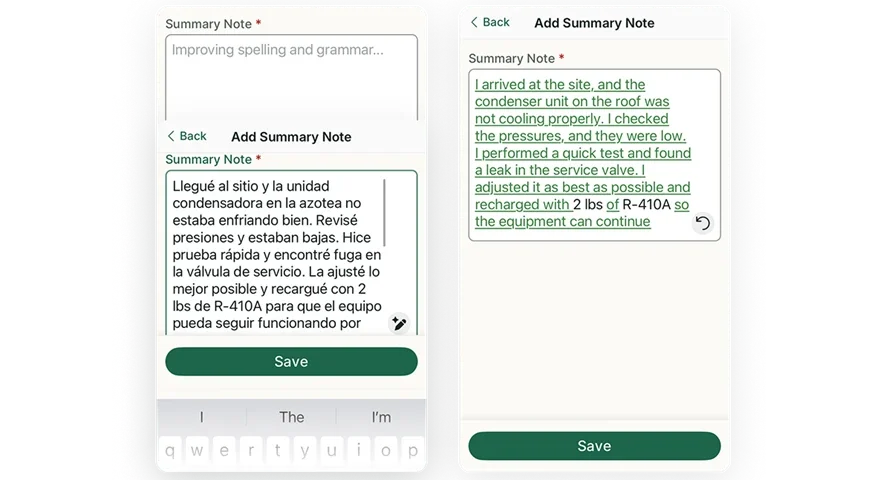
AI Features: Simpro's AI support targets mobile closeout workflows, including generating work-completed notes from job details and improving writing quality with grammar and spelling corrections — which helps reduce follow-up calls between the field and office when documentation needs to read consistently across different crews and trades.
Features Beyond AI: Beyond AI, the platform offers core field operations coverage including scheduling, job management, quoting, reporting, and tools that connect field activity to financial tracking, plus an ecosystem of integrations that can extend the platform depending on how your construction team runs service and project work.
How Pricing Works: Pricing is quote-based and often depends on user count and selected modules, with setup and onboarding costs common for configuration, training, and data migration.
What Sets It Apart for Cost-Focused Teams: Simpro connects field activity directly to financial tracking, giving construction contractors who juggle both service calls and longer project work a single view of costs, margins, and job performance across different work types.
Rating: 4.0 on Capterra from 145 user reviews
See how to choose the right Simpro alternative for your team.
4. Procore: best for general contractors

Image Source: Procore
Procore is designed for general contractors coordinating complex construction projects across multiple trades and teams. Its tools span pre-construction through closeout — covering daily logs, document control, cost management, and submittal tracking — giving field contractors on large projects strong coordination and real-time visibility into budgets and timelines.
Procore’s project‑delivery focus means it’s missing key trade-specific field workflows like equipment capture, recurring maintenance, asset tracking, and AI-driven dispatch.
AI Features: Procore AI automates routine tasks and provides foresight for faster, more certain decisions on active builds. Its AI capabilities are purpose-built for the jobsite — helping teams surface risks, reduce manual data entry, and accelerate document review across project execution and cost management workflows.
Features Beyond AI:
- Project execution tools connecting office and field on a single platform
- Real-time cost management with visibility into project financials
- Resource management for optimizing crews, hours, and equipment
- Project lifecycle management unifying budgets, contracts, and field progress
- 500+ out-of-the-box integrations through the Procore App Marketplace
How Pricing Works: Procore uses a custom pricing model based on company size and annual construction volume. Demos are available to evaluate the platform before committing to a contract.
What Sets It Apart for General Contractors: Procore centralizes project tracking, budgeting, and multi-team collaboration into one platform, making it a strong fit for general contractors managing large-scale builds where coordination across owners, subs, and trades is the primary challenge.
Rating: 4.5 on Capterra from 2,657 user reviews
5. Buildertrend: best for home builders and remodelers

Image Source: Buildertrend
Buildertrend targets home builders and remodelers who need one platform to manage sales, project execution, financials, and client communication from first lead to final walkthrough. Trusted by over 20,000 builders and powering over half of new home builds in the U.S., it gives residential teams a centralized hub for schedules, change orders, daily logs, and punch lists.
Buildertrend is built for residential construction and remodeling, not the complex multi-trade, multi-property service work commercial contractors need, so key workflows like dispatch, asset tracking, and recurring service are lacking.
AI Features: Buildertrend uses AI-powered progress updates to keep clients informed automatically, reducing the communication burden on project managers. Its AI capabilities focus on client-facing communication and scheduling optimization rather than field-level dispatch intelligence or technician documentation cleanup.
Features Beyond AI:
- End-to-end sales management with CRM, email marketing, and professional proposals
- Centralized project management connecting schedules, change orders, and daily logs
- Financial management with budgets, job costing, and connected accounting
- Dedicated client portal with online payment options
How Pricing Works: Buildertrend offers tiered pricing plans. Specific pricing details are available through their website, with plan levels scaling based on features and team size.
What Sets It Apart for Residential Builders: Buildertrend covers the full residential build cycle — from lead capture and estimating through construction and client handoff — in a single platform designed specifically for how home builders and remodelers operate.
Rating: 4.5 on Capterra from 2,483 user reviews
6. Buildxact: best for residential estimating and takeoffs

Image Source: Buildxact
Buildxact is tailored for small-to-midsize builders who need fast, accurate estimating and procurement tools. Its automated takeoff and cost estimation capabilities let contractors generate bids quickly while keeping material costs in check — a strong fit for residential builders focused on pre-construction accuracy.
Buildxact may fall short on field execution for commercial teams—it’s missing service and maintenance tracking, real-time dispatch, and AI-powered project intelligence.
AI Features: Buildxact's AI capabilities center on estimating automation — helping builders generate takeoffs and cost estimates faster by pulling from material databases and historical pricing. Its AI focus stays within pre-construction rather than extending into field execution, scheduling intelligence, or documentation automation.
Features Beyond AI:
- Automated digital takeoffs from uploaded plans
- Job costing and budget tracking tied to estimates
- Procurement tools for managing material orders and supplier pricing
- Scheduling tools for sequencing residential build phases
How Pricing Works: Plans start at $133 per month, making it a mid-range option for small builders focused primarily on estimating and pre-construction workflows.
What Sets It Apart for Estimating-Focused Teams: Buildxact streamlines the bid-to-build handoff for residential contractors, turning plan uploads into detailed cost estimates and material lists faster than manual methods — keeping pre-construction tight and reducing estimating errors on new builds.
Rating: 4.6 on Capterra from 180 user reviews
7. Knowify: best for trade contractors on QuickBooks

Image Source: Knowify
Knowify serves trade contractors who need project and service management in one system — with what it calls the #1 QuickBooks integration in construction. From bids and proposals to change orders, scheduling, daily logs, and invoicing, Knowify gives electrical, plumbing, HVAC, and other specialty contractors a single source of truth for both long-term projects and fast-paced service calls.
Knowify is ideal for linking field work to QuickBooks, but it lacks the advanced, AI-driven capabilities and scale larger commercial operations require.
AI Features: Knowify's AI capabilities are still emerging compared to platforms with dedicated construction AI engines. Its current focus leans toward automation within financial workflows and job management rather than AI-powered dispatch optimization, field note cleanup, or predictive scheduling.
Features Beyond AI:
- Estimating, proposals, and contract management
- Change orders, RFIs, and submittals
- Scheduling, time tracking, and daily logs
- Subcontractor management and inventory tracking
- Service dispatch, invoicing, and online payment processing
- AIA billing, budgeting, job costing, and reporting
- Client portal and CRM
How Pricing Works: Plans start at $99 per month, with pricing scaled based on the features and modules your team needs.
What Sets It Apart for Trade Contractors: Knowify bridges project work and service work inside one platform while keeping QuickBooks perfectly synced — giving trade contractors real-time financial visibility without double-entry or disconnected accounting.
Rating: 4.5 on Capterra from 109 user reviews
Compare Knowify against BuildOps right here to see who comes out on top.
8. Contractor Foreman: best for budget-conscious small contractors

Image Source: ContractorForeman
Contractor Foreman packs a wide feature set into an affordable package, starting at $49 per month with a 100-day money-back guarantee. Created for small and medium-sized residential and commercial trade and general contractors, it covers project management, financials, people management, and document control across phone, tablet, and desktop.
Contractor Foreman offers strong, affordable features, but may lack the advanced AI and depth needed for large, complex commercial operations.
AI Features: Contractor Foreman's platform focuses on operational coverage rather than AI-powered intelligence. Its feature set prioritizes breadth — giving small teams access to scheduling, estimating, and documentation tools — but does not currently offer the kind of AI-driven dispatch recommendations, predictive risk flagging, or automated field note processing that larger commercial teams rely on.
Features Beyond AI:
- Project management with daily logs, scheduling, work orders, and inspections
- Estimating, bid management, and change orders
- AIA and progress invoicing with online payments
- Time cards, crew scheduling, and incident tracking
- RFIs, submittals, drawings, and PDF markup
- Vehicle and equipment logs
- Client portal and team chat
- Integrations with QuickBooks, CompanyCam, Zapier, Google Calendar, Outlook 365, Gusto, and Angi Leads
How Pricing Works: Plans start at $49 per month, making it one of the most affordable construction management platforms available. Higher-tier plans unlock additional features and user capacity.
What Sets It Apart for Small Contractors: Contractor Foreman delivers a full construction management toolkit at a fraction of the cost of enterprise platforms — giving small teams access to project tracking, financials, and documentation without a steep monthly commitment.
Rating: 4.5 on Capterra from 816 user reviews
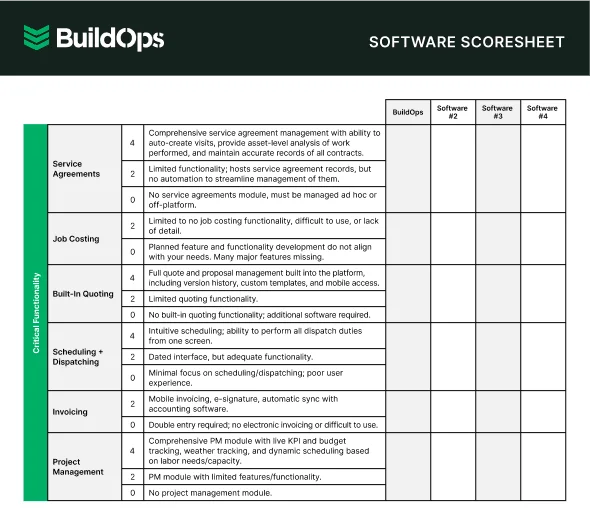
Compare software at a glance
Find the right software with this easy-to-use software scoresheet.
7 benefits of using AI tools for construction project management
AI tools don’t just automate tasks—they transform how contractors manage every stage of construction in the field. Here are seven ways AI delivers measurable value for construction teams operating in the field.
1. Tighter scheduling and fewer crew conflicts
AI builds and continuously updates optimized technician schedules in real time, keeping labor productive and minimizing downtime between jobs. For contractors managing on-site field services across multiple locations, that kind of scheduling intelligence prevents the overlaps and gaps that quietly erode margins.
2. Faster, more accurate project documentation
AI turns raw technician notes—voice, bullets, nameplate scans—into clean, structured reports in seconds, automatically feeding invoicing, compliance, and asset history records.
3. Stronger cost control across complex builds
AI monitors labor, materials, and budgets in real time to catch cost overruns early so managers can fix issues before they become major losses. For contractors working on commercial construction megaprojects, where research shows cost overruns averaging 79% with delays of 52%, that kind of visibility is the difference between a profitable job and a write-off.
4. Reduced administrative burden on field and office teams
AI automates repetitive admin work—data entry, timesheets, invoicing, and parts tracking—so your team spends more time on billable work, not paperwork. When it comes to modernizing procurement in construction, AI-driven automation cuts the lag between field activity and back-office processing, especially as a younger workforce expects digital-first tools from day one.
Did you know
AI has already started shifting how construction contractors handle their field service workflows. What used to take hours can now happen in minutes — with more accuracy and fewer surprises.
In our 2025 survey, The Pivot Point: AI and the Future of Commercial Contracting, 78% of contractors said they believe AI improves efficiency, and 47% are already using AI in some capacity for their field ops.
5. Better client communication and relationship management
AI keeps customers informed with real-time updates and summaries—without extra PM work—cutting status calls and building trust that drives repeat business. Pairing AI with a construction contractor CRM centralizes every client interaction so your team manages relationships from one place instead of digging through emails and spreadsheets.
6. Scalable operations without proportional headcount growth
AI lets contractors take on more work with the team they already have — automating scheduling, dispatch, documentation, and reporting so each person covers more ground. Agentic AI in field service takes this further by autonomously detecting issues, assigning the right tech, and triggering follow-up actions without human input.
7. Proactive risk detection and predictive maintenance
AI doesn’t just react to issues—it predicts them. By analyzing performance and service data, it spots failures before they happen, shifting contractors from emergency calls to planned maintenance that boosts uptime, cuts costs, and extends asset life across properties.

Questions to ask when choosing AI tools for construction PM
Pick a tool built for real construction field workflows—not another generic tracker that creates more work. They reveal which platforms truly power AI contractor workflows—and which are just generic project trackers that create extra work.
- Workflow and job mix alignment — Does the platform follow how your jobs move from call intake through dispatch, field execution, and closeout? Can it handle your mix of break-fix service calls, scheduled maintenance, and multi-phase construction work without forcing you to rebuild your process around the software?
- Field adoption and crew usability — Will your techs actually use it on active job sites? Can a crew member run a full job — checklist, photo upload, notes, sign-off — without fighting the interface or falling back to paper?
- AI data quality and reliability — What inputs does the AI rely on to generate dispatch recommendations, documentation summaries, or schedule changes? How does the system handle gaps — like missing asset history or incomplete field notes — without producing unreliable outputs?
- Implementation and rollout timeline — How long does it take to get your team fully running on the platform? Are job templates, price books, asset fields, and permissions something you configure yourself, or does the vendor own that setup and migration?
- Integrations with existing systems — Does it connect cleanly to accounting, payroll, CRM, and the communication tools your office already depends on? What data migrates without manual cleanup, and what requires work before you switch?
- Full-cycle field service feature coverage — Does the AI connect across dispatch, documentation, invoicing, fleet tracking, asset capture, and reporting inside one platform? Or are you stitching together separate tools to cover the full lifecycle of a construction service call — from first dispatch to final invoice?
With the evaluation criteria locked in, contractors still have practical questions about how AI shows up in daily field operations and whether it delivers real value on active job sites. Next, we answer the most common ones.
4 important construction project management AI tool FAQs answered
These questions are from active contractors assessing whether AI can handle complex field workflows, with answers focused on real operational priorities.
1. What is an AI tool for construction project management?
It's software that uses AI to automate scheduling, dispatch, documentation, cost tracking, and risk detection across active construction projects — connecting field crews and the back office through one real-time data thread.
AI construction tools learn from job data to spot schedule or budget risks early and automatically trigger fixes, like reassigning crews or flagging inspection gaps.
2. How do AI tools connect to existing construction field service workflows?
AI only delivers real value to construction contractors when it’s built into existing workflows, not bolted on as a separate layer.
AI that works connects the full job lifecycle—pushing updates and data into your systems automatically—so there’s no double entry, no delays.
3. Are AI tools for construction project management worth the investment?
For multi-site contractors with 10+ crews, the real cost isn’t software—it’s operating without AI-driven visibility into schedules, costs, and documentation. An AI-connected platform cuts rework, speeds invoicing, tightens dispatch, and delivers audit-ready records, with efficiency gains that typically surpass the platform cost within the first quarter.
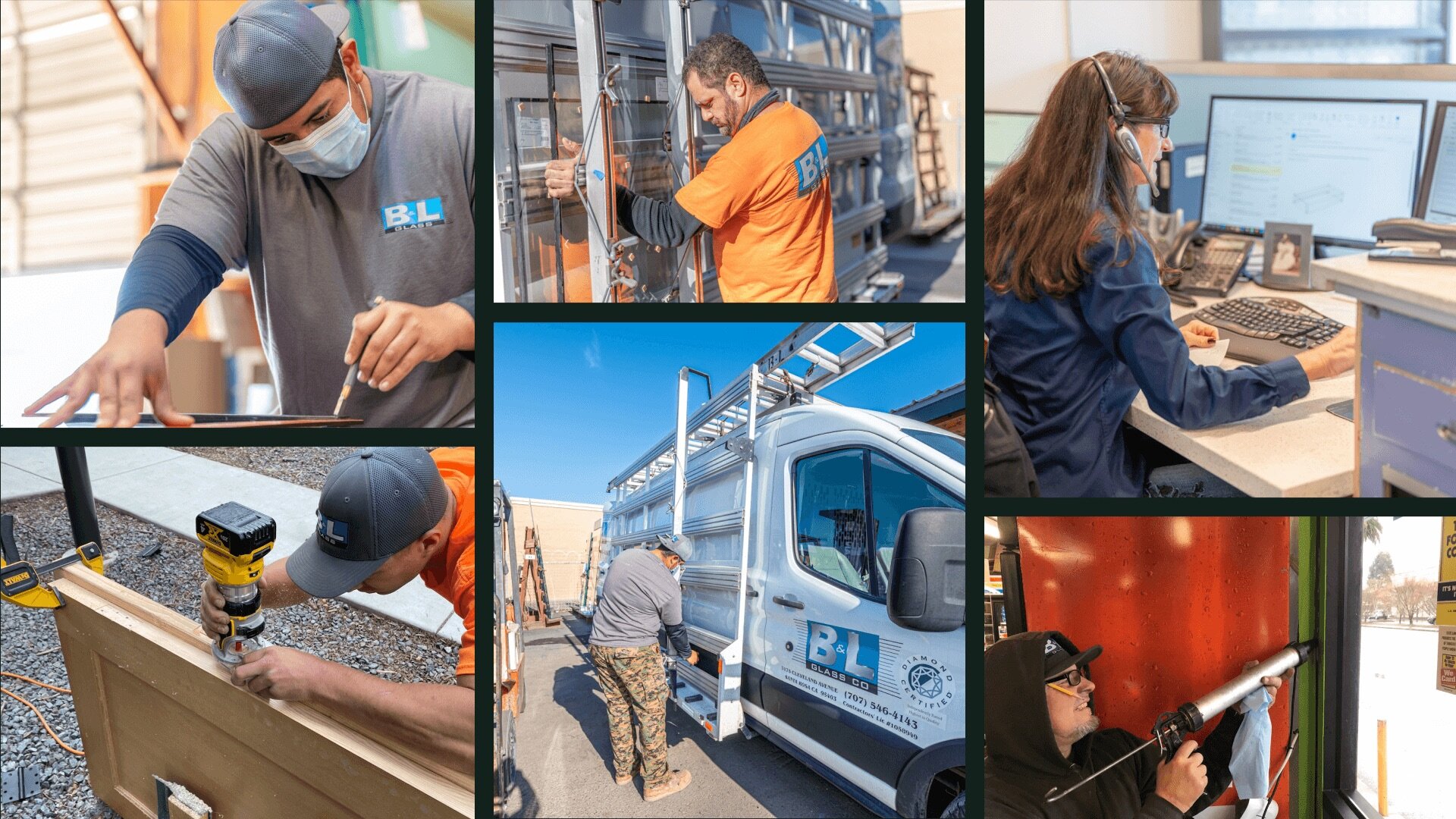
See how B&L Glass made that shift, cutting quote approval time from nearly 10 days down to 3.5 days after moving to one connected platform.
4. What are the best practices for using AI in construction project management operations?
AI discipline gives contractors clean data and tight margins instead of disconnected chaos.
- Require AI-assisted dispatch for every job — matching crews by skill, certification, location, and workload.
- Standardize field documentation — minimum one progress photo, one daily log, and one cost update per crew per day.
- Use AI to auto-generate and clean technician notes instead of manual write-ups.
- Link every job to a property, customer hierarchy, and cost code — never as a standalone work order.
- Sync field data to invoicing and reporting in real time to avoid month-end backlogs.
- Use AI-driven schedule optimization to rebalance crews when priorities change mid-day.
- Capture change orders and scope changes in the project workflow so cost impact is tracked immediately.
- Run weekly AI-generated reports on labor utilization, budget variance, and schedule adherence — and action the outliers.
- Use dashboards to flag projects trending over budget or behind schedule and alert project managers early.
- Train project managers and field leads on AI tools during onboarding and reinforce during regular reviews.
Incomplete data, blown deadlines, and clumsy handoffs don’t just cause headaches—they quietly drain profit from every job you run.
It doesn’t have to be that way.
Built for commercial contractors, BuildOps replaces scattered systems with one connected project hub. From preconstruction and scheduling to field execution, documentation, and closeout, everything lives in a single workflow your whole team can see and trust. No double entry. No missing job history. No guessing where things stand—just clear, accountable progress at every stage of the project.
With OpsAI, every project record becomes an action: smarter resource planning, tighter schedules, early visibility into cost overruns, and real-time alignment between the field and the back office. Your data doesn’t just get stored — it actively drives margin, speed, and client satisfaction.
See how AI-native construction project management can work for your team. Schedule a free demo.
Streamline your project management
See how BuildOps connects construction PM to the rest of your field ops.