High-Stakes Bids: How Contractors Decide What to Take — and When to Walk
In hot markets, it’s tempting to chase backlog. But experienced contractors know that not all work is good work — and the most dangerous risks don’t show up in the field.


Commercial work is booming — from billion‑dollar data centers to hospitals, universities, and government campuses. Data centers alone drove more than 70% of all private nonresidential construction spending growth from March 2024 to March 2025, and roughly one in eight contractors is already on a data center job.
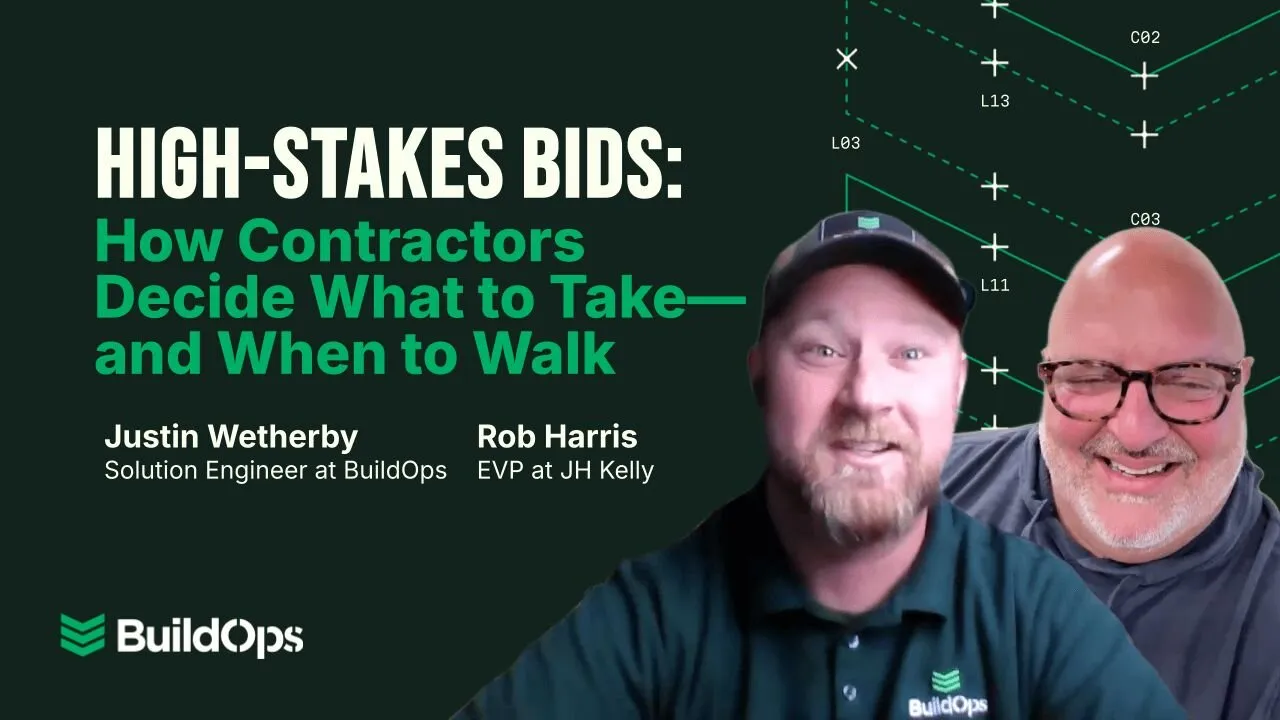
But as Rob Harris, Executive Vice President at JH Kelly, stressed in our recent BuildOps webinar, the biggest risks on these projects don’t start in the field. They start much earlier in how you choose which jobs to pursue, under what terms, and how disciplined you are in preconstruction.
Here are the core lessons from “High‑Stakes Bids: How Contractors Decide What to Take — and When to Walk,” with Rob Harris and BuildOps Solution Engineer Justin Wetherby.
The Work Is There. The Risk Is, Too.
Mission‑critical and large institutional work is accelerating nationwide. Owners and developers are investing heavily in data centers and decentralized power, from fuel cells and on‑site generation to containerized simple‑cycle plants, creating new opportunities for industrial and mechanical contractors who can build both the facilities and the power to run them.
The question isn’t “Is there enough work?” It’s which projects will actually be good for your business and which could quietly put margin, people, and reputation at risk.
Go / No‑Go: Not “Can We Build It?” But “Should We Take It?”
For Harris, the make‑or‑break moment on a high‑stakes job is the go/no‑go decision, not what happens after award.
One strong “no” is enough reason to walk away, even if everything else looks attractive. Red flags include:
- No credible PM bench or craft supervision
- No estimating bandwidth to produce a responsible proposal
- A competitive environment or contract structure that feels one‑sided
- Ambiguous, owner‑favored commercial terms
Span of control matters. On mega‑jobs that may require thousands of craft, contractors need to know whether they can truly supply skilled labor, maintain productivity in overheated markets, and “track the holy living snot out of it” as conditions change.
Execution excellence can’t fix a bad go/no‑go call. If you ignore what your experience and numbers are telling you, much of the damage is locked in before the first crew arrives.
Where Risk Really Enters the Job
By the time teams feel pain in the field — blown schedules, rework, margin erosion — causes usually trace back to preconstruction decisions.
Harris and Wetherby highlighted three main entry points:
- Contract strategy. Who actually holds which risks, and how are liquidated damages, schedule guarantees, and equipment delays handled?
- Scope clarity. Open‑ended or “squishy” scopes almost guarantee you’re underwriting risk you can’t fully quantify.
- Design status and volatility. There’s a big difference between pricing off 30% concept drawings versus 100% IFC — especially on fast‑track industrial and data‑center work where density, cooling, and power strategies are moving targets.
If contract type, scope, and design maturity aren’t surfaced and debated up front, teams end up chasing late changes and absorbing risks they never meant to take.
Preconstruction: Where Margin Is Won (or Lost)
If risk shows up early, margin is protected or surrendered in preconstruction.
On the jobs JH Kelly feels best about, Harris said they’re brought in early based on capability, then work with owners, GCs, and engineers to shape how the job will actually be built — not just how it’s priced.
That means:
- Driving constructability reviews and value engineering
- Using modularization and outside manufacturing to move hours from the field into safer, more productive shop environments
- Steering delivery models and scopes toward configurations the contractor can realistically execute with their true capacity
For contractors who aren’t yet at the table that early, Wetherby sees a different starting point: replacing spreadsheets, email, and “in people’s heads” tribal knowledge with a connected system that tracks:
- A pipeline of large bids with explicit risk tags (contract type, design status, owner/GC risk)
- Capacity views by year — what you actually have room for
- Feedback from project actuals back into estimating — where you consistently beat or miss on labor and margin
When go/no‑go criteria, precon discipline, and project results live in one place, leaders are making high‑stakes bid decisions with data, not just gut feel.
The Discipline That Scales Beyond Megaprojects
You may never chase a billion‑dollar data center. But the disciplines Harris and Wetherby outlined apply across commercial work:
- Treat go/no‑go as a strategic guardrail, not a formality
- Make contract structure, scope clarity, and design maturity part of risk review
- Invest in preconstruction practices that let you shape delivery, not just price
- Use connected systems to tie bids, capacity, and project outcomes together
In hot markets, it’s easy to believe more backlog is always better. As Harris sees on the ground, one bad job can undermine years of good ones.
The contractors who come out ahead in this cycle won’t just win more work — they’ll be far more selective and disciplined about which high‑stakes bids they say yes to in the first place.
{{related-content-block="/resources/the-talent-war-behind-the-data-center-construction-boom"}}