


ONE SYSTEM, EVERY WORKFLOW
A single operating backbone
Project Management
Manage commercial projects, budgets, crews, and documents from procurement through active construction to closeout. Spot what's slipping before it costs you, and keep complex contracts on track from bid to closeout.


Service Management
Keep every service job on track from first dispatch to final invoice. Manage work orders, assets, maintenance schedules, and purchasing, so more work doesn't come at the cost of control.


Financials
Stop chasing paperwork after the job's done. BuildOps keeps time tracking, procurement, and invoicing moving in real time, so the money follows the work, not the other way around.


Sales & CRM
Follow-ups slip. Quotes go cold. Good contractors lose deals they could've closed. BuildOps keeps your pipeline moving from first contact to signed contract, so the right jobs don't get away.


EXTEND THE PLATFORM
Same platform. More firepower
These aren't disconnected tools duct-taped to the side. Our add-ons seamlessly integrate to share data with your core workflows, giving you a unified view of the job without the double entry.
What makes BuildOps different
Built from the ground up for contractors who run projects, service, and everything in between. Not adapted. Made for the work.
Commercial work isn't an add‑on
Most platforms started in residential and stretched to fit. BuildOps starts with the complexity of commercial work.
Run the work in one connected system
Field, office, finance, and sales — all in one place. No duct-taped tools, no double entry, no dropped balls.
OpsAI is built in, not bolted on
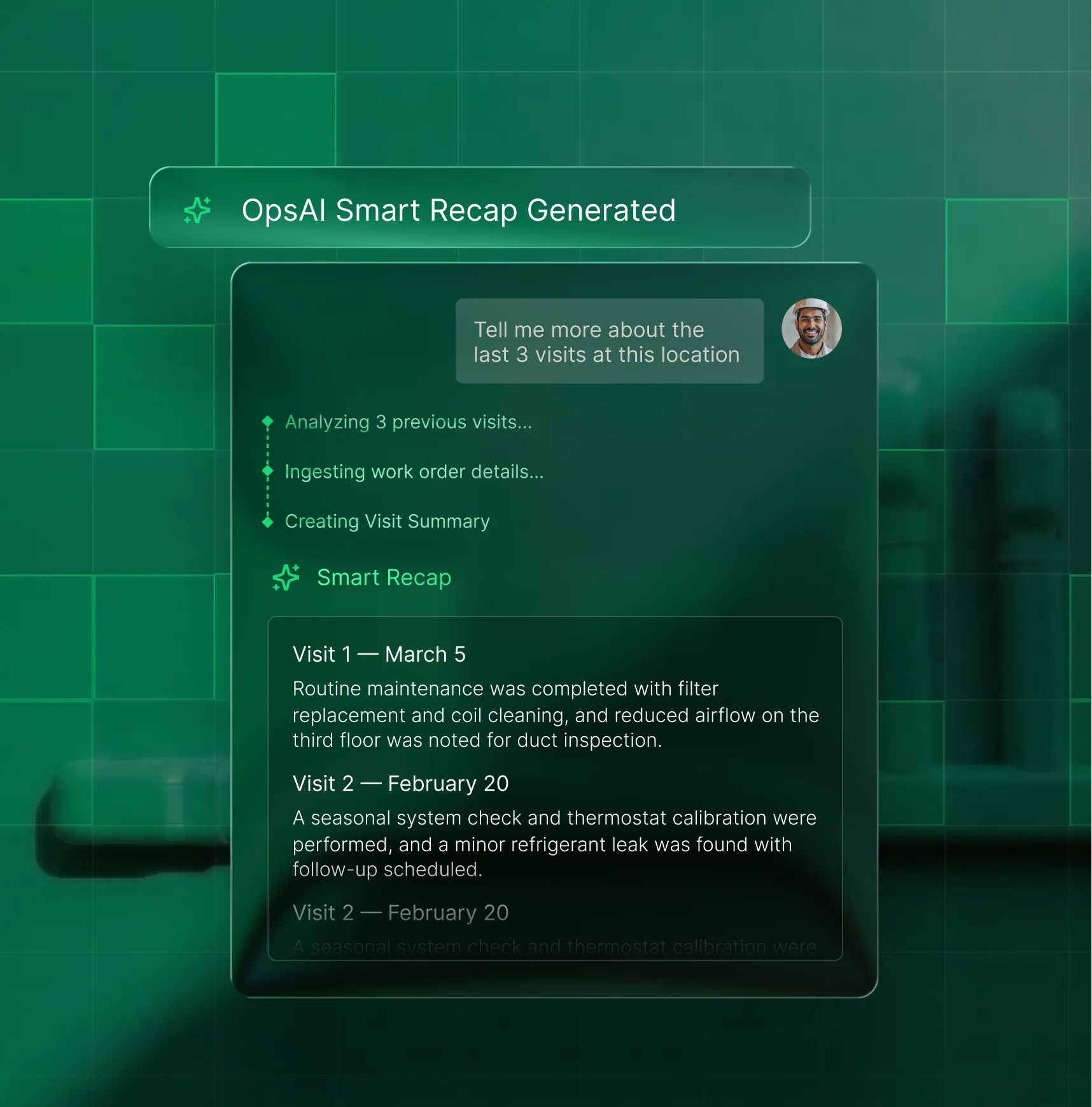
OpsAI is already in your workflows. It recaps the day, calls out risks, and gives every role a clear next step.
FIELD AND OFFICE, CONNECTED
Every job. Every number. In your hands
Built for the way contractors work with structured data, offline-ready mobile tools, and real-time analytics that turn every job into a clearer, more profitable operation.
Common Questions
Your field service platform questions, answered
What are the core features of a field service management platform?
If your field service business focuses on commercial jobs and projects, a field service platform should have core features that handle the complexity of that type of work. Here are the key things you should look for in a platform to fully enable commercial field service work:
- Technician Mobile App—Sync data instantly right from field to office, across all team members, in real-time.
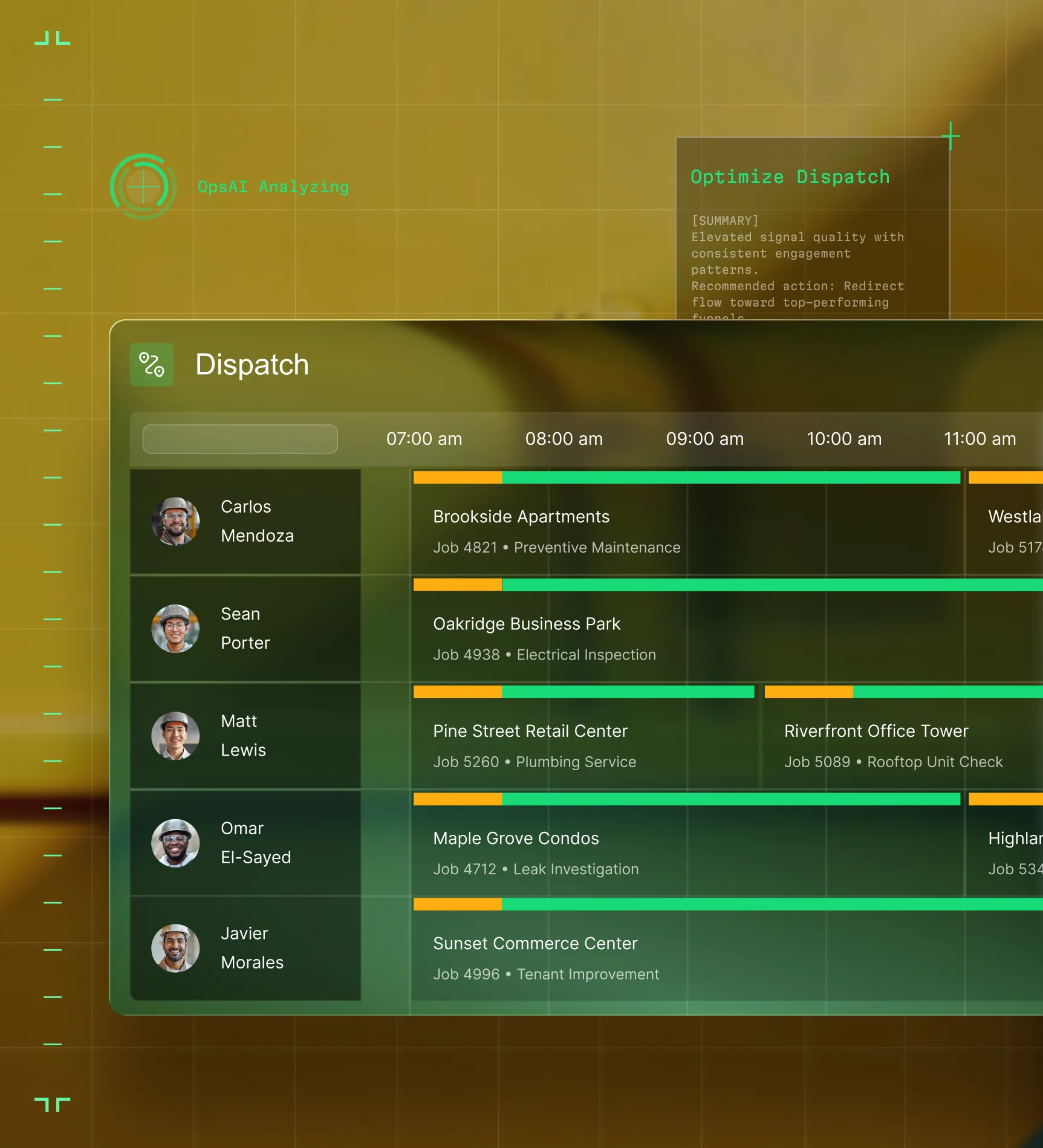
- Scheduling & Dispatching—Plan the whole week with the ability to make changes on the fly and optimize tech schedules based on skills and certifications.
- Time Tracking—Enter job details and time spent on work instantly in the app, so everything is accounted for right in the moment.
- Invoicing—Send records of work to customers with full service history and detailed field notes (including photos and videos) attached.
- Reporting & Analytics—Create custom reports and dashboards that work for you based on the exact type of work you do and how you’re trying to scale.
- Project Financials—Connect field activity directly to the bottom line with real-time visibility into costs, billing, and margins to catch drift before it becomes a problem.
- Asset Management—Full service history of every RTU, chiller, and panel your team touches, accessible to anyone, anywhere.
- Document Control—Manage RFIs, submittals, and drawings in a single platform so every document is linked to the right project and ready to defend work scope.
- Purchasing Inventory—Field teams see what's on hand, can create POs from the field, and log exactly what was used without ever leaving the app.
- Procurement—Track POs, receipts, and vendor bills from the field directly to your ERP so a job's true cost is always visible right now, not weeks after the project is done.
- AI-Powered—Today’s field service management platforms need to have AI built right in, providing useful enhancements to your operations like flagging issues and saving techs time out in the field.
- Pull-Through Work Enablement—Unlock new revenue opportunities from in progress service visits with a direct path for techs to make recommendations while onsite, and office to act on Quotes immediately based on those recommendations
- Preventative Maintenance—Auto-generate recurring visits from service agreements, tracking the margins on every contract in real time.
- Resource Planning—See every crew, every project, and everything you need in one platform where everything is connected to your project plans and your people.
- CRM & Sales Ops Handoff to Field—Track every prospect and fully customer details, even for complex multi-address accounts and projects. Move customer details through the pipeline into the field when work is approved so there’s no starting from scratch.
- Fleet—Track where every tech is, and details about your fleet. Turn your dispatch map into a live GPS.
- Payments—Collect payments right from customers, offering them multiple ways to pay. Apply payments directly against invoices in your platform.
- Integrations—With whatever other tools that are essential to you, or work within your ERP. Most platforms should integrate with key tools used by field teams like QuickBooks, Sage Intacct, NetSuite, and Viewpoint.
Is BuildOps the best field service platform for commercial contractors?
For commercial teams, BuildOps is a platform that was purpose-built from day one to handle the complexity of commercial-scale and multi-trade service work, so we believe it comes out on top when it comes to the needs of commercial field service operations.
This is primarily due to its comprehensive, large-scale Project Management tools, fully customizable dashboards and reporting, and OpsAI-powered features that significantly cut down on manual tasks that slow down commercial work. Customers who make the switch to BuildOps have frequently noted how other tools don’t seem to stack up when they weren’t built with commercial work in mind. As our customer Austin Hamlin from Certified Fire puts it: “A lot of alternatives treat a $1m project the same as a $2k service.”
We recommend doing your own research to find the field service management platform that’s the best fit for your team. Field service platforms are not all the same, and are not built for the same use cases. If you're a residential-only team, tools designed for simpler workflows may be a better fit for you.
What are the biggest benefits of using a field service automation platform?
The biggest benefits of using a field service management platform is how they save your team members significant time by cutting down the manual work required on repetitive tasks, they reduce mistakes, and they flag issues you might not have noticed without the data from the platform.
But how do they do that specifically? When looking for the right field service platform for your team, you want to make sure the platform is providing benefits like for the roles across your entire operation:
- Less Drive Time—Platform makes schedule suggestions and optimizations that assigns techs who are closer to jobsites when possible.
- Stop Clocking in At Incorrect Jobsites—App provides real-time schedule updates and assignments, so techs always have the most current version of the schedule right in their hands.
- App Briefs Techs About Job Requirements—So techs stop arriving at jobsites without the tools or parts they needed.
For Service Departments & Office Admin
- Send Notifications to Tech Mobile Apps—No more answering the phone and calling to notify techs one at a time to sort out issues. The platform pushes notifications to techs in real-time, significantly cutting down time spent doing this.
- Increase team-wide compliance—All team members are unified on company procedures in one system with guidelines clearly set out, so you don’t have to tell techs what they need to do one at a time.
- Pull-through Work—Techs can identify work recommendations on the job and sync photos and info to the office instantly, sales teams can generate quotes much faster, sometimes even before the tech leaves the jobsite.
- Faster Work Closeout—When techs can instantly turn voice notes into invoice summaries and confirm the work done through custom forms, invoices go out much faster, and even sometimes before the tech leaves. Signatures can be captured on-site so paperwork is done before techs get in their vehicles.
- Email Invoices to Customers—So jobs are closed out that day, and not weeks later.
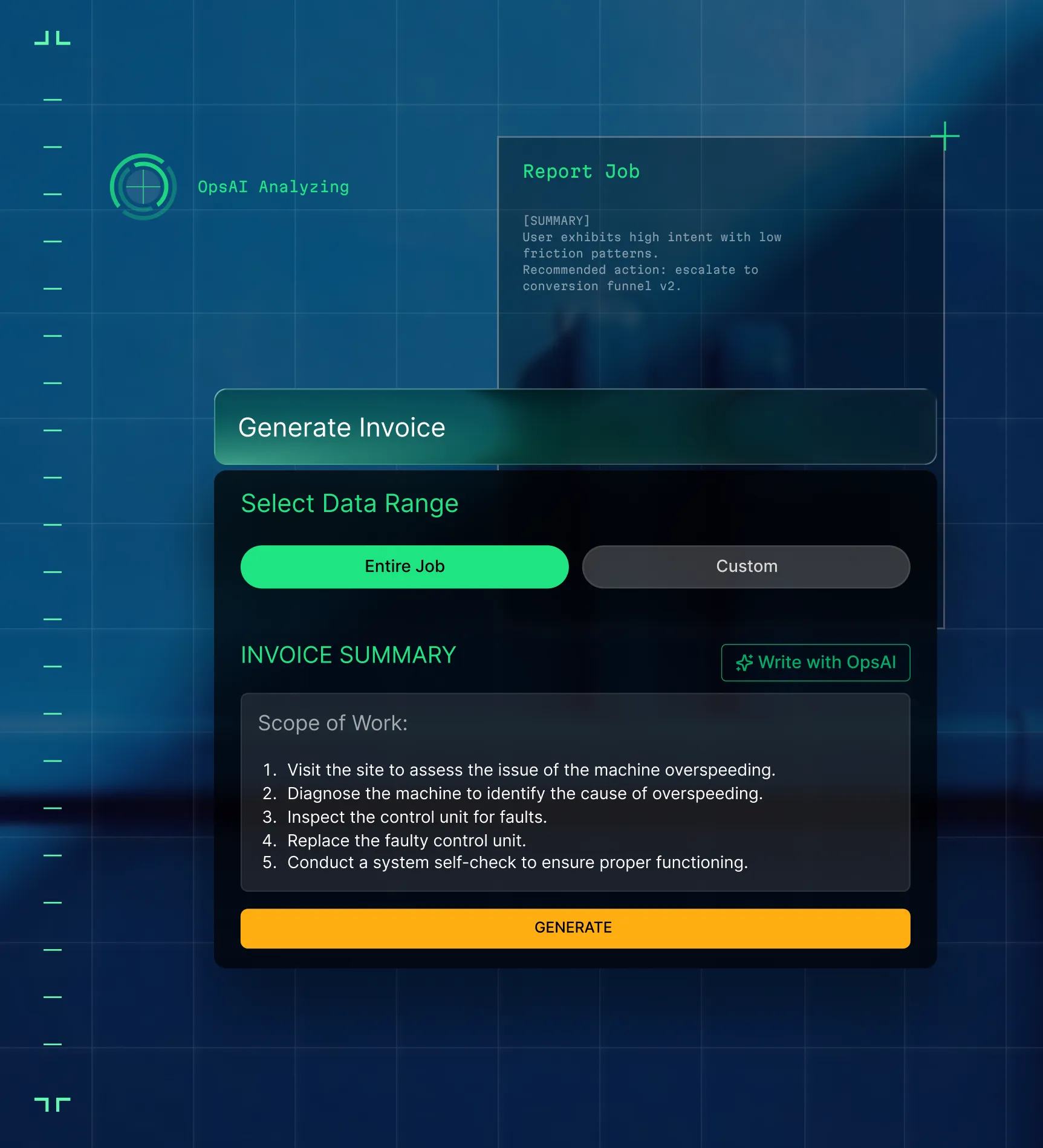
- Turn Field Notes Into Invoice Summaries—Provide detailed summaries that actually make sense to your customers, and get paid faster when they have a more comprehensive look into the work actually done
- Faster and more accurate Quotes—Leverage real service history data, photos, videos, and field notes, so Quotes are approved faster by customers.
- Real-time Data Sync & Project Visibility—When work completed is updated in real-time, owners have a much better overview of how long-term projects are going daily, and can identify margin leak or issues before they become big problems when a project is already done and there’s no time to fix it.
- Fewer Callbacks from Customers—When customers have access to detailed service records, they don’t question the work. Customer workflows require techs to move through step-by-step, providing a full history of all work done. Photos and videos show visual work of work completed.
- Fewer Mistakes Across the Entire Operation—Especially when manual double or triple data entry across multiple team members in all departments is no longer necessary.
- Act Faster Using Real Numbers—When your data is synced instantly in real time from every team member, you can take action quickly rather than waiting for spreadsheets before the monthly team meeting. Fix today’s small issue before it becomes tomorrow’s big problem.
- Revenue Growth—Increase profit margins through data collection from real work, so you can prioritize more of the things that are working, and less of the things that aren’t making you money.
How does OpsAI automate field service operations for commercial teams? Is it ready now?
OpsAI is the intelligence layer of the BuildOps platform, and is live and in production today. Contractors are using it now across dispatch, field documentation, asset capture, invoicing, and payment matching. It ships as part of BuildOps, not as a separate add-on.
Using OpsAI, our customers have seen results like 80% less data entry using our PO scanning tools, have saved hours every month using our Smart Dispatch and invoice automation, and love the ability to turn tech voice notes into structured field notes in seconds. All of these components of the platform are powered with OpsAI.
OpsAI learns from your jobs and project data to flag issues, identify recommended work, suggest next actions, and cut busywork, getting sharper with every visit. It turns your legacy system of record (showing you the history of what was done) into a modern system of action, guiding every team member from field to office on what steps to take next.
If you want some specifics, here are some of the key ways OpsAI enhances a field service operation across different roles in a business:
- In the Field: OpsAI sends the right field tech to the right job, briefs the foreman before the crew gets there, captures visit voice notes and turns them into work summaries, and summarizes daily reports from jobsites.
- For Service Operations: Turns visit notes into invoice summaries to close out billing faster, provides summaries and daily reports from jobsites, optimizes dispatch boards and scheduling based on which field techs have the skills or industry certifications required for each job.
- For Finance: Generates invoice summaries that customers can actually read and understand, matches bulk payments to open invoices, and pulls line items from PO photos.
- For Sales and Marketing: Identifies pull-through revenue and work recommendations from completed visit notes to make faster recommendations to customers for additional work.
- For Business Owners: Surfaces jobs, trends, and risks so they aren’t caught too late, and time is spent making decisions, not looking for information.
Do you have any proof of how BuildOps has helped field service teams?
We have so much proof. Using BuildOps, our customers have seen these results:
- Classic Electric unified their whole operation in a single platform, achieving 300% growth
- Service 1st went from 3-4 systems down to 1, saw 2x faster invoicing, and had a record year
- Certified Fire saw service employee billable time increase from 75% to over 95%, monthly service billing rose 54%, and an incredible 250% increase in profit margins
- Jackson Mechanical saw a 100% increase in tickets handled with no headcount added, a 50% reduction in time taken to create a job and get it scheduled, and a 30% growth in revenue
- Layer One fixed their job costing process, saving 1 week of manual work every month
- JL Minter Inc. slashed billing time by 73%
- Dane Electric cut invoicing time by over 30%
- Jolma Electric saw a 50% leap in overall efficiency
- Omnia Mechanical Group reduced their accounts receivable period by 75%, from 120 days down to just 30
- JBS Plumbing Services used Fleet tracking to notice no one was wearing their seatbelt, and brought that up from 0% to 90% compliance with just one message
There’s a clear reason commercial field service teams use the BuildOps platform to scale.
How do I ensure high adoption rates of the BuildOps platform across my entire team?
The BuildOps platform was built so even the least tech-savvy person can use it effectively, and most team members become comfortable with BuildOps with only 1-2 training sessions. During implementation, we help you build the custom workflows your business actually uses. When your techs are getting started with the platform, they’re learning how to use it to complete the exact type of work they are going to do out in the field. When office staff are trained, they’re setting up what they need during implementation so they aren’t figuring it out later.
What does the timeline for a BuildOps integration look like for commercial teams?
Most businesses are up and running on BuildOps within 8-12 weeks. We map your legacy data, configure custom workflows that match your specific field service ops and the work you do, and we train your crew—office staff and field techs alike. Our integration specialists will be with you every step of the way to help you build out your new operational architecture.
BuildOps was created specifically for commercial companies, and continues to be guided by input from service departments, business owners, managers, dispatchers, and field techs.
How does BuildOps integrate with QuickBooks, Sage, or my existing accounting system?
BuildOps integrates with many of the tools frequently used by commercial field service businesses including QuickBooks and Sage, and has a bidirectional sync with these tools, so data can flow from the field directly into your accounting system, job costing, payroll, and other tools, cutting out the need for manual double or triple entry.
BuildOps also integrates with tools commonly used in different trades and industries, and features an integration with Bluon for HVAC teams, and an integration with Inspect Point for fire and life safety service teams.
We see BuildOps as the operational backbone you can build your operation on top of, no matter what other tools are in your tech stack.
