


BuildOps x Sage Intacct
Sage Intacct runs the books. BuildOps runs the field. Job costs, invoices, and purchase orders stay aligned across both. No double entry, no cash left on the table
Seamless data integration
Connect BuildOps with Sage Intacct to ensure your financial data is always accurate and up-to-date. Reduce manual data entry and improve overall efficiency.
- GL accounts, dimensions, payment terms, and payment methods import from Sage Intacct into BuildOps automatically.
- Customers and items push from BuildOps to Intacct. Vendors sync one-way by default (BuildOps to Intacct) with optional bidirectional sync available for customers who need Intacct as their vendor system of record.
- Jobs, construction projects, service agreements, and maintenance jobs created in BuildOps become Sage Intacct projects so there’s no re-entry required.
- Cost codes and cost types can be aligned between Intacct and BuildOps during onboarding, so your field and your ledger speak the same language.
- Sage Intacct stays your financial system of record. BuildOps runs the operations. Data flows between both without gaps.
- Dimensional tagging in Intacct works with BuildOps data, giving your CFO the flexible analytics they need without extra cleanup.
- One integration, two platforms, zero duplicate entry.
Automated data sync
Field data syncs automatically with the office, ready for invoicing. Review and approve tasks, notes, photos, and parts ordered, all within BuildOps. Send invoices directly to customers via email seamlessly.
- When a tech wraps a visit, the time, materials, and job notes move straight to the office so they are ready for review before anything hits Intacct.
- Purchase orders and receipts created in BuildOps push to Sage Intacct. AP bills and bill cost updates flow back automatically — so your procurement, field, and accounting teams all see the same numbers.
- Three-way matching reconciles what was ordered, received, and billed, closing the loop between procurement, job execution, and financials.
- When your field team uses or receives inventory, BuildOps automatically generates the corresponding journal entries in Intacct's general ledger — keeping your inventory asset accounts accurate without manual postings
- No more chasing paper between the field, operations, and accounting. One workflow, start to finish.
- Approved timesheets export from BuildOps to your payroll provider with labor journal entries flowing into Intacct automatically.
- Approved invoices push to Intacct as sales invoices. Payments posted in BuildOps sync to Intacct so your AR ledger stays current without re-keying.Approved invoices push to Intacct as sales invoices. Payments received sync back so AR is always current.
- Your office team stops re-keying data and starts acting on it.
Simplified invoicing
Generate invoices quickly and accurately within BuildOps. With Sage Intacct integration, eliminate data duplication and maintain consistency.
- Build invoices directly from completed work. Labor, materials, and notes pull in from the field automatically.
- Posted invoices export to Sage Intacct as sales invoices. No second entry. No mismatched records.
- For construction projects, BuildOps manages cost codes, cost types, phases, and change orders, while progress invoices export to Intacct as sales invoices.
- Every line item, invoice, and variance rolls up cleanly into the general ledger. Job costing your CFO can trust.
- Cut the lag between work done and invoice sent. Get paid faster without adding accounting headcount.
- Contractors using BuildOps have cut billing cycles from weeks to days.
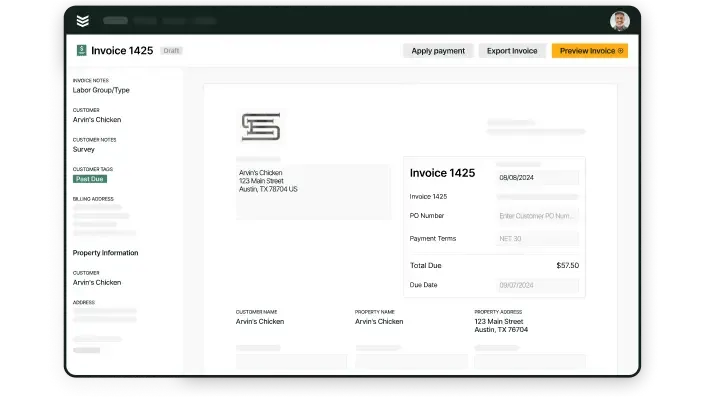
Financial insights and visibility
Track invoice statuses as they sync between BuildOps and Intacct. Monitor payments, overdue invoices, and customer payment histories to maintain financial control.
- See which invoices are posted, pending, or past due — in one dashboard that reflects what's actually happening in the field.
- Payment data pushes from BuildOps to Sage Intacct so your AR ledger stays current - no end-of-month reconciliation scramble.Payment data syncs between BuildOps and Sage Intacct so your AR is always current — no end-of-month reconciliation scramble.
- Track committed costs at the job level. Know where your purchase commitments stand before the month closes.
- WIP reports generated in BuildOps can be posted to Sage Intacct as journal entries — giving your accounting team the data they need without rebuilding reports from scratch.
- Customer payment histories are visible and actionable. Spot trends before they become write-offs.
- Collections become proactive, not reactive. Cash flow visibility that used to take a full audit now takes a glance.
The onboarding process
Getting your Sage Intacct integration live is a structured, hands-on process. Our implementation team works alongside your Sage Intacct partner to make sure both systems talk from day one.
Every integration follows the same proven path — map it, validate it, turn it on. Your data stays clean, your team stays working, and your books stay accurate from the first sync.
Step 1: Financial mapping and configuration
We map your existing GL accounts, dimensions, items, cost codes, and cost types in Sage Intacct to BuildOps. Every field activity gets a pre-defined landing spot in your ledger. Project dimensions get enabled so jobs, projects, and service agreements sync as Intacct projects automatically.
Step 2: Sandbox validation
Before going live, we run test work orders, invoices, POs, and project syncs through a validation environment. Tax rates, labor burdens, material markups, and dimensional mappings are verified so nothing surprises your accounting team on day one.
Step 3: The bidirectional handshake
Once validated, we trigger the live sync. BuildOps becomes your system of action for the field, while Sage Intacct remains your system of record, with data flowing between the two. Field to office. Office to ledger. Operations to finance. No gaps.
Peer perspective
Contractors running BuildOps and Sage Intacct together talk about one thing: speed to cash.
Less time wrestling with manual reconciliation. Less time re-entering data across two systems. Less time wondering if the books match the field. More time running the business.
"With the integration of BuildOps and Sage Intacct, our accounting system, we've been able to speed up the time it takes for us to bill customers, which also impacts our cash flow."
Arik DeCleene, CFO Rabine Group.
Sage Intacct field service software integration questions, answered
What is a bidirectional sync, and why is it important with a Sage Intacct integration in a field service software?
A bidirectional sync means data flows freely two ways when you have two tools talking to each other. With BuildOps and Sage Intacct for example, when the integration is set up, it means that when information is updated or changes in one tool, that change is automatically reflected in the other tool.
This is critical for a field service software that integrates with Sage Intacct, because without a bidirectional sync, teams have to continue manually updating the other tool after a change is made in the first tool. That’s not really different than using the two tools separately.
Checking for a bidirectional sync is one of the most important things to focus on when looking for a Sage Intacct integration in a field service software. Otherwise, the integration is unlikely to be particularly useful to you.
How do I make sure a Sage Intacct integration with my field service software will be successful?
Make sure your field service software vendor is there to support you during integration by setting up and testing your data in a safe environment before you launch. Before pushing the integration live, you should run a series of test work orders with at least 10 example customers in a sandbox environment. Use that test to verify that GL accounts, dimensions, items, cost codes, and cost types are all calculating how you need them to, and you get the output you need from the integration.
Ask to see how the Sage Intacct integration works in a demo to make sure it really works for your business use case, and that the field service software vendor understands how it would integrate within your exact system. Ask for proof of concept.
What questions should I ask in a demo to make sure the Sage Intacct integration will work for my business?
Here are the things you should double check with the vendor before signing on:
- How and where are GL accounts, dimensions, items, cost codes, and cost types, and other financial data synced?
- How do I prevent data duplicates using this integration?
- Can you show me what happens when an invoice is edited on both ends (in the field and in finance)?
- How do field techs access the Sage Intacct integration on their mobile app? Does it work that way or will it only work on desktop?
- What can Sage Intacct connect to in this platform? Is it just accounting, or can it connect to other things like quotes and estimates or my sales CRM?
- How can I export reports with Sage Intacct data?
Learn more
See other integrations