Fire and Life Safety: The Best Recurring Revenue, Paid the Slowest
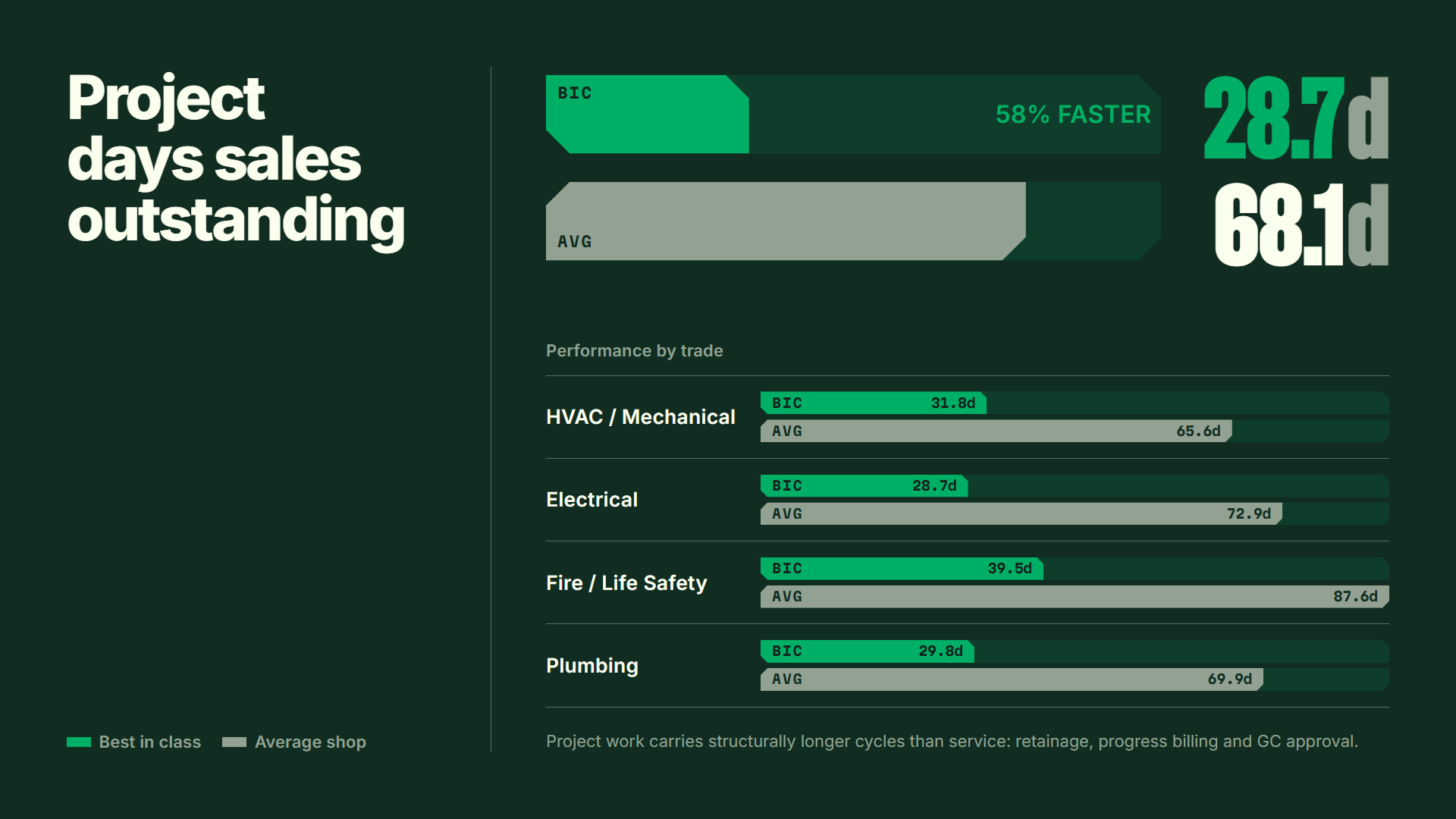
The average fire and life safety contractor waits 87.6 days to collect project revenue compared with 39.5 days for best-in-class contractors, a 48.1-day gap.
Fire and life safety contractors have a built-in reason for customers to come back.
- Inspections are required.
- Testing is recurring.
- Equipment needs to be maintained.
- Deficiencies routinely create opportunities for additional work.
For contractors that can consistently turn those visits into renewals, recommendations, and follow-on projects, the recurring-revenue model can provide a level of predictability that is difficult to replicate with one-time service alone.
Torque 2026, the annual Commercial Contractor Benchmark Report by BuildOps, shows best-in-class fire and life safety contractors generate 29.1% of their revenue from maintenance agreements compared with 17.8% for the average fire and life safety contractor.
Those contractors have the highest maintenance agreement penetration of any commercial trade in the report. That is a significant advantage, but recurring revenue does not automatically translate into fast cash flow.
Despite high rates of maintenance agreements, the report shows the average fire and life safety contractor waits 87.6 days to collect project revenue compared with 39.5 days for best-in-class contractors, a 48.1-day gap.
The recurring-revenue advantage
Fire and life safety work is built into the requirements of operating the facility, which creates a natural opportunity to establish ongoing relationships around inspections, testing, maintenance, and compliance.
Those relationships also can create opportunities beyond the agreement.
- An inspection can uncover a deficiency.
- A deficiency can lead to a recommendation.
- A recommendation can become a quote.
- A quote can become project work.
When the process works as it should, the recurring inspection base becomes a source of additional business that already is connected to an existing customer relationship.
Torque 2026 identifies maintenance agreement penetration as a leading indicator of resilience because those customers provide more predictable recurring revenue and are a primary source of pull-through work identified during scheduled visits. That makes the size and health of the agreement base worth watching.
But a recurring customer base is only one part of the equation. Contractors need to make sure the opportunities that surface during those visits do not disappear between the field and the office. And they need to be certain the work moves through the billing cycle efficiently.
Internal inefficiencies lead to delayed cash
Project work naturally carries longer collection cycles than service work. Torque 2026 points to retainage, progress billing, change-order cycles, and general contractor approvals as structural reasons project revenue can take longer to collect.
At the same time, it identifies documentation gaps as an important source of avoidable delay, including:
- Missing labor reports;
- Unsigned change orders; and
- Incomplete lien-waiver packages.
That distinction matters because the delay may be due to issues in the contractor’s workflow, beginning well before an invoice reaches a customer’s accounts-payable department.
For example, the inspection or project may be complete, but the job record may still be missing a required piece of documentation. The office then has to track it down, billing waits, and the invoice eventually moves into an approval process that may introduce another round of questions or missing information. By the time the invoice is finally submitted, several days, or even weeks, may have passed since the work was finished.
None of those steps necessarily looks like a major problem on its own. Taken together, however, they can turn completed work into an 87-day cash cycle.
Find the cause of long payment cycles
For fire and life safety contractors, Torque 2026 identifies two questions fire and life safety contractors should ask themselves.
Are you turning your recurring inspection base into predictable renewal and follow-on work?
Best-in-class fire and life safety contractors reach 29.1% maintenance agreement penetration. That does not mean 29.1% is a universal target for every company, but it does provide a useful benchmark for understanding how much of the customer base is tied to recurring work.
Start by looking at customers who received one-time service during the past year but were never offered an agreement. Then look at upcoming renewals, inspection findings, and recommendations.
The report recommends making the agreement offer part of the service visit and tracking penetration by technician and customer segment, rather than relying only on a company-wide number.
Once work is complete, how quickly does documentation become an invoice and then a payment?
Take the projects that have been sitting in accounts receivable for more than 60 days and identify the factors holding each one up. Follow the entire path from inspection or project completion to complete job record, invoice creation, invoice approval, and payment. Then look for patterns.
- If the work is complete but the documentation is not finished for several days, the problem may be in the field-to-office handoff.
- If the documentation is complete but the invoice does not go out promptly, billing cadence may be the issue.
- If the invoice is submitted quickly but sits while someone waits for a PO, signature, lien waiver, or other approval, the bottleneck is somewhere else entirely.
The goal is to identify which part of the process is consistently adding delays and determine who owns the next step to streamline the billing workflow.
A better workflow with the right tools
A strong recurring-revenue business and a fast cash cycle should not have to operate as separate processes. The same customer relationship that generates an inspection also creates the:
- Job history;
- Documentation;
- Deficiencies;
- Recommendations;
- Renewals; and
- Potential follow-on work.
That is where a connected operating process can make a difference. BuildOps connects agreement schedules, inspection work, deficiencies, recommendations, and renewal activity to the customer and job record. Field documentation can be captured as the work happens so the office has the information needed to support a complete, reviewable invoice. Operations and billing can work from a shared view of completed work, including:
- Work that’s ready to invoice;
- Invoices waiting for information; and
- Factors that have been held as an exception.
Torque 2026 gives fire and life safety contractors a useful picture of best-in-class performance. Those benchmarks are a starting point for finding the gaps in your own operation and figuring out whether the bigger opportunity is growing the recurring base, moving more of that work into follow-on revenue, or simply getting paid for completed work much faster.
Download the full Torque 2026 Benchmark Report to see where your business stands across cash velocity, recurring revenue, productivity, and operational efficiency, and identify where closing the gap could have the biggest impact.