How Geauga Mechanical Rebuilt its Service Operation on BuildOps
"Before BuildOps, I couldn't see where we were making money, where we were losing money, without drilling very deeply into our accounting software."
Geauga Mechanical has been in business since 1950 — third generation, family owned, based in Chardon, Ohio, serving greater Cleveland with design/build construction, VDC coordination, building automation, and commercial service.
Dan Slattery, Service General Manager, has been there 25 years. Tina Snider, Account Manager, has been there 21. Between them they've been through every system change the company has made in the last two decades, starting with paper tickets. So when Geauga went looking at field service platforms again, neither of them had to guess at what to ask.
Customer snapshot
The challenge: The company outgrew what it had
Geauga went live on a field operations platform in May 2024. A year and a half later, they started looking elsewhere.
"It was great when it started, because we didn't have it before," Slattery said. "But as time went on and as we evolved as a company and we grew, it didn't change with us."
Slattery and Snider each experienced their own challenges with the platform.
"I couldn't see where we were making money, where we were losing money, without drilling very deeply into our accounting software," Slattery said.
For Snider, who works service-to-construction, the information she needed came from technicians in the field — but how much of it arrived at her desk was up to them.
"There was a lot of play on their end of stuff they could put in and not put in, so we were constantly battling to get all the information and get it quickly," she said.
That turned into a billing problem as the agreement book grew.
"The billings never worked right," Snider said. "It was always a struggle every month to get everything done correctly."

The solution: A system that could keep up
The Geauga team compared multiple platforms. A few things stood out about BuildOps.
"In the process of talking with BuildOps, there was a lot of transparency that I really liked," Slattery said. "If we asked them something that wasn't possible, they would just tell us, well, we can't do that." Elsewhere, he said, a yes had a way of turning into an extra cost or an extra module once they looked closer.
Two capabilities settled it. Gated workflows answered Snider's problem directly — a technician can't move to the next step until the current one is done. And AI summaries cleaned up what came back from the field.
"Our technicians write, whether it's three sentences or 30 sentences," Slattery said. "The AI summary makes it a lot more pleasing to read, especially when we present that to a customer."
The Geauga team was methodical during implementation — they knew they wanted the platform to work as intended from day one, rather than using shortcuts that would get them live faster and never go away.
"If you're thinking you're going to come back later and set it up, you probably won't. You'll probably just have these workarounds in there," Slattery said. "We wanted to use it as it was intended."
Getting there meant working closely with the same person at BuildOps leading up to go-live — their Implementation Manager, Sam. “He dove into things we hadn't even thought about,” Slattery said. “We didn't realize it at the time, but he was setting us up for success.”
By the time Sam flew out to Chardon for the go-live, the relationship was already built.
"We had a chemistry before he even got here, just because we'd been on all these Zoom calls," Slattery said. "When he actually showed up in our office, it was awesome — because it was the same guy."
Putting the app in front of technicians was the part Slattery worried about most. It was much easier than he expected. Sam spent two days on-site, running two separate training sessions and sitting down with every technician one-on-one to make sure each of them was comfortable before he left.
"Once he went through it with them, everybody just kind of looked around and nodded and said, okay, I got it," Slattery said. "We took away all the flip phones about a year ago and handed out iPhones. That didn't go over nearly as well as BuildOps did."
Snider felt the difference too. "The onsite, I think, was huge. We did not have that in our past implementations," she said. "After the last implementation, some things never worked — we had great support, and then we had no support. It was just great that there was someone in the room, and we worked through any problems that came up."
The consistency didn't end at go-live. Geauga stayed in close contact with Sam for a while after launch, then settled into a weekly call with their CS rep, CJ.
"The support is awesome," Slattery said. "It doesn't matter what our question is, we feel like it's handled with a pretty high level of urgency."
The results: Visibility they can act on
Ask how much faster quotes and invoices go out now and there's no percentage, which is its own kind of answer.
"I don't know, because we really didn't have a way to measure that before," Slattery said. Geauga now tracks quote turnaround, close rates, quote volume, and accounts receivable in one place.
The visibility changed decisions. Some of the accounts that felt like the biggest lift turned out not to be.
"Sometimes it feels like we're doing a huge amount of work for a customer, and then when you look at the numbers, you realize they're just being really loud and demanding a lot from us," Slattery said. The quiet ones that pay fast and rarely complain, he said, were the ones getting taken for granted.
Geauga has started prioritizing its best accounts, and tightened receivables using credit risk warnings and credit holds configured during setup. "Those things we implemented during the setup process allowed us to make those decisions kind of automatically," Slattery said.
On the service side, the field information problem went away, and purchase orders came in from the two separate modules they used to live in.
"We're getting our notes and we're getting the pictures, and we're able to get quotes out faster, we're able to get invoices out faster," Snider said. "It's nice that a lot more of our service work lives in BuildOps."
Geauga also replaced a standalone GPS platform with Fleet+, which feeds the dispatch board directly.
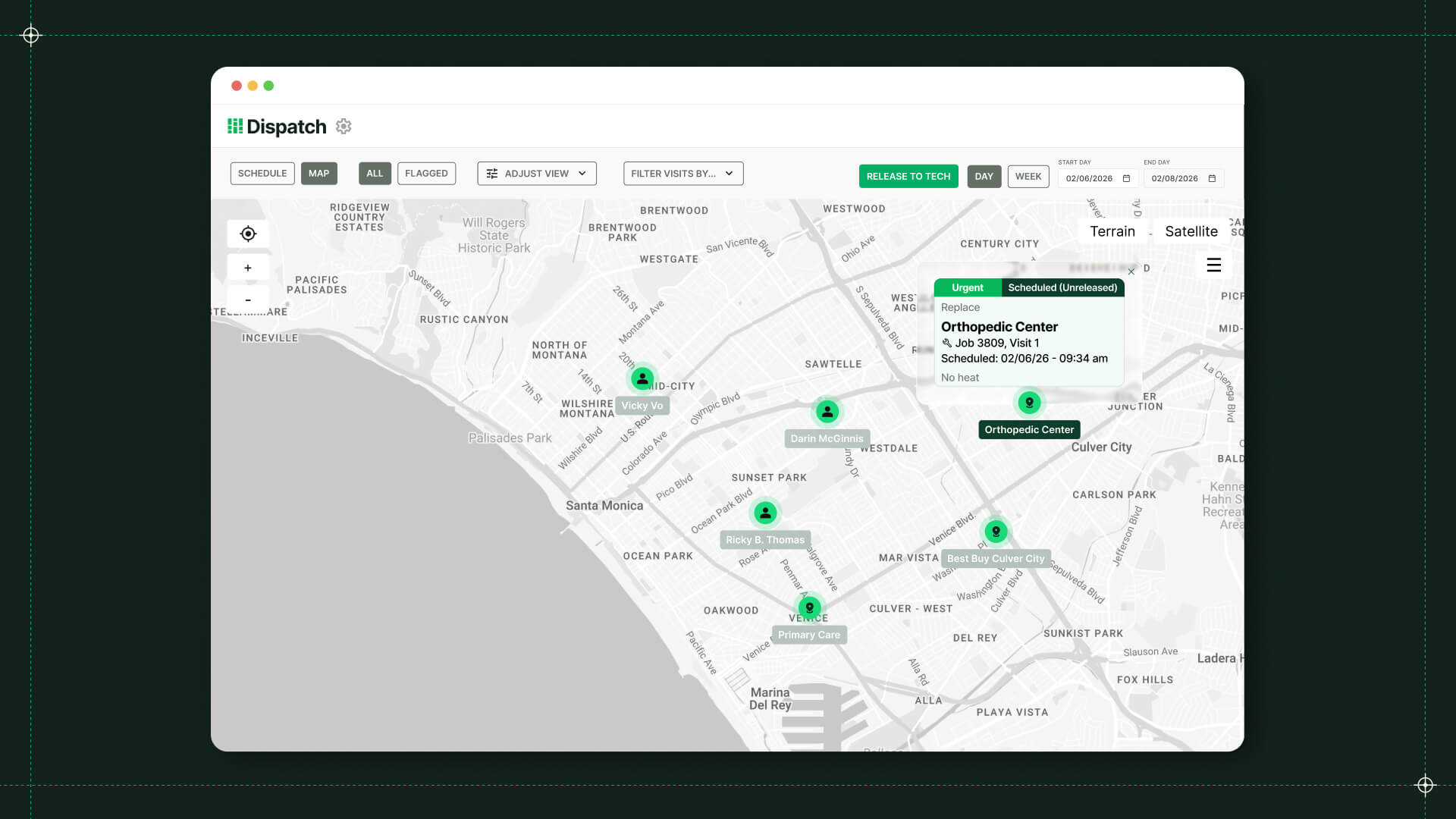
"All of us as contractors are toggling between a whole bunch of different programs," Slattery said. "With Fleet+, it populates right into the dispatch board and the dispatch map, so we can see where our active service calls are and where our technicians are."
Looking ahead
Slattery isn't easily wowed by updates to any technology. So his opinion about the BuildOps roadmap is worth listening to.
"I'm not the first person to be very receptive to the latest update on my iPhone," he said. "But these things that BuildOps is coming out with are actually useful for people like me, and we're using it a lot."
Geauga has more it plans to do with BuildOps. Snider wants to bring the company’s equipment into asset tracking, something they never did in previous systems, and get more from profitability reporting by customer and service type. Slattery wants to build out scheduled reporting. Both have already started using Smart Dispatch, and Slattery sees plenty of room left to grow with it.
"There's so many different ways to use BuildOps and customize it," he said. "We're getting there, but there's a lot that we could still be doing."
Slattery's advice to contractors looking at the same decision is the process Geauga ran on itself: "Look at multiple different platforms, talk to other contractors and see what they use, and then take your time when you're implementing your choice."