Data centers are booming. Is the rest of construction?
Data-center contractors report 11.4 months of backlog. Everyone else reports 7.5. Here's why the gap exists and what it means if you're not one of them.
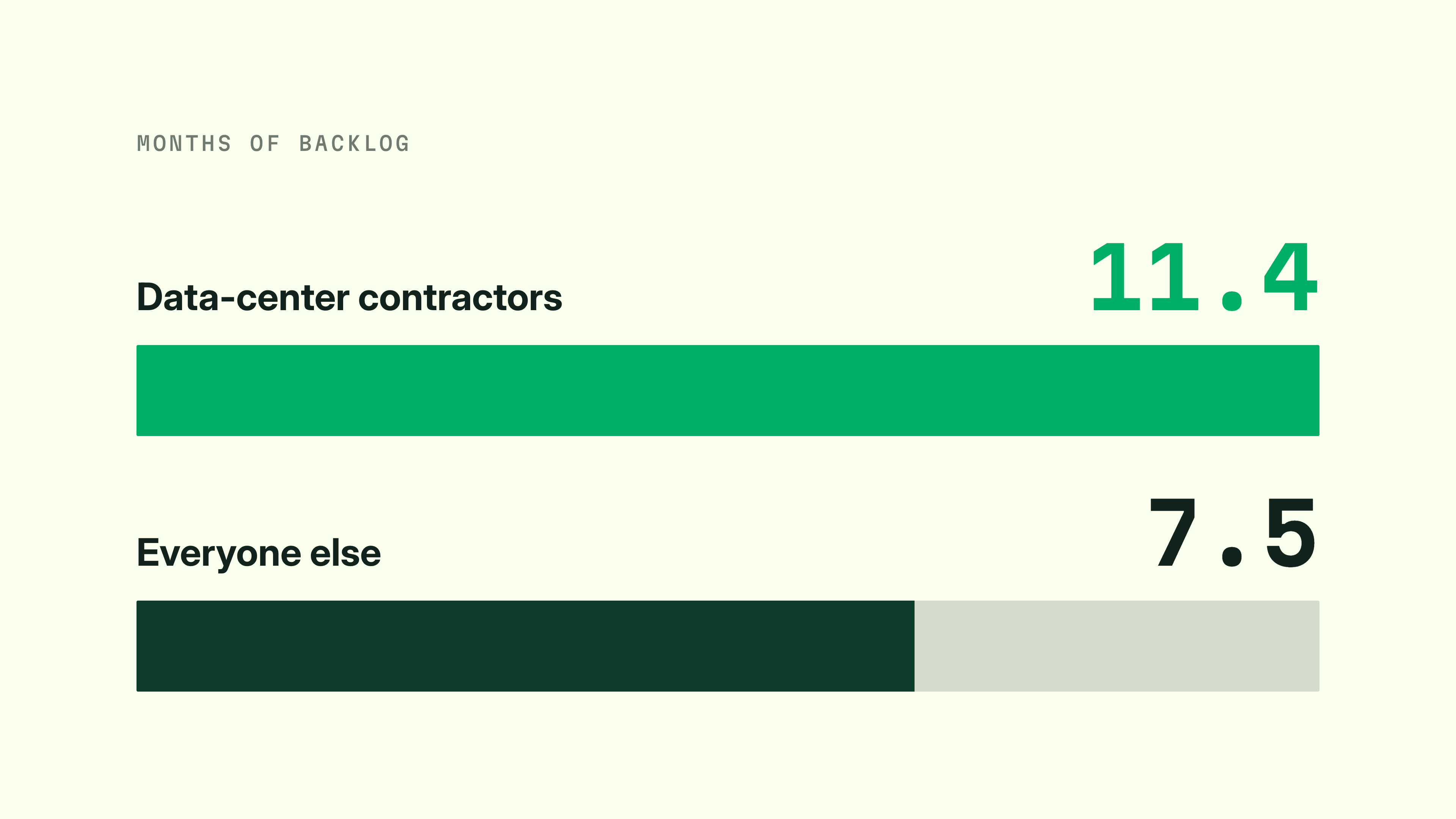
Much of this year's construction coverage has centered on a boom driven by data centers and AI infrastructure. Despite that attention, most commercial contractors aren't feeling it. The average commercial contractor had 8 months of work under contract as of July — the lowest reading since January — according to Associated Builders and Contractors' Construction Backlog Indicator. Contractors currently under contract for data-center work are sitting on 11.4 months of backlog. The other 88% of ABC's membership — the contractors not building data centers — average just 7.5.
Why this gap exists: data-center construction right now is being funded by a small handful of buyers — Amazon, Microsoft, Google, Meta, and the private capital chasing the AI buildout — who are committing to multi-year, multi-billion-dollar projects largely without blinking at financing costs. Almost every other kind of commercial and industrial work is funded by owners who are blinking: tighter lending conditions, tariff-driven material costs, and real uncertainty about federal infrastructure funding are all making ordinary owners slower to commit. One small slice of the industry has demand that's effectively recession-proof right now. The rest of it doesn't. BuildOps saw this coming before the backlog data confirmed it: a survey of over 600 commercial contractors found that 50% of electricians were already reporting growing demand tied specifically to data centers, months before this split showed up industry-wide.
The spending data shows the same split. The Census Bureau's Value of Construction Put in Place — the government's monthly measure of actual, completed construction spending — puts total spending at a seasonally adjusted $2,166.5 billion in June 2026, down 3.2% from June 2025. The category breakdown inside that number is telling: nonresidential manufacturing construction is down 21.4% year over year, while office construction — much of it tied to the same data-center and tech-infrastructure buildout — is up 12.5%. Spending is soft almost everywhere except the categories riding the same demand wave as data centers.
Hiring confirms the same pattern. The Associated General Contractors of America found construction employment grew in only 165 of 360 metro areas — 46% — in the year through June 2026. It fell in 131 and was flat in 64. The metros with the biggest gains — Houston, Baton Rouge, St. Louis — are also among the country's most active data-center and industrial-buildout markets. Job growth is following the same money as the backlog.
Margins show the same divergence. Construction input costs are up 7.1% year over year as of June, according to an AGC analysis of BLS producer price data — roughly double the 3.5% growth in contractors' own bid prices over the same period. Every contractor is facing that same materials inflation. Pricing power only exists where demand is strong enough to support it. A contractor with 11 months of backlog and buyers who aren't price-shopping can push more of that cost increase into the bid. A contractor competing for a shrinking pool of ordinary commercial work can't — they eat it instead.
The same materials inflation is hitting every commercial contractor in the country this year. One narrow segment has enough demand behind it to absorb that and keep growing. Everyone else is holding the same rising costs against work that's flat or shrinking — a harder business to run in 2026 than the headlines about a construction boom suggest.