Only 14% of Contractors Are Confident They Catch Every Dollar Owed
We asked contractors and more than 29% said that their quotes don't get followed up on. That's not just a visibility problem, it's a revenue leak.
If you are looking for the best software to find the revenue your field-service jobs are leaving behind, the answer isn’t another place to store notes.
It’s a system that turns completed work into a clear next action: a quote, a repair, a replacement, or an agreement conversation.
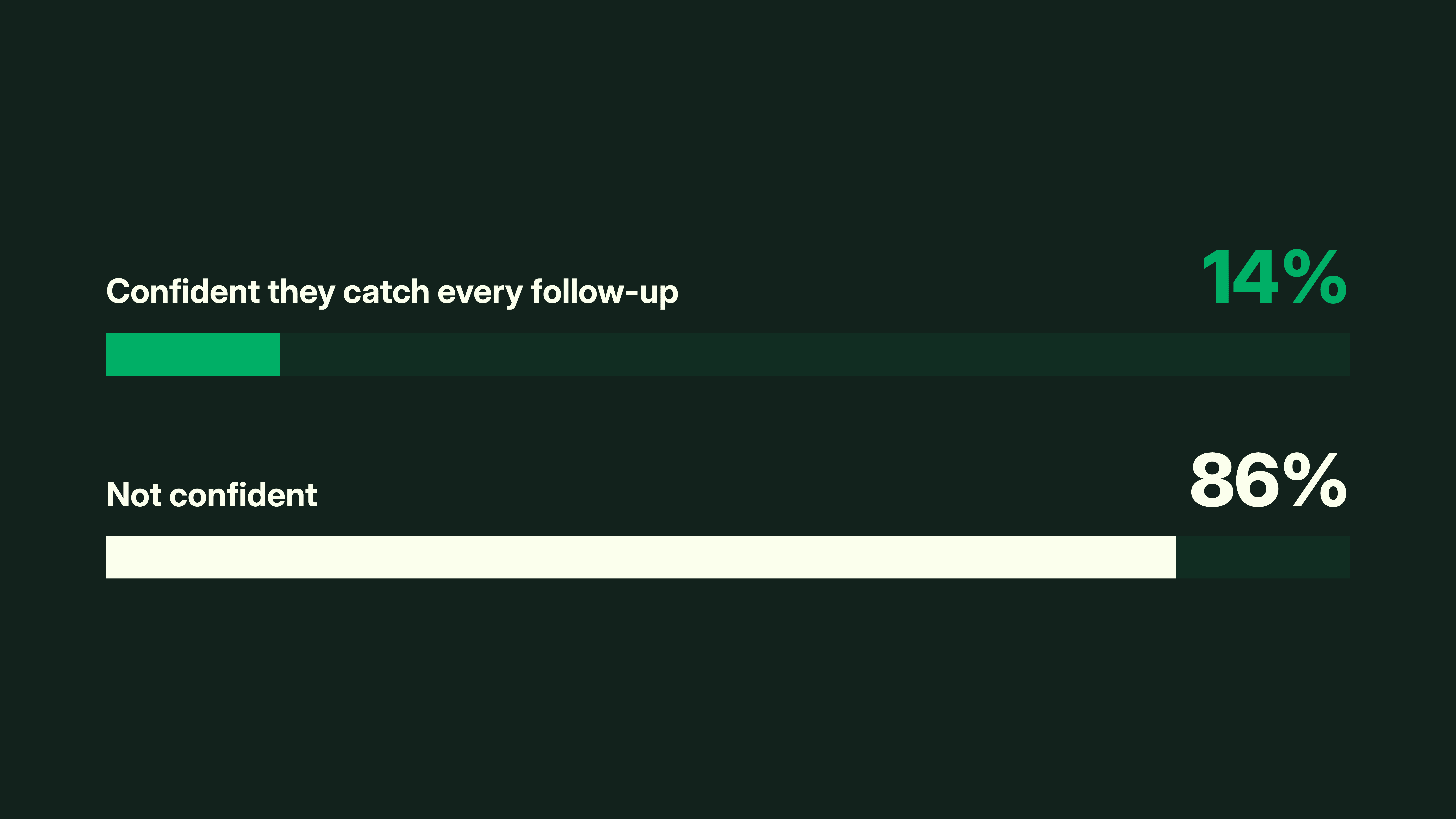
In our recent survey of 76 commercial contractors, only 14.5% said they were very confident they captured every follow-up opportunity.
Most contractors don’t have a reliable way to know whether every follow-up made it into the quoting process, and that’s more than a workflow issue. It reflects a bigger operating problem: contractors are doing the work, documenting what they found, and still losing the thread before that work becomes revenue.
Revenue gets missed when field information disappears between the visit and the follow-up.
The fix is a system that can connect those two moments.
The black hole is where the money goes
Contractors see their notes, payment details, and job information go into systems, but don’t always see it come back as something the team can use.
One contractor described it as 100,000 dollars falling into a black hole with no one the wiser.
Another contractor explained that data doesn’t matter unless the team can rely on it.
“It makes it difficult to make good business decisions when you don’t trust the data.”
These are not separate problems. They are the same broken handoff showing up in different places. A field observation does not become a quote. A job detail does not make it to billing. A report does not give leaders enough confidence to act.
The result is a business that has to rely on memory, inbox searches, spreadsheets, and manual checks to find work it already paid someone to uncover.
Leakage usually comes from a collection of small handoff failures: work orders stay open, documentation sits in inboxes, material charges miss invoices, changes are not captured, or invoices go unpaid.
A useful self-audit follows one completed job through four comparisons: work completed versus work invoiced, invoiced work versus payments received, materials used versus materials captured, and technician documentation versus what billing actually receives.
Keep reading here to see how small discrepancies compound before anyone sees a six-figure problem.

The numbers show how often the handoff fails
In BuildOps’ survey 51.3% of respondents were only somewhat confident, 31.6% were not very confident, and 2.6% said they do not track it. Confidence in follow-up capture is the exception, not the norm.
The next question is where the opportunities disappear.
The top answer, selected by 37.5% of respondents, was that issues found in the field never become quotes. Another 29.2% said quotes are not followed up. Together, those two gaps accounted for 66.7% of responses to the question about where money is being left on the table.
That is the important distinction: the problem is not always a lack of demand or a lack of work. Often, the issue has already been found. It simply does not move forward.
The second finding is that follow-up control depends on five basic checks:
- Are opportunities visible?
- Does each one have an owner and next step?
- Is the team acting fast enough?
- Does every opportunity have a clear outcome?
- Are those measures improving month over month?
Keep reading here to see how to make the gap measurable instead of leaving it to memory.
What actually fixes it: make completed work actionable
The practical fix is to read the work that is already being completed and give the office a clear action while the context is still fresh.
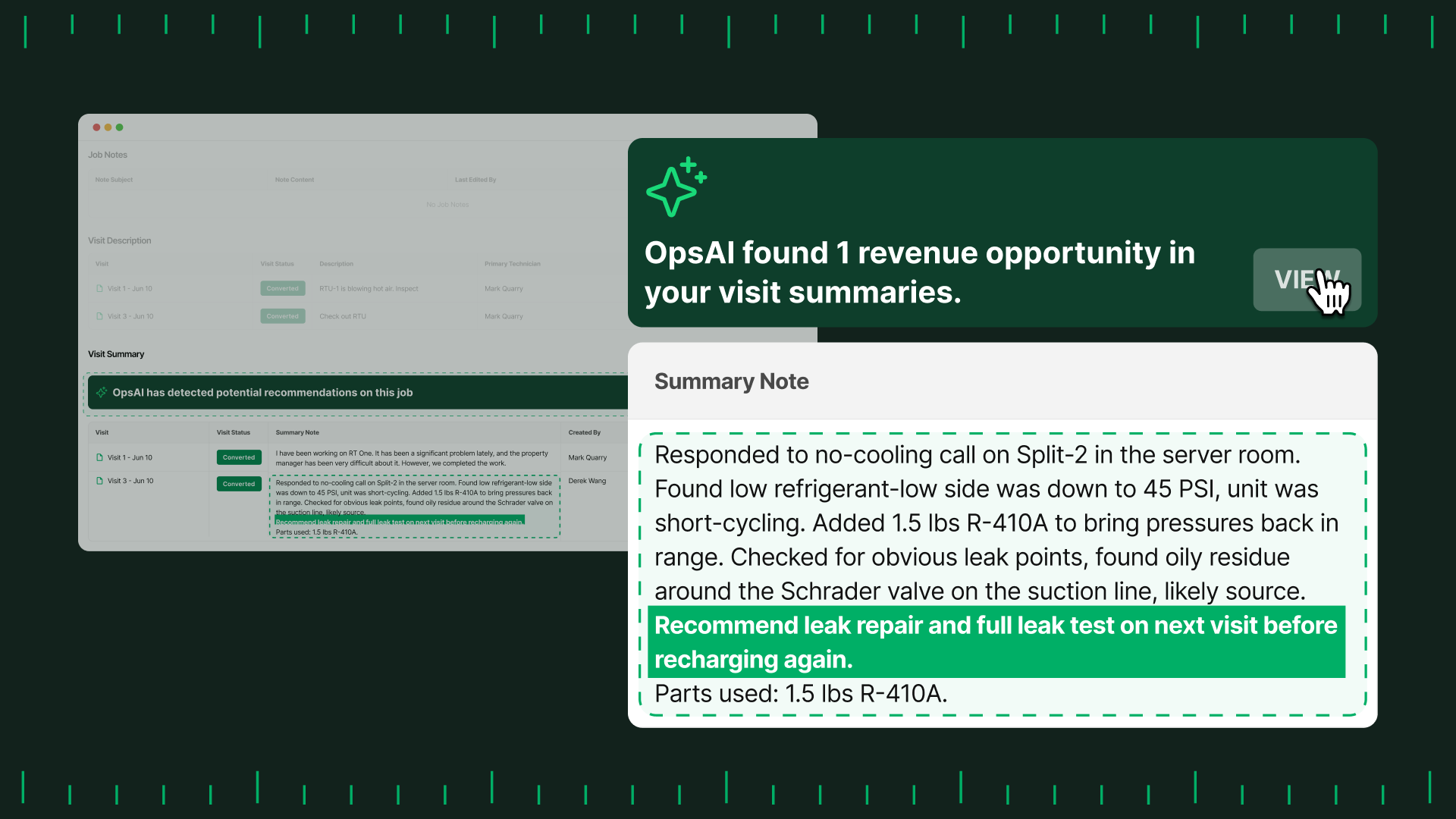
Revenue Finder reads completed visit notes and surfaces signals for deferred repairs, replacements, and agreements. Those signals appear inside the service workflow as one-click quote actions. The office does not have to build a follow-up list from scratch, search through old notes, or copy the same details into a separate system.
The value is in the handoff:
- A technician documents what they found during the visit.
- Revenue Finder surfaces the follow-up signal from the completed note.
- A service manager reviews the context and converts it into a quote.
- The opportunity stays connected to the customer, asset, and job history.
In 90 days, 4,500 surfaced recommendations converted into real quotes. On surfaced recommendations, quote-creation time fell by about 60%.
This is what a useful system should do with field data: bring it back as a next step. Not another report to check later or queue for someone to maintain. A quote your team can review while the job, asset, and customer context are still in front of them.
The same pattern shows up in purchasing. When purchase orders live in email or comments instead of a connected workflow, the office has to re-enter information and reconcile what was ordered, delivered, and invoiced. The supporting findings put the potential reduction in manual purchase order entry at about 80% when purchase documents are captured and matched in the workflow.
The leak looks different by trade
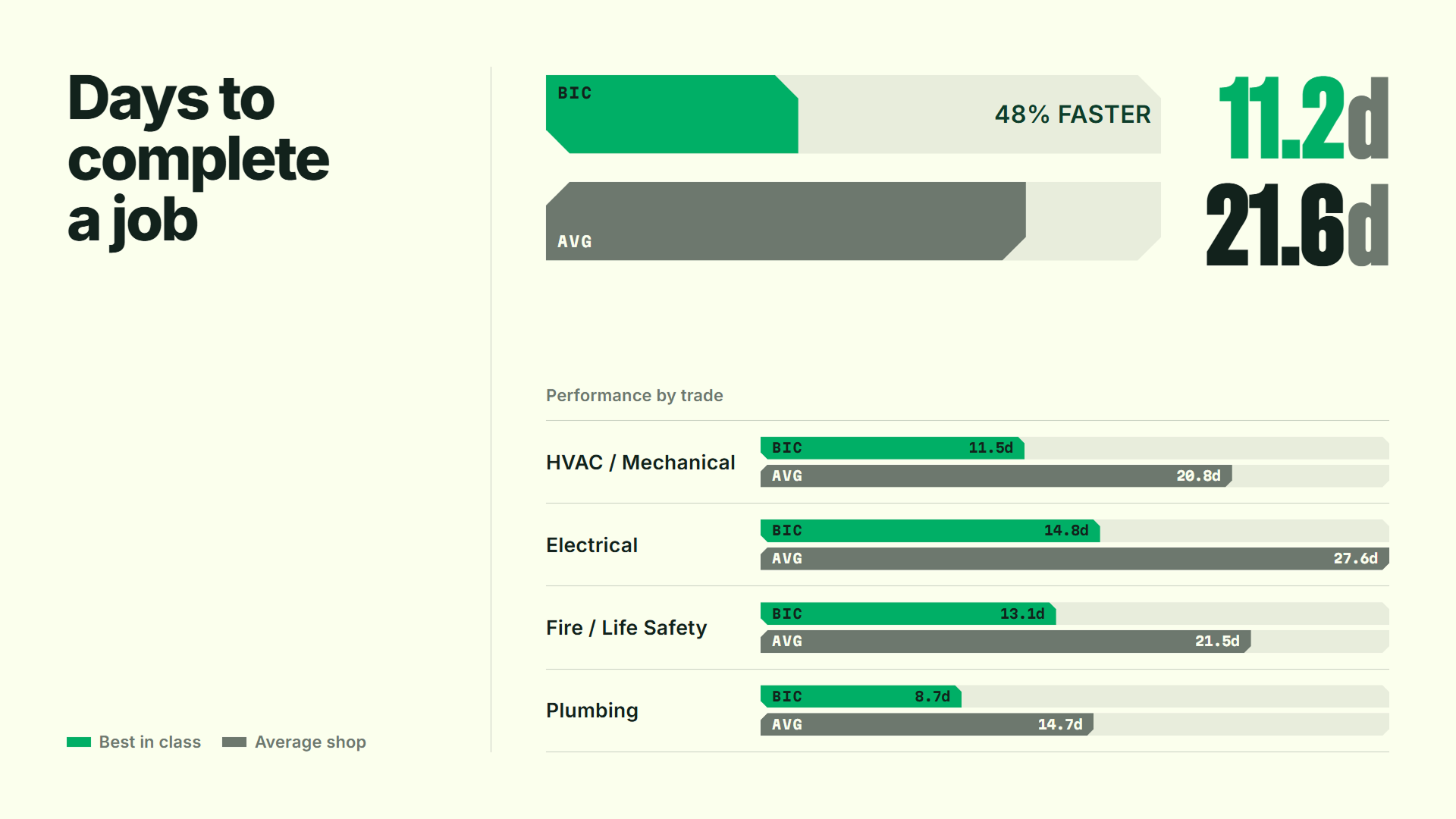
The same handoff problem shows up differently by trade. Plumbing contractors face an average 85-day service DSO, compared with 25.8 days for best-in-class shops. A completed job that is not documented, invoiced, and followed through quickly can tie up working capital for months. The 2026 Torque Benchmark Report makes the cash-collection gap visible.
Fire and life safety teams show the same issue through recurring work and payment delays. Best-in-class contractors reach 29.1% agreement penetration, while the average Fire and Life Safety contractor sits at 17.8%; the trade also carries an average project DSO of 87.6 days. Recurring work only helps when inspections, deficiencies, quotes, service, and billing stay connected.
Across those trade-specific gaps, the Torque 2026 Benchmark Report gives leaders a way to see the whole picture. The measures include revenue per technician, service DSO, job cycle time, tech-to-back-office ratio, quote-to-close win rate, and maintenance agreement penetration. Tracking those numbers turns “we might be missing something” into a short list of measurable handoffs to fix.
Start by finding where you're losing revenue
Contractors know that if they're not watching it, revenue will fall through the cracks. What they need a way to see where it’s happening and stop it:
- Which completed visits included a repair or replacement recommendation?
- How many of those recommendations became quotes?
- How long did it take to create each quote?
- Which quotes are still waiting for follow-up?
- Where does information disappear between the field, the office, and billing?
Answer those questions, and the software decision becomes clearer. The right platform is not the one with the longest feature list. It is the one that helps your team carry work from the field into the next action without losing the details along the way.