Plumbers Wait Longest of Any Trade to Get Paid. Here’s Why.
The top 20% of plumbing contractors on BuildOps collect in just 25.8 days.
Getting paid can feel like a never-ending job for commercial plumbing contractors. The work is complete, so the technician moves on to the next call, and the truck is dispatched somewhere else. Meanwhile, the invoice makes its way through a process that can involve a:
- General contractor;
- Facility owner;
- Purchasing department; and
- Public-sector approval chain.
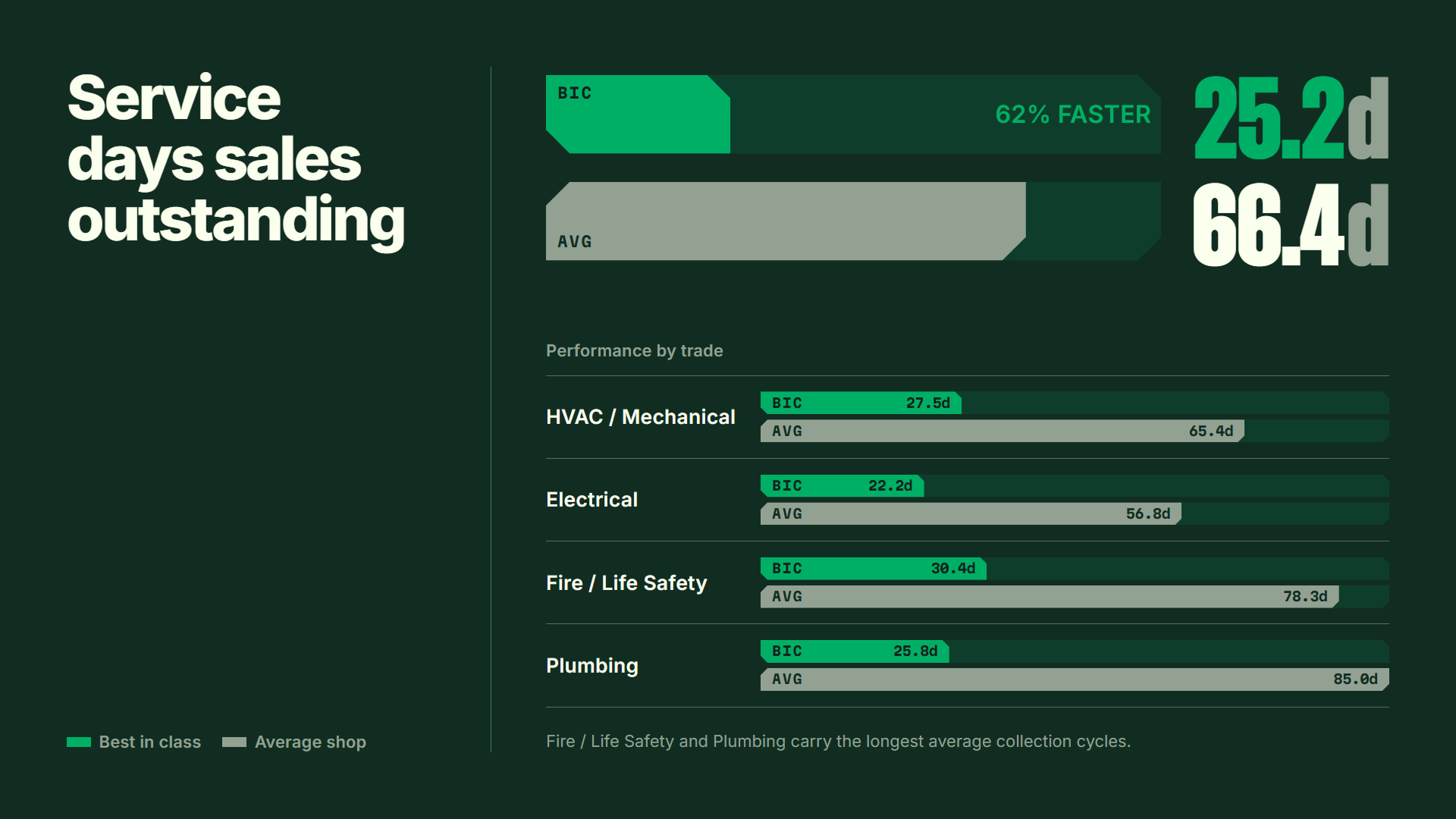
According to Torque 2026, the annual Commercial Contractor Benchmark Report by BuildOps, plumbing contractors wait an average of 85.0 days to collect on service work. That is the longest service collection cycle of any commercial trade in the report.
Alternatively, the top 20% of plumbing contractors on BuildOps collect in just 25.8 days. That is a 70% improvement over the average and the largest service DSO gap of any trade.
The top plumbing contractors have not discovered a secret way to make customers pay faster. Instead, they are better at making sure there is less waiting between completing the work and placing a clean invoice in front of the person who needs to approve it.
Structural vs. procedural billing delays
Commercial plumbing has a legitimate cash-flow problem that contractors cannot simply operationalize away. Plumbers often sit at the end of the commercial payment chain.
- A contractor may complete the work for a GC.
- The GC then has to bill the property owner.
- The owner may have its own review process.
- Public-sector work can introduce another layer of approvals before a payment is released.
Those cycles can add days or weeks to an otherwise straightforward invoice. But structural payment terms do not explain an 85-day average when the top 20% of plumbing shops are collecting in 25.8 days.
That difference proves the same slow-paying customer base can pay top plumbing shops in under four weeks. The distinction between the two is:
- What happens before the invoice reaches the customer; and
- Whether that invoice arrives complete enough to move through the approval process without another round of questions.
Realistically, not every invoice can be collected in 26 days. The goal is to separate unavoidable delays from delays created by inefficient workflows.
Improve DSO with better billing
Consider what happens at the end of a service call. The technician finishes the work, but the job record is missing a few details.
- The labor isn't fully documented.
- The parts used were not entered correctly.
- Photos or notes are missing.
- Purchase-order information is incomplete.
- A signature still needs to be tracked down.
Those problems mean the contractor is not ready to bill, not necessarily that the customer is refusing to pay. That distinction is where a surprising amount of cash can disappear.
Torque 2026 found documentation and billing processes are major contributors to long collection cycles. And it points to billing speed, not customer behavior, as the issue. The difference between average and best-in-class performance is when the invoice goes out and how complete it is when it lands in front of the customer.
Plumbers should start treating billing as a process that starts in the field. Every completed service call contains information that eventually has to support an invoice before payment can move forward, like:
- Labor;
- Parts;
- Notes;
- Photos;
- Customer approvals;
- Purchase-order details; and
- All additional information the customer requires.
When that information arrives cleanly and quickly, billing can invoice. When it arrives piecemeal, somebody in the office has to track it down.
The broader findings in Torque 2026 reinforce the point. Across commercial specialty trades, the report identifies the “field-to-office gap” as a common root cause behind performance differences in DSO, job completion, and other operational metrics.
Plumbing offers a particularly clear example. The average plumbing contractor takes 14.7 days to complete a job, while the top 20% complete jobs in 8.7 days. Yet the trade still has an 85-day average service collection cycle. The physical work may be done, but the administrative work required to turn that work into cash may not be completed.
Best-in-class contractors close that gap by moving information from the field to the office more quickly and completely.
Find billing delays in your workflow
Revenue is not cash until the workflow turns completed work into a billable, approved, collectible invoice, which is why the 25.8-day number matters so much.
Plumbing contractors do not have to simply accept 85 days as the price of doing commercial work. Some of the payment cycle is outside their control, and some of it is sitting inside their own operation. The trick is understanding the difference.
Plumbers should start by identifying how many days pass between completing a service job and creating the invoice. Then they should look at every completed work order that has been sitting for more than 48 hours without an invoice.
- Is the documentation incomplete?
- Is somebody waiting for a PO number?
- Is billing unclear about who owns the job?
- Is the invoice missing information the customer requires?
Those are workflow problems that, unlike a customer's payment terms, a contractor can fix. Torque 2026 recommends working every completed work order that remains unbilled after 48 hours.
Solving those problems can improve DSO, which will improve operations. Every day between completed work and collected payment is another day the contractor is carrying the cost of labor, materials, vehicles, payroll, and overhead without the cash that work was supposed to generate.
Tools to stop the slow payment cycle
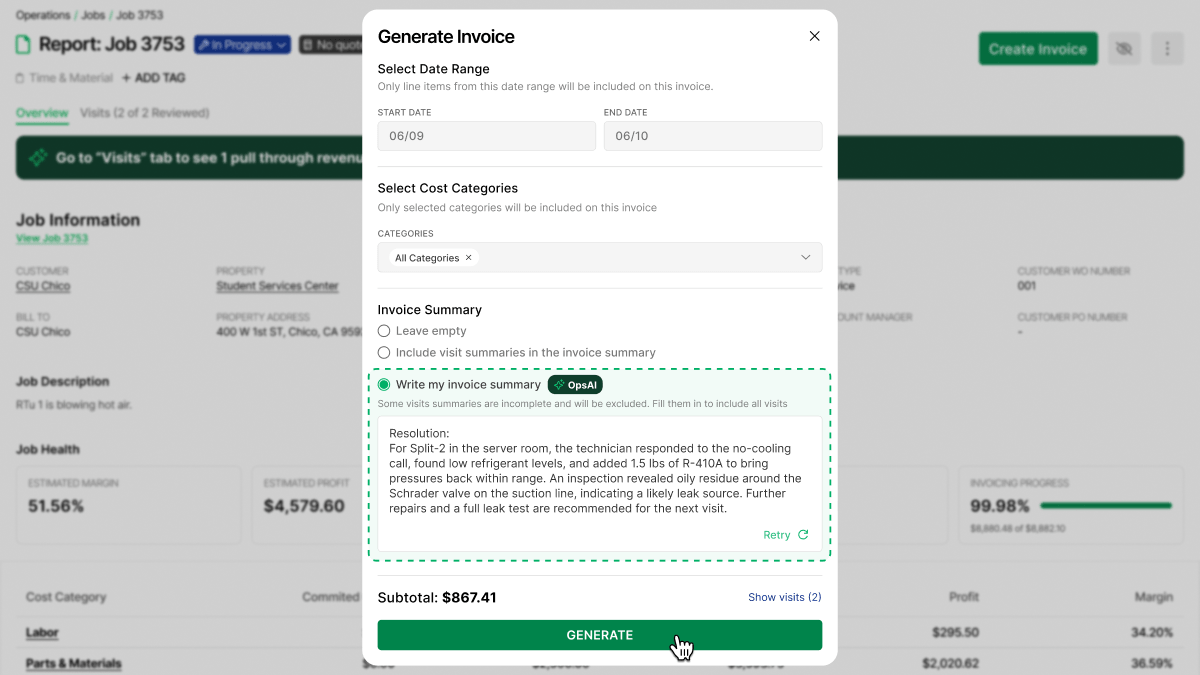
Technology can help make the handoff from field work to billing visible and repeatable. With BuildOps, plumbing contractors can capture labor, parts, notes, photos, and other billable information directly in the job record. Teams can:
- Review the Job Report before work moves into invoicing;
- Use required fields and invoice triggers to reduce completed work sitting unbilled; and
- Give billing and operations a shared view of work that is ready to invoice and exceptions that still need an owner.
That system helps contractors identify and streamline the part of the payment cycle they can control.
The full Torque 2026 Commercial Contractor Benchmark Report by BuildOps breaks down the payment gap across plumbing, HVAC/mechanical, electrical, and fire/life safety, including service and project DSO, revenue per technician, job completion time, work-order throughput, and more. It gives contractors a way to see where their own operation stands and the biggest opportunities to improve cash flow and shorten DSO.