HVAC Software with Bluon Integration for Field Crews

Your techs are on a rooftop, staring at a unit they’ve never seen before. In the HVAC service industry, that’s just another Tuesday. Dispatch is already eyeing the next call while your team thumbs through spec sheets, hopping between apps to get answers fast.
Bluon delivers the equipment data, refrigerant guidance, and live troubleshooting they need. But when that info lives outside your field service platform, techs waste time switching tools—and your office loses visibility into what’s really happening on the job.
HVAC field service software with Bluon integration transforms your workflow. Instead of bouncing between a tech reference app and a separate system for dispatch, invoicing, and job tracking, everything lives in one place. Your techs get the equipment insights they need without ever leaving the platform they already use to log hours, update job status, and close out work orders.
Here's what we'll cover:
- What Bluon does well vs what HVAC service software adds
- Top 6 HVAC field service software for contractors
- Real-world benefits of integrating Bluon with HVAC field service software
- 5 questions to ask a Bluon-compatible HVAC software vendor
Let's start with what Bluon brings to the table on its own, and where a dedicated field service platform picks up to handle the rest of your day-to-day operations, from the first dispatch to the final invoice.
What Bluon does well vs what HVAC service software adds
Bluon has earned a spot on almost every HVAC tech’s phone for a reason. When your team is standing in front of unfamiliar equipment, it delivers fast, reliable answers. That kind of access matters when you’re running service calls across dozens of building types and hundreds of unit models.
But Bluon is a technical reference tool, not an operational system. It’s built for quick lookups, not for running your business. Here’s what it does well, what it doesn’t touch, and where HVAC field service software steps in to handle everything else.
Why Bluon matters for HVAC businesses
Bluon is a data and AI company built specifically for the HVAC market.
It gives technicians instant access to the information they need to diagnose, troubleshoot, and service equipment faster, without waiting on hold or flipping through outdated binders.
Here's what Bluon brings to the table for HVAC teams:
- Equipment database - Access to specs, manuals, and parts lists across over 200 brands and nearly 500,000 model families
- AI-driven troubleshooting - Real-time technical support that helps techs work through diagnostics and repairs on the spot
- Refrigerant guidance - Up-to-date information on refrigerant types, charging procedures, and regulatory changes
- Manuals and parts lookup - Technicians can pull up what they need for a specific unit without leaving the job site
- Live expert support - When the database isn't enough, Bluon connects techs with knowledgeable support staff who can walk them through complex issues
For a deeper look at how Bluon's tools connect with a full field service workflow, the BuildOps and Bluon integration partnership breaks down exactly how that works in practice.
What HVAC service software adds that Bluon can't do
Bluon keeps your techs sharp on the technical side. But if scheduling, job tracking, invoicing, and customer records live somewhere else, or nowhere at all, you've got gaps in the process that are costing you time and money.
Here are the main features you're missing out on by not pairing Bluon with a dedicated HVAC field service platform:
- Mobile app for technicians to enter job details - Lets them track parts, labor, and hours right on the job in real-time so nothing is missed
- Scheduling & dispatching - Linking these to quotes, actual work done, and later invoicing removes a lot of manual time spent by office workers
- Service agreement management - For ongoing and recurring work for your customers
- HVAC tech time tracking - Linked to specific jobs and projects
- Field service reporting - Custom reports suited to HVAC businesses, built from data across your entire workflow, not just equipment lookups
- Invoicing and payments - Creating, sending, and tracking invoices from the field so billing doesn't wait until someone's back at the office
- Asset, equipment, and inventory management - For all the components that keep jobs moving along quickly
- CRM & pipeline management - Managing in-progress quotes and potential business coming in, as well as customer details
- Fleet tracking - Where your vans are, as well as GPS tracking and route optimization
Your tech uses Bluon to diagnose and fix the problem. Great. But your office still has to chase time, parts, and notes across tools—and that’s where money slips through the cracks.
Connect Bluon to your HVAC field service software and those details flow straight into the job record. No double entry. No app hopping. Techs stay in the field. The office stays on top of billing and scheduling. And you get one system where equipment intel and operations finally work together.
Up next: the best HVAC field service platforms for contractors in the field.
{{related-content-block="/resources/bluon/"}}
Top 6 HVAC field service software for contractors
Most HVAC platforms say they help techs in the field—but look closer and you’ll see the same problems: shallow equipment data, no Bluon integration, and clunky workflows that force your team to bridge the gaps.
So we pulled together six HVAC field service tools that actually perform. These platforms streamline dispatching, job tracking, invoicing, and daily ops—whether you’re managing commercial service agreements or residential maintenance—so your techs can stay organized, move faster, and focus on the work that matters.
1. Best for commercial HVAC teams with Bluon integration: BuildOps

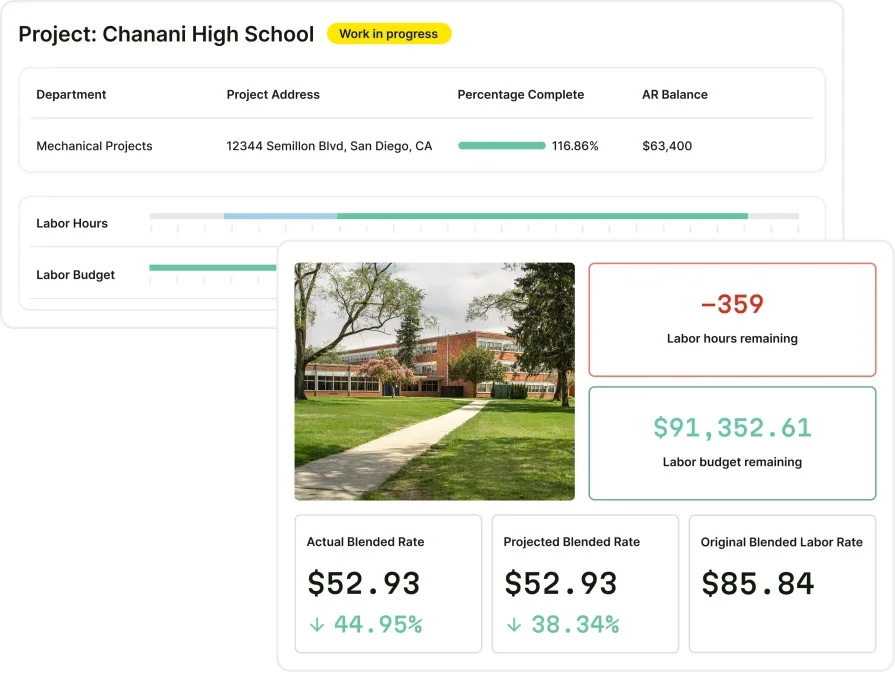
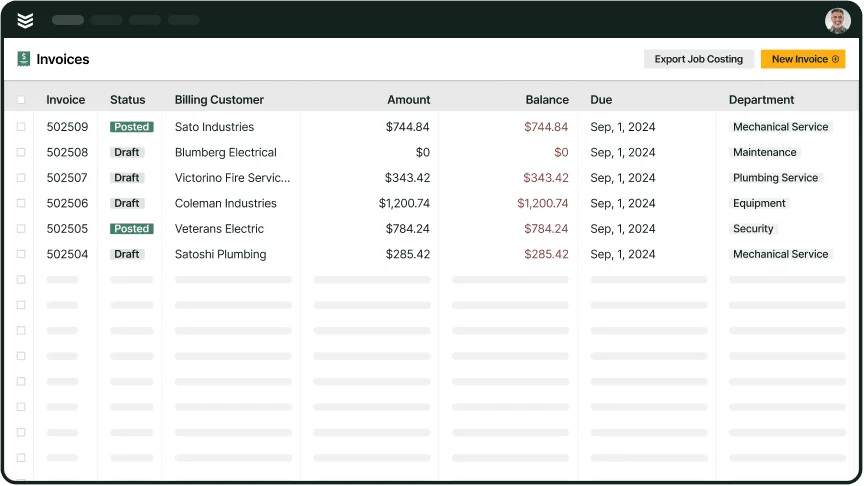
BuildOps is the all‑in‑one operations platform built specifically for commercial HVAC, plumbing, and electrical contractors. From scheduling and dispatch to job costing and invoicing, BuildOps connects your office and field in real time so you can run every job, every tech, and every dollar from a single commercial‑grade system.
What sets BuildOps apart is our direct integration with Bluon. We’re the first purpose‑built commercial platform to bring Bluon’s equipment database, AI‑driven troubleshooting, and live technical support straight into the field service workflow.
Techs get specs, manuals, and refrigerant data right inside the BuildOps app they use every day—no app-switching, no double entry, just faster, smarter service.
Bluon Integration: Built directly into the BuildOps platform
How pricing works: BuildOps operates on a custom pricing model based on company size, required features, and the number of users. Pricing is structured as a per-user, per-month fee with enterprise-level options available.
Features beyond dispatching:
- Advanced job costing and profitability tracking
- Smart scheduling and dispatching to optimize technician efficiency
- Custom workflows designed for large-scale commercial service businesses
- Asset and equipment tracking for preventive maintenance contracts
What sets it apart for commercial: BuildOps connects Bluon's equipment intelligence with complex commercial field operations workflows like service contracts, large-scale job tracking, and multi-location management—giving both techs and office staff full visibility from a single system.
Rating: 4.5 on Capterra from 151 user reviews
2. Best for residential HVAC: Housecall Pro
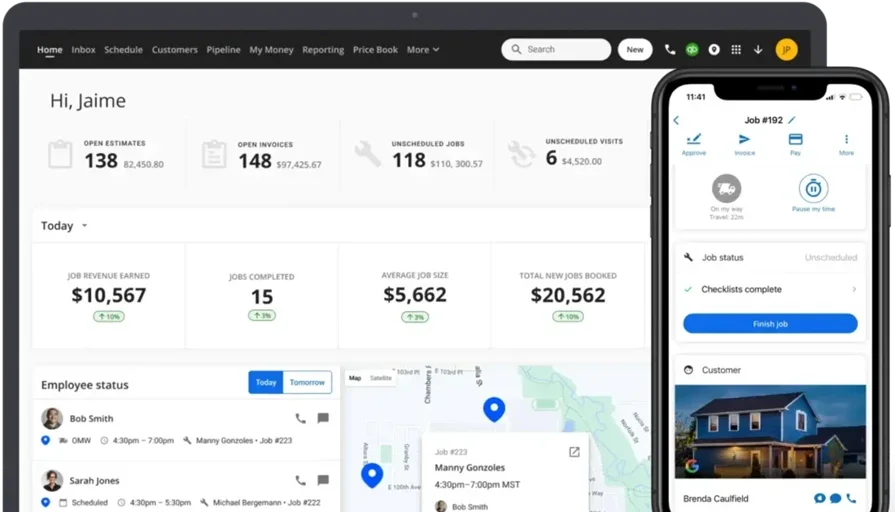
Housecall Pro Housecall Pro is geared toward residential HVAC businesses that want a simple way to manage scheduling, billing, and customer communication. It's user-friendly, mobile-ready, and keeps field and office teams in sync without a steep learning curve. It's a strong fit for smaller teams that handle routine service calls, installs, and homeowner maintenance.
Housecall Pro has partnered with Bluon to embed equipment data, manuals, parts lookup, and AI-driven troubleshooting directly into the platform—giving techs access to Bluon's toolkit without leaving their existing workflow. That said, it may still fall short for commercial contractors who need advanced job costing, asset tracking, or long-term service contract features.
How pricing works: Housecall Pro uses a tiered subscription model, with monthly pricing that scales based on features and number of users. Premium tiers unlock marketing tools, proposals, and advanced automation.
Features beyond dispatching:
- Online booking and customer text updates
- Mobile app with real-time technician tracking
- Paperless quotes and digital payments
- Automated maintenance reminders for recurring service
What sets it apart for residential HVAC: Housecall Pro simplifies day-to-day operations for small HVAC shops. With Bluon now integrated, residential techs get equipment intelligence alongside their scheduling and invoicing workflow—though the platform remains primarily designed for homeowner-facing service, not complex commercial operations.
Rating: 4.7 on Capterra from 2736 user reviews
See how Housecall Pro and BuildOps stack up against each other here.
3. Best for large residential and commercial operations: ServiceTitan

ServiceTitan is a well-known platform in the HVAC space, offering a wide range of features including dispatching, call booking, pricebook management, and marketing automation. It's designed for mid-to-large HVAC businesses that want a comprehensive system to manage both residential and commercial service operations.
ServiceTitan has partnered with Bluon to power its Field Pro AI product, giving technicians access to Bluon's equipment database, troubleshooting training data, and diagnostics for over 200 OEMs and over 25 million unique pieces of HVAC equipment—all through ServiceTitan's Atlas AI interface.
How pricing works: ServiceTitan uses custom pricing based on the number of technicians and selected features. Onboarding fees and implementation support are typically included.
Features beyond dispatching:
- Pricebook management with dynamic pricing options
- Marketing automation and call tracking
- Membership and service agreement management
- Detailed reporting dashboards for revenue and technician performance
What sets it apart for larger HVAC operations: ServiceTitan handles high call volumes and complex workflows across multiple service lines. With Bluon's data now powering its AI layer, techs get equipment intelligence through the Field Pro interface—though the Bluon data is accessed via ServiceTitan's AI rather than as a standalone embedded tool within the core workflow.
Rating: 4.3 on Capterra from 325 user reviews
See how BuildOps stacks up when it’s compared directly to ServiceTitan.
4. Best for streamlined service operations: Sera
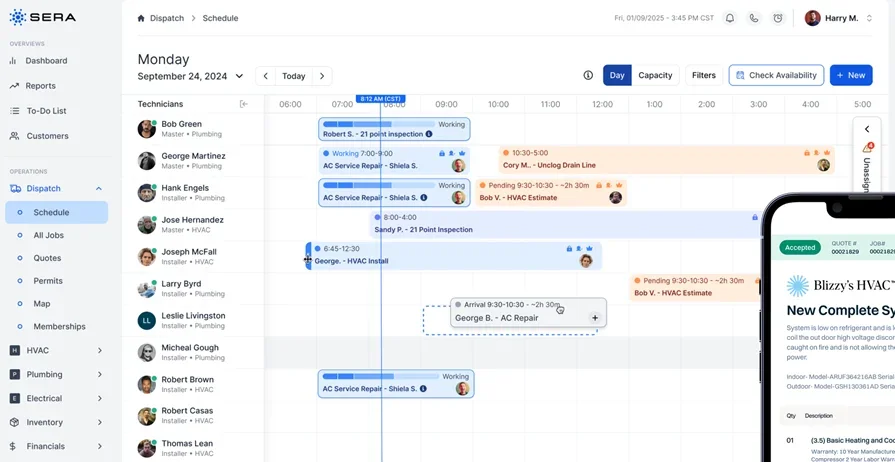
Sera focuses on helping HVAC contractors tighten their operations by connecting scheduling, dispatching, and financial tracking in a single workflow. The platform puts a heavy emphasis on real-time margin visibility, giving owners and managers a clear picture of profitability on every job as it happens—not weeks later when the books are reconciled.
With Sera and Bluon’s partnership, combining Sera's FSM capabilities with Bluon's equipment database, community tools, and tech support—with the goal of creating a connected ecosystem from OEM to distributor to contractor to technician.
How pricing works: Sera uses a subscription-based pricing model with plans that scale based on team size and feature access. Onboarding support is included.
Features beyond dispatching:
- Live job profitability tracking with real-time margin alerts
- Flat-rate pricing tools with built-in markup guidance
- Membership management for recurring service agreements
- Technician scorecards tied to revenue and close rates
What sets it apart for margin-focused HVAC teams: Sera gives HVAC business owners immediate visibility into whether a job is making or losing money—before the tech even leaves the site. With Bluon integration on the roadmap, the platform aims to pair that financial clarity with equipment-level intelligence, though the depth of the current integration may vary compared to platforms where Bluon is already fully embedded.
Rating: 4.4 on Capterra from 23 user reviews
5. Best for small to mid-size HVAC teams: Jobber
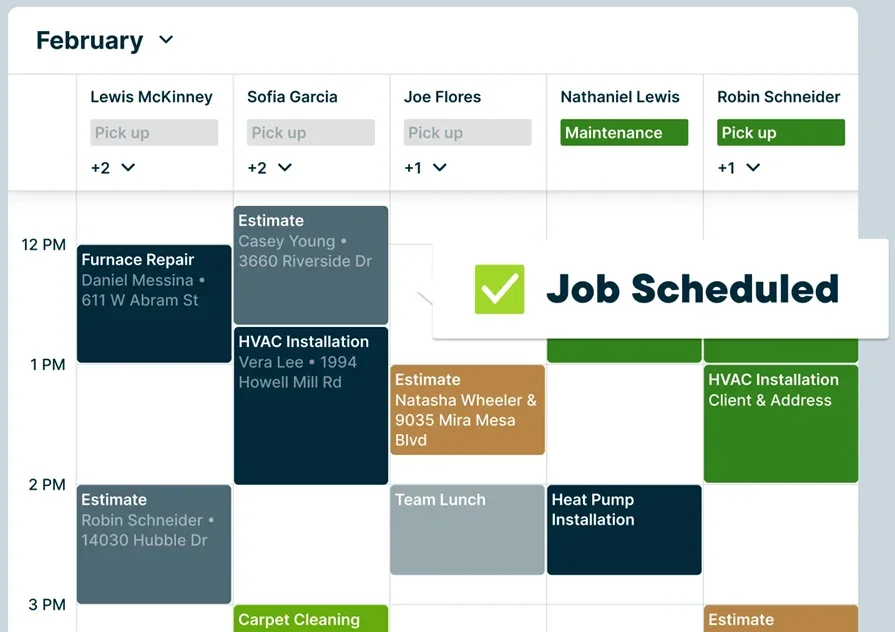
Jobber is a popular field service platform among small to mid-size HVAC businesses that need a clean, easy-to-use system for quoting, scheduling, invoicing, and client communication. It's designed to get teams up and running quickly without heavy onboarding or complex configuration, and its client-facing features—like online booking, a self-service portal, and automated follow-ups—help smaller HVAC shops stay organized as their customer base grows.
How pricing works: Jobber offers tiered monthly plans based on the number of users and feature access. Higher tiers include advanced reporting, automated follow-ups, and quoting tools.
Features beyond dispatching:
- Client hub for self-service booking, approvals, and payments
- Automated follow-up emails and review requests
- GPS tracking and route optimization for field crews
- Batch invoicing for high-volume service days
What sets it apart for growing HVAC shops: Jobber keeps things simple without sacrificing the tools a growing team needs. Its intuitive interface and quick setup make it a strong fit for HVAC businesses that want to professionalize their operations without a steep learning curve.
Rating: 4.6 on Capterra from 1438 user reviews
6. Best for high-volume residential service: Workiz
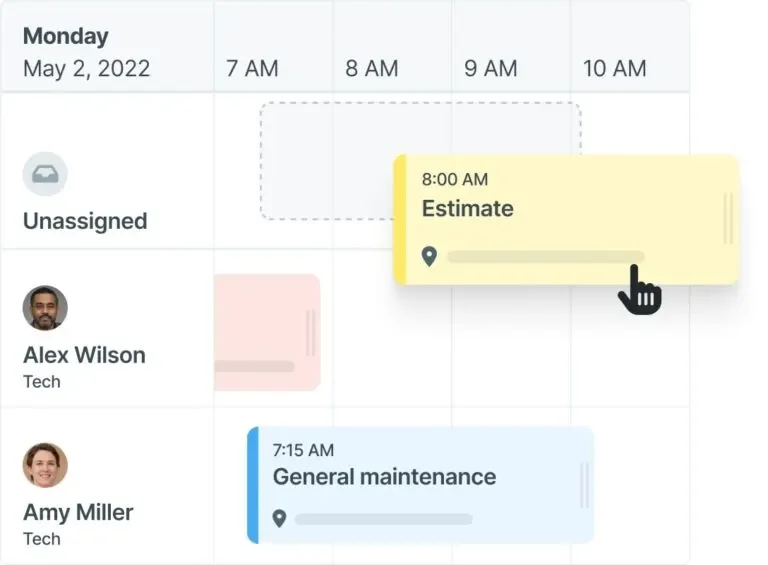
Workiz is designed for home service businesses that handle a high volume of inbound calls and need to convert those calls into booked jobs fast. It offers call tracking, online booking, dispatching, and invoicing in one platform—making it a solid option for residential HVAC teams that rely on phone leads and fast turnaround.
How pricing works: Workiz uses tiered monthly pricing based on the number of team members and selected features. A free plan is available for very small teams, with paid tiers unlocking automation, reporting, and integrations.
Features beyond dispatching:
- Built-in call tracking with lead source attribution
- Online booking widget for websites and social media
- Automated job reminders and follow-ups
- Inventory tracking and payment processing
What sets it apart for high-volume residential HVAC: Workiz helps residential HVAC teams capture and convert inbound leads without letting calls slip through the cracks. Its call tracking and booking tools are especially useful for shops where the phone is the primary source of new business.
Rating: 4.4 on Capterra from 218 user reviews
Real-world benefits of integrating Bluon with HVAC field service software
Here are some tangible ways you can expect pairing Bluon's equipment intelligence with a dedicated HVAC field service platform to pay off quickly—and show some early ROI:
1. Faster diagnostics, fewer return trips
Techs can access specs, manuals, and troubleshooting info before they open the panel, all pulled from Bluon’s database of 200+ brands and nearly 500,000 model families. Embedded in your field service platform, this data is tied to each job, customer, and asset—cutting “What unit is this?” calls, avoiding wrong parts, boosting first-time fix rates, and reducing costly repeat visits.
2. Dispatching that accounts for equipment, not just location
Most dispatch boards assign techs based on who's closest or who's available. But when Bluon's equipment data is connected to your dispatching workflow, dispatchers can factor in what unit the tech is walking into—not just where the job is. That changes the game for complex commercial service calls where the wrong tech on the wrong unit means wasted hours.
Pairing equipment intelligence with equipment dispatch software lets your team match certified techs to specific unit types, attach relevant manuals to the work order, and send the crew out prepared. Less guesswork for dispatch, fewer surprises for the tech.
3. AI-powered troubleshooting cuts downtime
Bluon’s AI support, trained on 120,000+ live calls, gives techs equipment-specific guidance in the field and writes it back to the job. Connected to your field service platform, it builds a real-world knowledge base that speeds diagnostics, keeps systems running, and helps newer techs handle unfamiliar units without pulling in a senior.

4. Cleaner job records without double entry
Your tech pulls up a unit's specs in Bluon, diagnoses the issue, logs the repair—and then someone back at the office has to re-enter all of that into a separate system. That's where details get lost, parts get missed, and invoices go out wrong.
Bluon automatically pushes equipment data into your field service platform, so models, specs, parts, and troubleshooting notes are captured once and stay with the work order, customer, and asset history. No app switching, no re-entry—your office sees exactly what happened on every job without chasing techs for notes.
5. More accurate quotes tied to real equipment data

Quoting a repair or replacement gets a lot easier when your estimating tools can reference the actual equipment on-site—model, age, parts availability, and service history. When Bluon's database connects to your quoting workflow, techs and estimators work from the same equipment data instead of relying on memory or handwritten notes.
That accuracy matters. Underquoting eats your margins; overquoting loses the job. HVAC quoting software that pulls from real equipment specs helps your team land bids that reflect the actual scope of work. And when those quotes tie back to takeoff data, the numbers stay consistent from estimate to invoice.
For teams handling retrofits and equipment swaps, HVAC takeoff software connected to equipment intelligence keeps quantities and labor hours aligned with what's actually installed.
6. Fleet coordination with equipment context
Sending the closest truck isn't always sending the prepared truck. When your fleet dispatch tools know what equipment is at the job site—and what parts, tools, or certifications the call requires—your dispatchers can route the crew that's actually ready to handle the work.
Fleet dispatch software paired with Bluon's equipment data means dispatchers aren't just looking at a map. They're looking at what the tech needs to bring, what unit they're walking into, and whether the van has the inventory to handle it. That cuts down on wasted trips, reduces idle time between calls, and keeps your fleet productive across the full service day.
7. Tighter operations from the field to the back office
When equipment, jobs, dispatch, and invoicing run in one system, everyone stays focused and efficient. AI-enabled HVAC scheduling optimization uses real-time data to automatically balance the board and keep the day on track.
When that scheduling intelligence connects to Bluon's equipment data, your dispatchers aren't reacting to problems. They're preventing them. And when things run smoother behind the scenes, customers notice. Faster diagnostics, cleaner documentation, and fewer dropped balls add up to a service experience that keeps contracts renewing and referrals coming in.
5 questions to ask a Bluon-compatible HVAC software vendor
Before you commit, bring these questions to your next demo:
- How deep is the integration? – Does it embed Bluon's database and AI support directly into the workflow, or does it just link out to a separate app?
- Is it built for HVAC service work? – Can it handle dispatching, service agreements, installs, and repairs the way your crew actually operates?
- How fast can your team adopt it? – A Bluon integration only helps if the platform around it is something your techs and office staff will actually use every day.
- Does equipment data attach to the job record automatically? – When a tech pulls up specs, do those details stay connected to the work order, the customer, and the asset history?
- Will it scale as you grow? – The platform should handle 50 techs across multiple locations just as cleanly as it handles five.
Equipment intelligence and field operations have always belonged together. The gap between them — a tech pulling specs in one app while the job record lives somewhere else — is where time, accuracy, and revenue get lost. Pairing Bluon with a field service platform that actually connects to it closes that gap for good.
Ask the hard questions before you commit to any vendor. Run the demo. Pick the platform that fits how your crew works — from the first dispatch to the final invoice.