The $200K You Lost Was Hiding in a Spreadsheet Until Month-End
If you don't see what's happening with a project until month-end, you're managing risk with a rearview mirror.
There's a moment in every project WIP meeting when someone's face changes.
It's the moment the numbers on the screen stop matching the story in their head. Labor ran hot in weeks three through six, but nobody flagged it because the hours were tracked on paper and the budget lived in a spreadsheet that only gets updated once a month. A change order was completed but never submitted. Materials were purchased against the wrong cost code. Overtime stacked up on a phase that was supposed to be finished two weeks ago.
None of these things are catastrophic on their own. But by the time they show up in a WIP report — four, six, eight weeks after they happened — the margin is already gone. The crews have moved on. The GC isn't going to sign a retroactive change order for work that was never documented in real time.
This is how projects lose money. Not in one visible mistake, but in a hundred small misses that only become visible when it's too late to fix them.
Why month-end visibility is too late
Service work gives you fast feedback. A tech goes out, the job is done, you invoice. You know within days whether it was profitable. If something went wrong, you fix it on the next call.
Projects don't work that way. The feedback loop is measured in months, not hours. Decisions made in week three show up as financial consequences in month four. And if your cost tracking depends on someone manually reconciling hours, materials, POs, and change events in a spreadsheet once a month, you're flying blind for 29 days out of 30.
The contractors we work with who run project financials well aren't doing anything magical. They've just closed the gap between "when money is spent" and "when someone knows about it."
That means daily labor cost estimates — not perfect-to-the-penny accounting, but a close-enough view that tells a PM "we're running 12% over on Phase 3 labor" before it becomes 30% over. It means committed costs from purchase orders and subcontracts visible the moment they're issued — not when the invoice arrives six weeks later. It means change events tracked from the field, connected to the scope and the budget, so nothing falls through the gap between "we did extra work" and "we got paid for it."
The change order gap
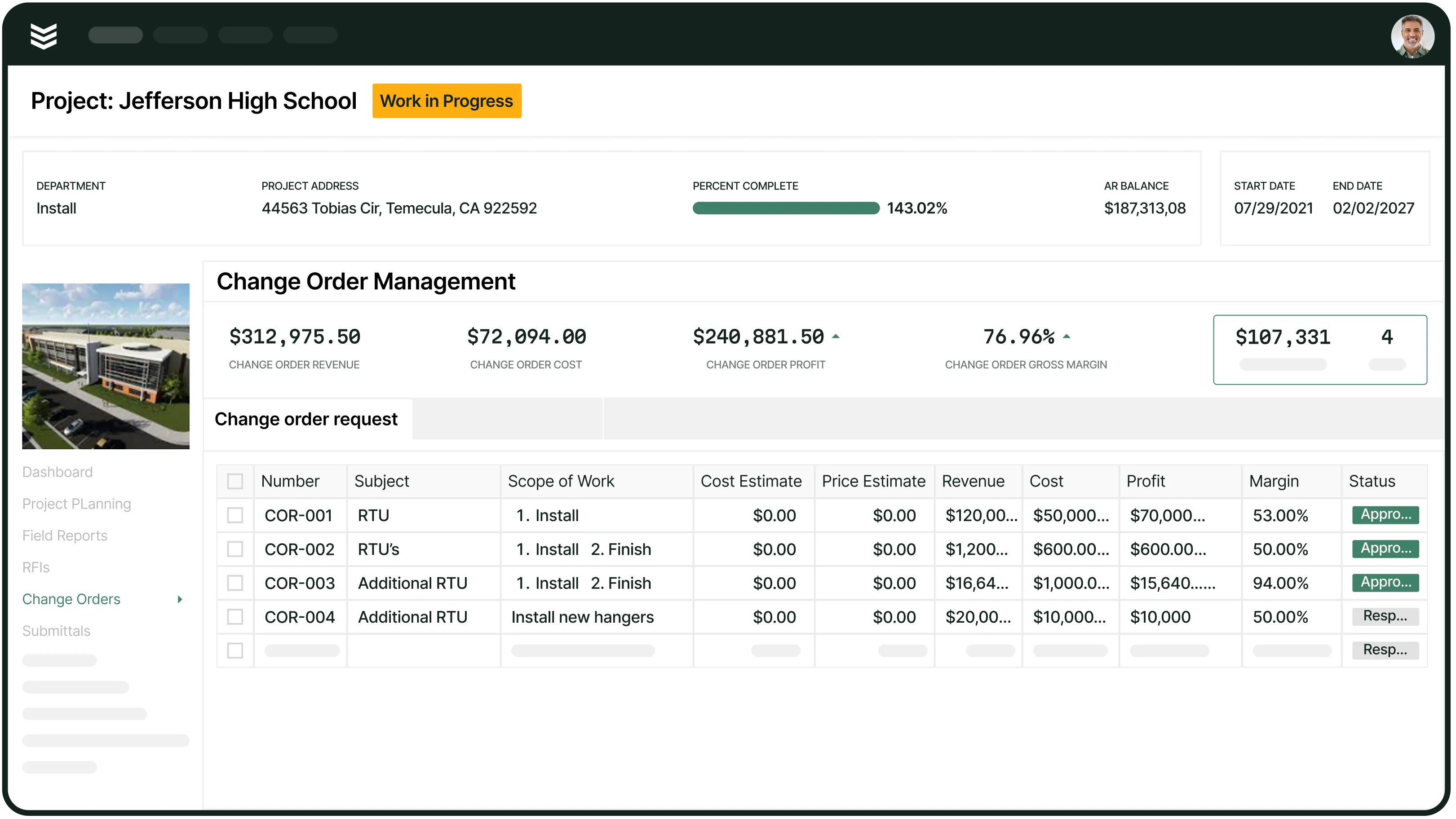
This is the single biggest margin killer in project work, and it's almost always a documentation problem — not a negotiation problem.
The work gets done. The field crew adjusts to conditions on the ground — that's what good crews do. But the adjustment doesn't get captured as a formal change event. Nobody submits the change order. Or they submit it three weeks late without backup. Or the PM knows it happened but can't connect it to a specific cost impact because the hours and materials aren't tracked against that scope change.
By the time it surfaces in the WIP meeting, the story sounds like an excuse, not a claim. And the GC has no reason to approve it.
The fix isn't "be better at paperwork." The fix is a system where a field observation — extra work, scope change, site condition — automatically connects to a change event, which connects to the budget, which the PM can see in real time without rebuilding a spreadsheet.
That's what it means to manage profitability instead of just reporting on it after the fact.
What 91% of contractors already know
According to BuildOps' own research, 91% of contractors say bidding is more competitive than ever. Margins are tighter. Inflation and interest rates are squeezing cash flow. 74% say operations are more complex than they've ever been.
In that environment, the difference between a profitable project and a money-losing one isn't usually the bid. It's what happens between the bid and the final invoice. And if you can't see what's happening in that gap until month-end, you're managing risk with a rearview mirror.
The WIP meeting shouldn't be where you find out. It should be where you confirm what you already know.