Why Classroom Learning Alone Doesn't Build Job-Ready Techs
The skilled labor shortage is pushing contractors, educators, and industry organizations to rethink how they develop the next generation of skilled technicians.
The skilled labor shortage is pushing contractors, educators, and industry organizations to rethink how they develop the next generation of skilled technicians. Trade schools are a critical part of that conversation, giving students access to modern equipment, experienced instructors, and a foundation in the technical principles they'll use throughout their careers.
But graduating from trade school isn't the same as being ready for the job site. The difference becomes obvious the first time a new technician steps onto a construction site. Suddenly, they're:
- Working in extreme temperatures;
- Navigating occupied buildings;
- Communicating with customers;
- Coordinating with other trades; and
- Troubleshooting equipment that rarely responds like the examples in a textbook.
Technical knowledge matters, and experience teaches technicians how to apply it.
The companies developing the strongest teams understand that classroom education and field experience are complementary approaches, and many are investing in digital workflows that support ongoing technician development. Classroom learning builds understanding while on-the-job lessons build confidence, judgment, and the ability to solve problems.
Trade school provides the foundation
Trade schools play an important role in preparing future technicians. Students learn electrical theory, refrigeration cycles, controls, safety practices, and equipment fundamentals before they're expected to work independently.
That technical foundation gives apprentices a vocabulary and framework for understanding what they'll encounter in the field. But the classroom has limitations.
"I went through trade school," says Karly Rolls Hoehn, Vice President of Rolls Mechanical. "It was 10 units that are pretty much brand new systems and a shop lab that's air-conditioned."
There's a good reason for that environment: Schools need equipment that's reliable, accessible, and safe for instruction. Students can focus on learning concepts without the unpredictability of active job sites.
Real buildings, however, don't operate under controlled conditions, and no classroom can fully recreate those variables.
- Equipment has years of wear.
- Components have been repaired, modified, or improperly maintained.
- Access can be limited.
- Customers expect answers.
- Production schedules don't pause because someone is learning.
The job site teaches lessons the classroom can't
The transition from school to the field can surprise even motivated graduates.
"I had somebody who joined our construction division who had gone through trade school,” Rolls Hoehn says. “He started with us on our install, went to the job site, and quit that same day. He said, 'I didn't know it would be hot.'"
Working in the trades means climbing ladders, carrying tools, crawling through mechanical spaces, working outdoors, adapting to changing schedules, and solving problems under pressure. Those experiences shape technicians in ways that lectures never can.
Just as importantly, the field develops skills that aren't purely technical. Technicians:
- Learn how to communicate with customers;
- Watch how experienced journeymen diagnose problems;
- Begin recognizing patterns that help them distinguish between symptoms and root causes; and
- Understand when to trust documentation and when to verify conditions themselves.
“Real-world experience is everything,” says Henry Kneeland, an HVAC service technician with Carolina Chillers.
Apprenticeships connect knowledge with experience
Rather than separating education from work, apprenticeships allow technicians to build both simultaneously. Classroom instruction provides the theory, while the field provides immediate opportunities to apply it.
"When you have the technical skills to back up that learning experience, it helps that much more," Kneeland says.
"You'll see something in the field, and it makes it easier to learn in class because you've actually seen it in operation and put your hands on it. They just work really well hand in hand."
Instead of trying to visualize how a control sequence works, apprentices can picture equipment they serviced earlier that week. Instead of memorizing components, they remember where they encountered them during an actual service call.
That's why Kneeland believes contractors shouldn't think of classroom education and apprenticeships as separate phases.
"I think it's essential to do them at the same time, because it's just going to take longer to learn otherwise," he says.
Tech tools turn field experience into structured learning
Many contractors already have strong apprenticeship cultures built around mentoring, but it’s key to make sure that learning is consistent and repeatable. Every service call contains valuable knowledge. The question is whether that knowledge disappears when the truck leaves the parking lot or becomes part of the organization's collective experience.
This is where connected field service technology can reinforce the work experienced technicians are already doing. With BuildOps, every service call creates a detailed record that goes well beyond closing out a work order. Through technician reports in the mobile app, technicians document the:
- Assigned work;
- Equipment serviced;
- Troubleshooting steps;
- Materials used;
- Photos;
- Videos;
- Visit summaries;
- Customer signatures; and
- Time on site.
Instead of relying on memory or handwritten notes, contractors create a library of real-world service scenarios that supervisors can review with apprentices before or after a job.
“Before BuildOps we had pretty much no asset history. You'd have to call the office, and then the office has to look. When you have it right in your hand, it's a game changer. You can see what happened in the past on that unit and immediately try to narrow down some issues.” Jacob Farley, Service Manager, Rolls Mechanical
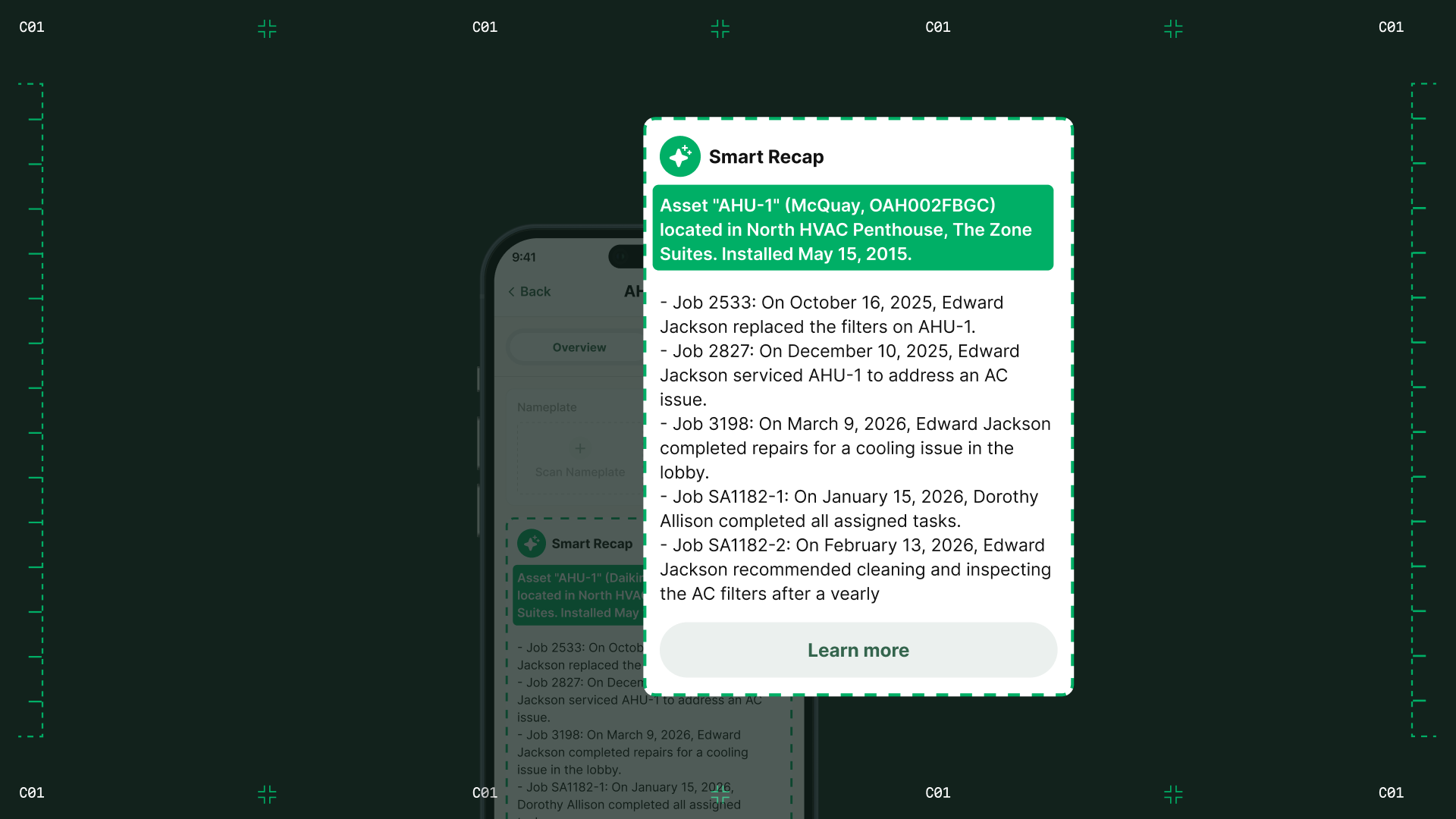
Asset history also gives junior technicians valuable context before they ever pick up a tool. Rather than arriving on site with no background, they can review:
- Previous repairs;
- Recurring issues;
- Maintenance history; and
- Technician notes to understand what has already been tried and why.
Seeing how experienced technicians diagnosed similar problems helps newer techs develop stronger troubleshooting skills while reducing unnecessary trial and error.
Standardized forms reinforce company expectations on every visit. Technicians are guided through the same process every time by:
- Preventative maintenance checklists;
- Customer-specific documentation;
- Startup procedures; and
- Compliance forms.
That consistency helps apprentices develop good habits early instead of learning different approaches from different mentors.
Learning doesn't stop once the job is complete. BuildOps' mobile Knowledge Hub gives technicians immediate access to short, searchable videos created by their own teams. Apprentices can find company-specific guidance while standing in front of the asset they're servicing, whether it's a:
- Walkthrough of a common rooftop unit;
- Troubleshooting tip for a recurring issue; or
- Quick explanation of customer-specific equipment.
Scheduling also plays an important role in technician development. Managers can intentionally expose apprentices to a broader mix of equipment, customers, and service scenarios instead of assigning the same types of calls repeatedly. Combined with detailed service history and standardized workflows, that variety helps technicians build experience faster while reinforcing what they learned in the classroom.
Technology doesn't replace apprenticeships or experienced mentors. Instead, technology gives contractors a better way to capture, organize, and share the knowledge those mentors build every day, turning every completed service call into another opportunity for the next generation of technicians to learn.