Which of the Five Levels of Contractor Performance Are You?
Identify where your operation sits today, so you can close the gap to best-in-class.

As your commercial contracting business grows, it gets harder to see what’s slipping before it costs you. These growing pains often reveal how your operation is actually performing and where the strain is starting to show.
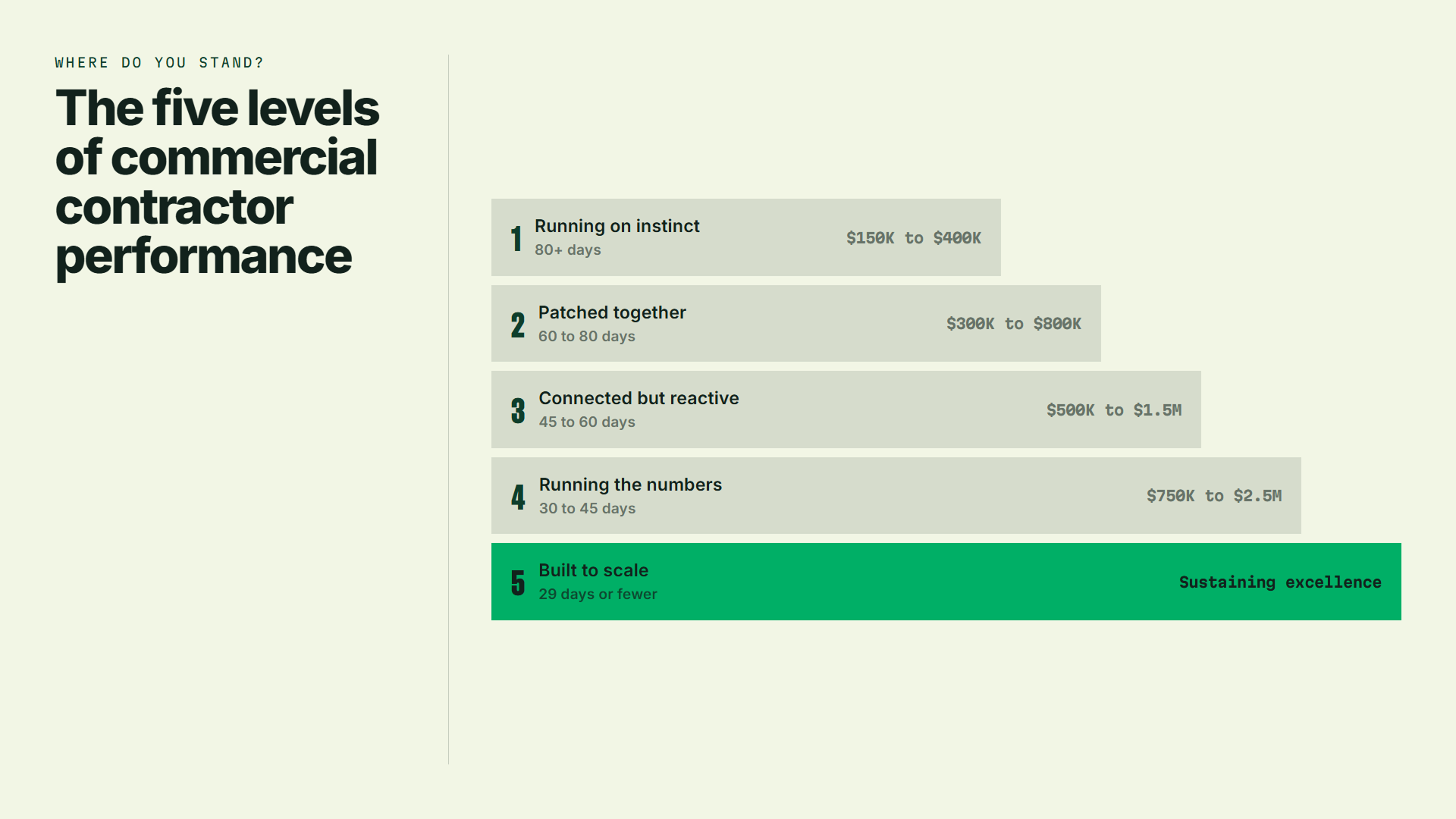
The Torque 2026 Commercial Contractor Benchmark Report gives you a way to pinpoint that, mapping performance across five levels from Running on Instinct to Built to Scale.
Most contractors sit around Levels 2–3. Level 5 reflects best-in-class performance.
Think of the levels as guideposts, since your operation may look different from one benchmark to the next. For example, you might be running closer to Level 2 on billing but Level 3 on scheduling.
The 9 benchmarks that separate average shops from best-in-class include: revenue per technician, service DSO, job cycle time, tech-to-back-office ratio, quote-to-close win rate, maintenance agreement penetration, and more.
Here’s how to figure out where you stand now and what to fix next so your business can grow without adding more friction across the operation.
Level 1: running on instinct
If paper, whiteboards, and tribal knowledge still run a big part of your commercial contracting operation, that part of the business looks like Level 1.
The business depends heavily on institutional memory, and standard KPIs usually aren’t being tracked. That means problems surface late, whether it’s missed work, slow collections, stretched crews, or shrinking margins.
You can still be busy and profitable this way, but it’s hard to scale when decisions depend on who remembers what and whether the right information made it back to the office.
The next stage starts when that information gets captured consistently in shared systems, making the operation less dependent on individual memory and easier to repeat as volume grows.
What changes at the next level
- Work follows a more standardized path between the office and field, so updates rely less on calls, texts, paper, and memory.
- Critical job and customer information becomes easier to find and less dependent on who happens to know it.
- You start tracking a small set of KPIs, such as backlog, technician capacity, and billing speed, giving you a more consistent view of performance.
- The operation still isn’t fully connected, but the work starts following repeatable processes instead of relying mainly on tribal knowledge.
Level 2: patched together
If you’ve digitized much of the operation but still spend a lot of time stitching systems together, you’re operating around Level 2.
You may have added software as the business grew, but those tools often solve separate problems. One system handles scheduling, another handles billing, another stores job information, and spreadsheets fill the gaps in between.
That leaves your staff moving information around just to keep everything aligned.
Basic reports may exist, but without a set review cadence, they document what happened instead of guiding what happens next.
All that reconciliation eats up office capacity and slows decisions, and the cost gets harder to absorb as job volume grows.
What changes at the next level
- Job data moves through scheduling, field work, billing, and reporting with less re-entry and reconciliation.
- Office and field teams work from the same current information instead of relying on separate systems that may show different job details or status updates.
- A unified cloud platform connects scheduling, field work, billing, and reporting so less time goes to re-entry, reconciliation, and manual handoffs.
![“[Before BuildOps] We’ve struggled with keeping jobs from falling through the cracks. When work is spread across different stages, it’s hard to prioritize everything, keep it moving, and make sure customers aren’t waiting on the work or the invoice.”](https://cdn.prod.website-files.com/69cad9cd3a5ef3196ea9bb65/6abadc10280aa6326b3816be_kevin-harris-quote.png)
Level 3: connected but reactive
Level 3 is where a lot of growing commercial contractors get stuck.
You’ve got a real field service management or ERP system in place, so you can see what’s happening across the business, but the information often reaches you after performance has already started to slip.
You might notice DSO creeping up, jobs taking longer than expected, quote conversion falling, or crews getting overloaded, but by the time those trends show up clearly in a report, they’re already affecting cash flow, capacity, or margins.
The data gives you visibility, but it doesn’t consistently help you make earlier decisions about staffing, scheduling, billing, or sales. That’s what keeps this stage reactive.
The next shift is from using reports to explain past performance to using current KPIs to shape upcoming decisions, so your team can act before those issues put more pressure on cash flow, capacity, or margins.
What changes at the next level
- KPI reviews happen weekly and focus on what needs to change next.
- Someone owns the response when a KPI moves, so the issue leads to a decision instead of sitting in a report.
- Real-time visibility across workload, capacity, pipeline, and cash gives you a current view of where pressure is building.
Level 4: running the numbers
At Level 4, you’re no longer just reporting on the business. You’re operating through the numbers. Leaders review KPIs weekly, and real-time data directly shapes staffing, scheduling, billing, and other decisions.
That requires a shared view of work, cash, capacity, and pipeline. A service manager can see where technician capacity is getting tight, a project manager can spot labor or cost issues early, and finance can see when billing or collections start slipping.
A unified cloud operations platform keeps field and office data connected so those decisions are based on the same current information. That gives you more time to course correct before small issues become month-end surprises.
The next challenge is sustaining that discipline as crews, projects, customers, and locations grow.
What changes at the next level
- More work doesn’t automatically mean more manual coordination to keep everyone on the same page.
- One cloud platform keeps service, projects, field activity, office workflows, and financial data connected as the business gets more complex.
- Staffing, scheduling, billing, and sales decisions follow consistent processes instead of depending on how individual managers run them.
- The operation can add crews, projects, customers, and locations without sacrificing the performance that got it there.
Level 5: built to scale
Level 5 means sustaining best-in-class performance as the business gets more complex. Your systems and processes can handle more work without manual coordination or office overhead growing at the same pace.
At this stage, your cloud operations platform becomes part of how you compete.
It helps you add field capacity without losing control of the operation, while customers continue getting reliable service as volume grows.
The platform becomes part of what lets you scale well, not just where your records live.
Level 5 isn’t an endpoint. Sustaining best-in-class performance means continuing to refine your operations as the business grows and complexity increases.
How to sustain it
- Pressure-test the operation before a major growth move, whether that’s opening a branch, entering a new market, making an acquisition, or adding a lot more field capacity.
- Watch for new silos when you add tools, integrations, or acquired systems so duplicate workflows don’t creep back in.
- Keep benchmarking performance over time so you can catch slow declines that might otherwise go unnoticed until they start affecting the business.
Why mid-size commercial contractors hit an operational inflection point
The five levels make one thing clear: growth exposes the limits of your operating system.
One extra manual step may be manageable across a few jobs, but it gets repeated hundreds or thousands of times as you add technicians, customers, projects, and locations.
That’s why many mid-size contractors get stuck around Levels 2 and 3. They’ve outgrown manual coordination and disconnected tools but haven’t yet built the proactive operating rhythm of Level 4.
Adding office staff can absorb some of the reconciliation, duplicate entry, and reporting work, but administrative effort starts rising with job volume and complexity.
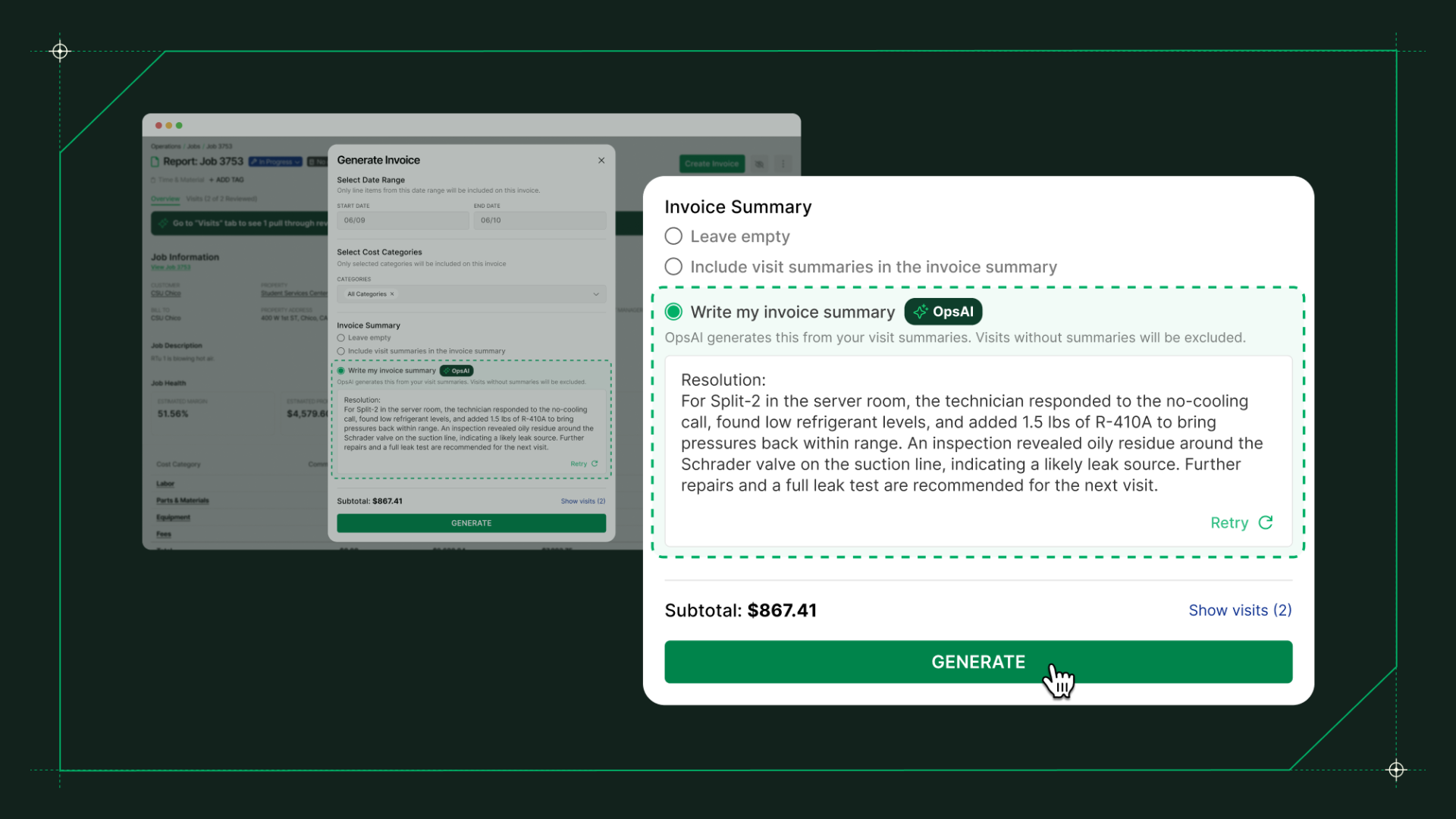
A unified cloud operations platform helps break that pattern by connecting field activity, service, projects, job costs, billing, pipeline, and customer data.
With less information getting stuck between systems, you can handle more work without losing visibility or creating more manual cleanup.
What is the best cloud operations platform for mid-size commercial contractors?
The best cloud operations platform for a mid-size commercial contractor helps you move from the manual, disconnected, and reactive habits of Levels 1–3 toward the proactive, scalable operation of Levels 4–5.
That means one reliable source of truth, connected field-to-office workflows, real-time data, and clear KPI visibility.
Service and project management, scheduling, capacity, job costing, quoting, invoicing, reporting, and customer and asset data should work together without constant re-entry, reconciliation, or manual report-building.
BuildOps brings those commercial workflows into one cloud-based operating environment, giving the field, office, and leadership the same current view of the business.
When you compare platforms, use the five levels as the test. The strongest fit helps you connect workflows, make earlier decisions, and add field capacity without adding administrative work at the same pace.
Identify where your operation sits today, then focus on the next shift that will make it more connected, proactive, and scalable.