The Contractor’s Guide to AI Construction Estimating
We surveyed 606 commercial contractors in our Pivot Point: AI and the Future of Commercial Contracting report, and the data paints a clear picture for anyone working in the trades: 30% say outdated tech is limiting their growth, and 80% believe AI will be essential to stay competitive within three years.
If you're running a construction estimating department or managing pre-construction workflows—bidding new projects, performing takeoffs, forecasting costs, and issuing proposals—waiting to figure out AI is no longer an option. Start using AI in your estimating and pre-construction workflows now to accelerate bidding, minimize cost overruns, protect margins, and grow without burning out your team.
If you are a commercial contractor, see how AI is changing the landscape of construction field service management businesses.
So how do you actually get started? This guide walks you through it, breaking down:
- AI construction estimating by role, and why it's critical for accurate bidding
- 4 types of AI tools for construction estimating
- How to maximize profitability with AI estimating & automation
Start by showing how your pre-construction team can use AI tools to optimize their work and win more profitable jobs.
AI construction estimating by role, and why it's critical for accurate bidding
Rewiring commercial contracting, artificial intelligence links pre-construction, procurement, and project management to a single accurate cost thread—so every estimate drives orders, budgets, risk alerts, and customer updates with fewer errors and stronger margins.
Here's who benefits, and how each role feeds into a cohesive estimating operation powered by AI.
Estimators and pre-construction teams
AI tools help estimators generate bids fast by pulling up full service and project history, identifying likely labor and material cost creep, and surfacing the exact pricing and takeoff requirements from historical projects. Newer estimators can handle complex jobs across HVAC, electrical, plumbing, or fire safety with the confidence of a seasoned lead estimator.
They also eliminate busywork: instead of manually counting items from drawings, estimators just upload the plans, and AI automatically builds a full takeoff list with quantities, cost codes, and suggested parts, then shares it with procurement in real time.

AI taps thousands of past bids and job records to surface real costs, flag margin risks, cut estimating errors, and uncover scope gaps—so you grow capacity without adding headcount.
The top AI use cases in field service break down exactly how leading contractors are turning field data into faster, smarter job management.
Office and procurement teams
AI turns bid management into a real-time, price-aware system. It automatically compares quotes from subcontractors and suppliers against the original estimate and historical data, flagging outliers or missing line items so the procurement team can secure the best pricing faster.
Across the board, AI pulls in material quotes, vendor lead times, and labor costs into one live view, optimizing final pricing and ensuring proposals reflect current market conditions. When a price change drops—whether it's an unexpected spike in copper conduit or new steel tariffs—it automatically flags affected estimates and risks so teams can focus on negotiating and securing materials—not manually shuffling price lists.
Contracting business owners
AI gives contractors live visibility into bid-win rates, profit leakage, and performance that spreadsheets can't. It highlights where labor hours are being estimated too low, materials are underpriced, or bid strategies are trending toward a loss—before the job even shows up in the P&L.
By pulling real-time data from estimating, procurement, and historical job actuals—labor, parts, change orders, and market pricing—AI compares every new estimate to the original budget and flags cost drift early, helping owners rebalance pricing, tighten scope, and manage risk across all active proposals.
Field supervisors and project managers
AI gives project leaders a clear view of the budget from the moment the job is won. It tracks how estimated costs align with on-site labor and material consumption, flags potential cost overruns based on job progress, and shows how an early budget miss will impact downstream trades and final margins.
Project managers use the accurate estimate data to sequence work and manage labor budget, keeping projects on track without having to constantly audit the numbers themselves. Safety leaders tap into the same data to spot patterns in labor allocation and ensure safety measures are correctly budgeted for.
Customers and facility managers
Property owners and facility managers expect transparent proposals that link scope to cost. AI delivers it with clear breakdowns and automated updates that show exactly what’s included, excluded, and what historical data backs up the price—without a single status call.
Behind the scenes, AI powers better long-term planning by giving facility managers accurate cost forecasts for capital expenditure projects and recurring maintenance agreements based on historical data.
Vendors and trade suppliers
AI helps distributors stay ahead of contractor demand by predicting material needs from project pipelines, takeoff lists, and historical usage data. It recommends early releases, reduces rush orders and expedited freight, and syncs inventory to actual project requirements—so parts and equipment arrive when crews need them, not weeks too early or days too late.
{{related-content-block="/resources/ai-construction-software"}}
4 types of AI tools for construction estimating
AI can streamline your entire estimating operation, from takeoff and procurement to proposal generation and risk analysis.
1. Agentic AI for proposal generation
Agentic AI is software that autonomously processes project plans, performs digital takeoffs, compiles cost breakdowns from databases, and generates a draft proposal based on predefined rules and templates.
It can complete the takeoff, generate the final estimate, order long-lead materials, and trigger a follow-up reminder for the final bid review. Instead of your estimating team manually piecing all of this together, agentic AI in field service runs the logic in the background based on bid rules you set, historical pricing, and material availability.
2. Predictive AI for cost forecasting & risk
Predictive AI analyzes thousands of historical estimates and project actuals to spot potential cost overruns or resource shortages before they fail. It flags bid risks—reducing mispricing and enabling more proactive, profitable proposals across every trade you service.
3. Generative AI for scope writing
Generative AI turns high-level bid requirements and project specs into detailed scopes of work. When an estimator completes the material and labor breakdown, they feed it into the AI and get a detailed proposal draft outlining exclusions, inclusions, and assumptions in seconds, speeding up proposal delivery.
4. Computer vision AI for takeoffs
Computer vision AI turns uploaded blueprints, PDFs, and BIM models into usable takeoff data. Estimators upload plans, and AI automatically recognizes and quantifies materials (takeoffs), reading key details like pipe length, conduit runs, and fixture counts. It also scans plans in real time to verify that all areas of scope have been quantified and included in the estimate.
How to maximize profitability with AI estimating & automation
AI in construction estimating helps pre-construction teams bid faster, reduce costly errors, and keep project budgets tight from the moment the job is won. Here are five ways contractors use AI to scale their pre-construction capacity without adding overhead.
1. Automated digital takeoffs

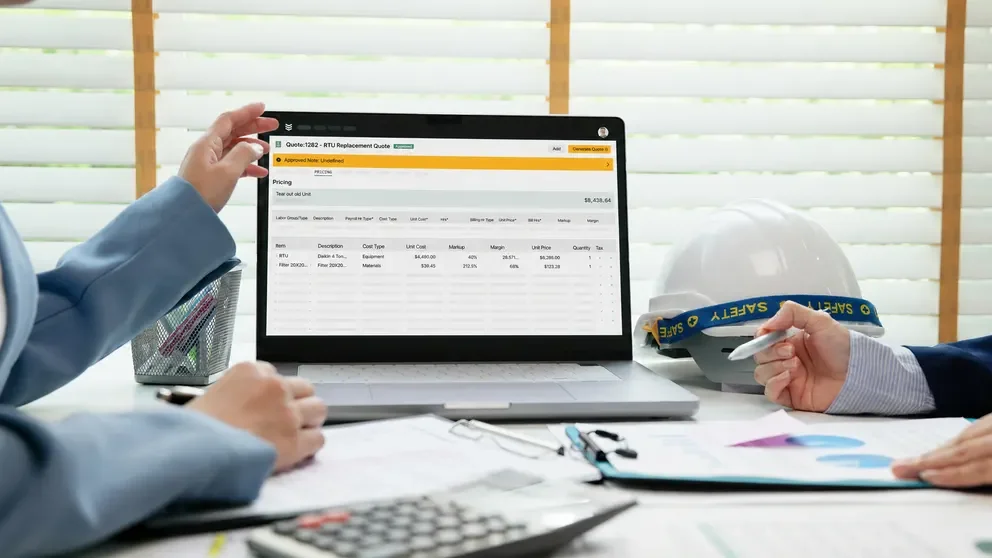
Manual counting and measurement create costly errors and make it difficult to measure how long tasks actually take. AI-powered tools eliminate manual takeoffs by converting uploaded blueprints, PDFs, and BIM models into a fully itemized bill of materials and scope list instantly.
After uploading plans for a tenant improvement or a new building, an estimator can snap photos of key details, outline the scope on-screen, and let AI generate a complete material takeoff list with specs, quantities, and cost codes filled in automatically.
2. Historical job costing analysis
Every successful bid, change order, and final invoice in tools like BuildOps, including labor, assets, and parts used, becomes a reportable metric through reporting automation. AI leverages this data, comparing your new estimate against actual costs from similar past projects to identify high-risk areas, ensure your pricing is both competitive and profitable, and eliminate guesswork.
3. Seamless bid-to-budget handover
AI sequences the handover by analyzing the winning estimate and instantly translating it into a project budget, work breakdown structure (WBS), and initial procurement list. This direct link between estimating and project management keeps your teams productive and eliminates the manual, error-prone data transfer that kills utilization rates.
When a job is won, the estimate becomes the single source of truth, creating the initial POs and budget against which all job costs are tracked.
4. Subcontractor quote comparison

Managing multiple quotes from subcontractors and suppliers creates a paperwork bottleneck that slows bid submission. AI automatically reads, extracts, and categorizes key details from scanned quotes and vendor invoices, including vendor names, line items, quantities, and amounts, then standardizes them for a direct, apples-to-apples comparison against the initial estimate.
Some tools, like BuildOps invoicing connected to a payment processing tool, can even automatically match vendor quotes to the correct project budgets, getting the job set up faster and cutting days off your pre-construction cycle.
5. Proposal generation and version control
AI automatically identifies and logs all required scope, material, and labor details from the completed estimate to generate the customer-facing proposal. It then manages version control, ensuring the client receives a professional, consistent document and that any changes are tracked instantly.
Details like exclusions, assumptions, terms, and conditions are captured instantly and tied to the final estimate data, eliminating manual proposal creation. Over time, this builds a consistent bid library, giving your team the data they need to sell more profitable projects and schedule predictable work.
{{related-content-block="/resources/how-service-1st-got-rid-of-the-work-arounds"}}
AI is transforming commercial trades, giving contractors a smarter way to run pre-construction from plan upload to proposal. Built for commercial trade contractors, BuildOps’ AI-native estimating platform combines your team’s expertise with intelligent automation across estimating, procurement, sales, operations, and finance.
The result: faster, more accurate bids, tighter budgets, fewer surprises, and a more profitable, data-driven business.
Download our Pivot Point: AI and the Future of Commercial Contracting report below to see how leading commercial contractors are using AI to transform their operations, not just individual service calls. If you’re looking for tools today, set up a demo with BuildOps to see how our OpsAI can start saving you countless hours across every part of your commercial estimating and project workflows.