The State of AI in the Construction Industry & Market
Multiple market research reports agree on one thing: AI in the construction industry is accelerating at a pace few sectors can match. Valued at approximately USD 4.86 billion in 2025, the global AI in construction market is projected to surge past USD 35 billion by 2034, driven by the growing need for efficiency, safety, and cost control across every phase of a construction project.
For contractors and construction firms managing crews, assets, budgets, and compliance across job sites, understanding where this market stands today, and where it's heading, is no longer optional. Whether you operate in the construction field service industry or run large-scale commercial builds, AI is already reshaping how projects get planned, executed, and maintained.
This article will serve as a guide to the construction industry market that covers the following topics:
- Market share and size analysis of AI in the construction industry
- The future of AI in construction: growth forecasts and market trends
- Essential market statistics and AI adoption trends in the construction industry
- Key construction industry challenges AI is built to solve
- Emerging AI technologies in construction software
- 9 important market reports on AI in the construction industry
AI is reshaping construction fast. From safer jobsites and smarter scheduling to better cost control and risk management, contractors are using AI to work more efficiently every day. This guide covers the trends driving adoption, the challenges slowing it down, and where the biggest opportunities are emerging.
Market share and size analysis of AI in the construction industry
AI in construction is projected to grow strongly from 2026 on. Forecasts vary in method, but all point upward. This section covers market size, regional trends, segment spending, and IoT support.
Global market projections from 2026 onward
The AI in the construction market is projected to grow from USD 2,179.91 million in 2026 to approximately USD 24,696.92 million by 2035, expanding at a CAGR of 31.27%.
That pace puts it among the fastest-growing technology segments in the built environment.
Fortune Business Insights projects the market at USD 6.02 billion in 2026, climbing to USD 35.53 billion by 2034 at a CAGR of 24.80%.
Grand View Research forecasts USD 16.96 billion by 2030 at a CAGR of 26.9%, while Research Dive estimates USD 8,545.80 million by 2031 at a CAGR of 34.1%.
The variance comes down to how each firm scopes the market, but the consensus is clear: AI spending in construction is scaling fast, and the investment window from 2026 forward is wide open.
Regional market share breakdown
North America is projected to lead AI in construction spending through the next decade. Fortune Business Insights forecasts the region at USD 2.36 billion in 2026, with the U.S. alone expected to reach USD 1.81 billion that same year.
Precedence Research projects North America reaching approximately USD 7,214.35 million by 2035, growing at a CAGR of 32.76% from 2026 to 2035.
Heavy investment in AI research, a large volume of active construction projects, and supportive government initiatives around digital infrastructure continue to drive this dominance.
Europe is projected to generate USD 1.89 billion in 2026, with the UK and Germany leading adoption.
The emerging Digital Construction Alliance (DCA) regulation in 2026 will mandate greater adoption of AI and digital technologies in all public construction projects across the continent, further accelerating deployment.
The AI in the construction market is also being shaped by BIM mandates and sustainability-focused policies across the region.
Asia Pacific, projected at USD 1.39 billion in 2026, is expected to witness the fastest growth in the coming years.
Rapid urbanization in China, India, and Japan, combined with massive infrastructure investment and government-backed smart city initiatives, positions the region as a high-growth market for AI-powered construction solutions. The AI in construction market report from Grand View Research confirms that China held a substantial share and continues to invest heavily in autonomous construction machinery and AI-driven site monitoring.
Market segmentation by offering, deployment, and construction type
On the offerings side, AI solutions dominate over services. Precedence Research reports that the solution segment held 62% of revenue share, driven by growing accessibility of AI-based tools for design optimization, project scheduling, and risk forecasting.
The AI in construction market analysis from Research Dive confirms that construction companies are increasingly utilizing AI solutions across supply chain management, project planning, and risk management.
Cloud-based deployment is outpacing on-premises setups. Fortune Business Insights projects cloud at 66.78% of market share in 2026, thanks to its scalability, lower upfront costs, and ability to support real-time collaboration across distributed job sites.
For contractors managing crews and assets across multiple locations, cloud deployment removes the need for heavy on-site IT infrastructure and enables field teams to access AI-driven insights from anywhere.
From a construction type perspective, commercial projects are expected to hold the largest share at 34.05% in 2026, while residential construction is anticipated to record the highest CAGR due to increasing urbanization and demand for affordable housing.
A PRISMA review published in the Journal of Open Innovation highlights that AI is particularly beneficial in the planning stage, where accurate cost and risk forecasting can prevent costly downstream errors, a factor that directly impacts both commercial and residential project outcomes.
{{related-content-block="/resources/modernizing-procurement-in-construction"}}
Adjacent market: IoT in construction
AI in construction does not operate in isolation. The broader IoT in construction market provides much of the sensor data, device connectivity, and real-time monitoring infrastructure that AI systems depend on. MarketsandMarkets projects the global IoT in construction market to reach USD 26.5 billion by 2027 at a CAGR of 16.5%.
Software leads the IoT segment, with remote operations representing the largest application area.
As construction sites deploy connected sensors, drones, and wearable devices, the volume of data available for AI analysis grows exponentially. AI technologies such as machine learning and computer vision are being integrated into construction site management to detect potential hazards, optimize workflows, and reduce the possibility of accidents.
This convergence of IoT infrastructure and AI-powered analytics is accelerating the shift toward predictive maintenance, autonomous equipment, and real-time safety monitoring across job sites.
The future of AI in construction: growth forecasts and market trends
The market data covered in the previous section tells one side of the story. By 2026, AI in construction and field service management moves beyond pilots and becomes part of everyday workflows, shaping how projects are planned, built, and maintained.
AI moves from pilot to production in 2026
AI has officially moved past the hype phase in construction, but the reality is nuanced. According to Autodesk's State of Design & Make report, only 32% of construction leaders say they've met or are close to meeting their AI goals.
That gap between ambition and execution is narrowing fast, though. Kaizen Institute reports that 37% of construction companies are now using AI in their projects, up from 26% in 2023, and each organization has implemented an average of 6.2 different digital tools, a 20% increase over the previous year.
The firms that treat AI as a baseline capability rather than a future experiment will pull ahead. As Ben Cochran of Autodesk puts it, "2026 marks the shift from AI as a 'future trend' to 'industry baseline.' Firms that fail to adopt risk losing contracts to competitors who deliver faster, safer, and more sustainably."
Field operations and project management get smarter
The biggest near-term impact of AI in construction is showing up in daily project management and field operations. Instead of functioning as a separate tool, AI is becoming a built-in assistant that summarizes RFIs, drafts meeting recaps, organizes punch lists, and flags schedule or cost risks before they escalate.
Ron Arana of Arana Group notes that this shift will help "project managers and superintendents spend more time making decisions and less time processing information."
For contractors managing crews, assets, and budgets across multiple job sites, this translates directly to tighter margins and fewer surprises. Craig Lewis of DPR Construction describes AI as "the digital co-pilot for mission control," automating administrative burdens so project managers can move from reactive firefighting to proactive, strategic decisions.
Atul Khanzode, also of DPR Construction, expects project teams to move beyond static Gantt charts to dynamic, AI-driven what-if analysis that lets planners test schedule disruptions, resource reallocations, and sequencing adjustments in real time.

For commercial contractors looking to implement AI across the full project lifecycle, from estimating and procurement to field execution and financial closeout, a practical breakdown of AI for construction management covers the core tool types and how they connect to day-to-day operations.
Workforce shortages accelerate automation
Labor gaps are pushing the industry toward automation faster than any technology roadmap could. The U.S. alone is expected to need approximately 499,000 additional construction workers by 2026, up from a shortage of roughly 439,000 in 2025.
A significant portion of the current workforce is nearing retirement, and interest in construction careers among younger generations remains low.
In response, tools such as drones for inspections, automated cutting and welding systems, 3D printing, and robots for repetitive or precision-based tasks are becoming increasingly common on large-scale projects.
AI-driven scheduling, smart resource allocation, and delay forecasting are enabling faster, better-informed decisions that reduce waiting times, scheduling conflicts, and rework. By 2026, hybrid team models that combine skilled workers with automated systems are expected to expand, particularly among major contractors and on complex commercial projects.
Trust, governance, and the human element
As AI becomes more embedded in construction, trust matters as much as capability. Clear governance, data transparency, and ethical guardrails will separate the firms that earn confidence from those that don’t. And while AI can streamline workflows and reduce errors, its real value is in strengthening human judgment, not replacing it.

Essential market statistics and AI adoption trends in the construction industry
The previous section explored where AI in construction is heading. This section looks at the adoption trends shaping how fast the industry actually gets there.
Three pressures pushing AI from optional to operational
For years, AI in construction was treated as experimental, interesting in theory but rarely essential in practice. That's changing fast, and the shift has less to do with the technology itself and more to do with the operating environment contractors face every day. A combination of persistent labor shortages, razor-thin construction margins, and dramatically improved project data is pushing AI from pilot programs into everyday construction operations.
Margins leave no room for reactive decision-making. When delays, rework, and miscommunication directly eat into profitability, the ability to analyze patterns across schedules, costs, and jobsite activity before problems escalate becomes a financial necessity. AI enables that shift from asking "what went wrong" to seeing problems coming and addressing them in advance.
At the same time, AI tools have become significantly easier to use. Interfaces inspired by platforms like ChatGPT and Gemini have raised the bar for what construction teams expect from software. Instead of navigating complicated dashboards or learning technical jargon, field and office teams can now interact with AI using natural language to surface clear, actionable insights in real time.
For contractors managing crews, assets, and budgets across multiple job sites, these trends converge into a single takeaway: AI adoption in construction is no longer a question of whether, but how quickly. Early adopters are already seeing better risk visibility, faster decision-making, and more predictable project outcomes. By the end of 2026, AI will stop being a differentiator and start being an expectation.
One of the biggest barriers to AI adoption in construction is fragmented institutional knowledge, with repair histories, SOPs, and equipment specs scattered across disconnected systems.
A dedicated construction knowledge management system centralizes that data so AI tools can actually access and act on it. Without a structured knowledge foundation, even advanced AI platforms have nothing reliable to learn from.
Key construction industry challenges AI is built to solve
The industry has long been held back by deep, structural challenges that traditional tools haven’t solved at scale. AI is now beginning to change that, from back-office operations to the realities of the job site.
- Fragmented data across disconnected systems. Project data is spread across spreadsheets, emails, paper files, and disconnected software, making it hard to see real-time project status.
- Manual, paper-based workflows. Estimates, invoices, reports, and compliance documents are often created by hand, causing errors, billing delays, and slower decisions.
- Budget overruns and cost unpredictability. Projects go over budget because forecasting relies on outdated methods and incomplete data, often catching overruns too late.
- Schedule delays and inaccurate forecasting. Static schedules can't keep up with daily job site changes, forcing teams to react instead of plan ahead.
- Communication gaps between field and office. Field updates get lost across calls, texts, and summaries, delaying decisions and creating costly mistakes.
- Chronic labor shortages. Skilled workers are leaving faster than new talent enters the trades, putting more strain on crews and schedules.
- Knowledge loss from workforce turnover. When experienced workers leave, undocumented knowledge like repair history, site procedures, and vendor relationships leaves with them.
- Safety risks and reactive compliance tracking. Hazards often go unnoticed until incidents happen, while compliance records are created too late to reduce risk.
- Rework and quality control failures. Installation, coordination, and material errors are often found too late, leading to expensive rework and delays.
- Supply chain disruptions and material waste. Poor visibility into procurement and inventory leads to ordering mistakes, delayed deliveries, and idle crews.
{{related-content-block="/resources/ai-construction-business-management-software"}}
Emerging AI technologies in construction software
Construction’s core challenges haven’t changed. What has is the software now being built to solve them—especially AI tools that are starting to improve margins, speed up crews, and reduce risk.
Agentic AI for autonomous field workflows
Agentic AI is reshaping construction software by detecting issues, making decisions, and automating tasks. In field service, it can spot a failed asset, review service history, assign the right tech, and schedule the job automatically. Unlike standard automation that still requires manual follow-through, agentic AI in field service acts on pre-established workflows, keeping operations moving even when the office is stretched thin.
AI-native contractor platforms
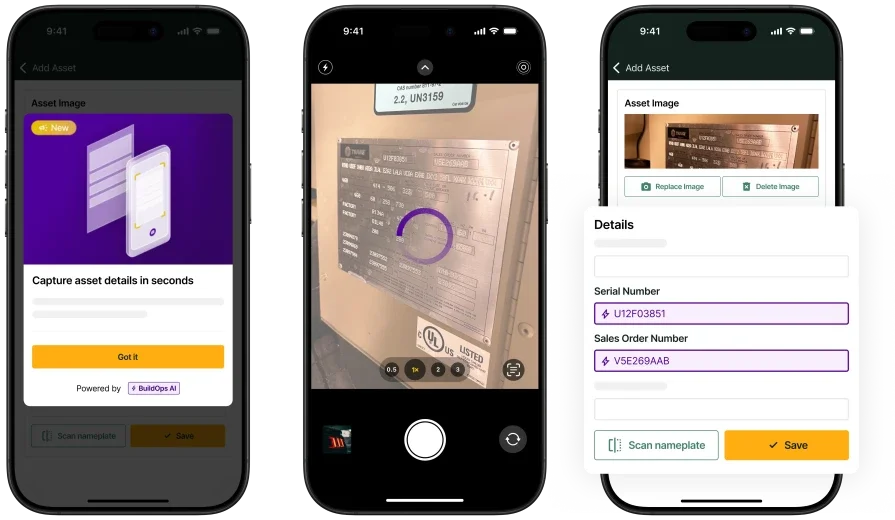
Legacy field service platforms were designed around manual inputs and static workflows. The emerging category of AI-native contractor software embeds intelligence across the entire operation, from dispatching and documentation to invoicing and reporting. AI is embedded across workflows—not just a chatbot—powering dispatch, reporting, PO scanning, and tech matching in one connected system. For commercial contractors, that means fewer fragmented tools and faster operations.
AI-powered scheduling and dispatching

Scheduling remains one of the highest-leverage areas for AI in construction field service. AI scheduling tools for field service teams analyze technician certifications, location, current workload, and job urgency to recommend optimal assignments automatically. When priorities shift mid-day, the system reshuffles the board, recalculates routes, and notifies affected techs and customers in real time. The result is fewer missed appointments, less idle time between calls, and higher first-visit completion rates.
AI across the full contractor workflow
AI in construction now spans estimating, procurement, fieldwork, invoicing, and customer communication. A practical AI playbook for contractors covers how each role, from field techs and dispatchers to business owners and project managers, can use AI to reduce admin overhead, improve diagnostics, and protect margins. From isolated tools to one workflow powered by a single job record.
Expanding AI use cases across trades
AI in the construction field service industry now goes far beyond scheduling, supporting invoicing, work orders, maintenance, forecasting, and compliance. A breakdown of the top use cases for AI in field service shows how teams across HVAC, electrical, plumbing, and refrigeration are applying these tools to reduce callbacks, speed up documentation, and keep crews focused on billable work instead of paperwork.
{{related-content-block="/resources/ai-field-service-assistant"}}
9 important market reports on AI in the construction industry
We drew on a number of recent reports about the AI in construction market to provide as complete a snapshot as we could, both of assessments on where the market currently is and predictions on where it's going. This article summarizes their findings and perspectives.
If you'd like a deeper dive into any one report, we've listed links to them all here:
- The Pivot Point: AI and the Future of Commercial Contracting report | BuildOps | 2025
- Global Construction Trends in 2026: The Industry's New Phase | Kaizen Institute | 2026
- Artificial Intelligence (AI) in Construction Market Size, Share and Trends 2026 to 2035 | Precedence Research | January 2026
- Artificial Intelligence in Construction Market Size Report 2030 | Grand View Research | 2024
- AI in Construction – Market Share Analysis, Industry Trends & Statistics, Growth Forecasts (2025 – 2030) | Mordor Intelligence | May 2025
- Artificial Intelligence in Construction: Transforming the Industry | Journal of Architectural Engineering Technology | November 2024
- Opportunities and Adoption Challenges of AI in the Construction Industry: A PRISMA Review | Journal of Open Innovation: Technology, Market, and Complexity | March 2022
- AI in Construction Market by Technology, Stage, Component, Application, Deployment Type, Organization Size, Industry Type, and Region – Global Forecast to 2023 | MarketsandMarkets | May 2018
- Why 2026 Will Be a Turning Point for AI Adoption in Construction | Buildup | January 2026
The data is clear: 30% of commercial contractors report that outdated technology limits their growth, and 80% believe AI will be essential to staying competitive within three years, according to our Pivot Point: AI and the Future of Commercial Contracting report.
BuildOps is built for the contractors powering commercial construction and field service. It connects the full operation—from asset and service management to project workflows—so teams can handle everyday jobs and large-scale work without losing visibility, speed, or control.
With OpsAI, BuildOps goes a step further, helping teams reduce manual effort, make better decisions in real time, and run a smarter business across the office and the field. For commercial contractors ready to grow, BuildOps is the platform that helps turn operational complexity into a competitive edge.
Ready to explore? Set up a demo with BuildOps to see how OpsAI can eliminate manual tasks and streamline your commercial construction workflow.