Your AI Playbook for Plumbing Companies & Contractors in 2026
We surveyed 606 commercial contractors in our Pivot Point: AI and the Future of Commercial Contracting report, and the data paints a clear picture for anyone working in the trades: 30% say outdated tech is limiting their growth, and 80% believe AI will be essential to stay competitive within three years.
If you're running a plumbing service business or leading a crew in the field, waiting to figure out AI adoption is no longer a viable strategy. You need to start building AI into your plumbing operations now if you want to keep winning work and scaling efficiently.
So where do you start? This guide breaks it down, covering:
- Who uses AI tools for plumbing field service, and why it’s critical for ops
- 4 types of AI tools used in plumbing field service
- How to scale plumbing field service ops with AI & automation
Let’s start with how each member of your plumbing team can use AI automation tools to optimize their roles in the field service work your business does.
Who uses AI tools for plumbing field service, and why it’s critical for ops
Artificial intelligence is transforming electrical contracting by connecting every role through a single, real-time data thread. The same job record powers dispatch, the tech’s mobile workflow, invoicing, P&L updates, and customer communication—so the whole operation runs faster with fewer errors, write-offs, and missed labor.
Here's who benefits, and how each role feeds into a cohesive electrical operation powered by AI.
Plumbers and field techs
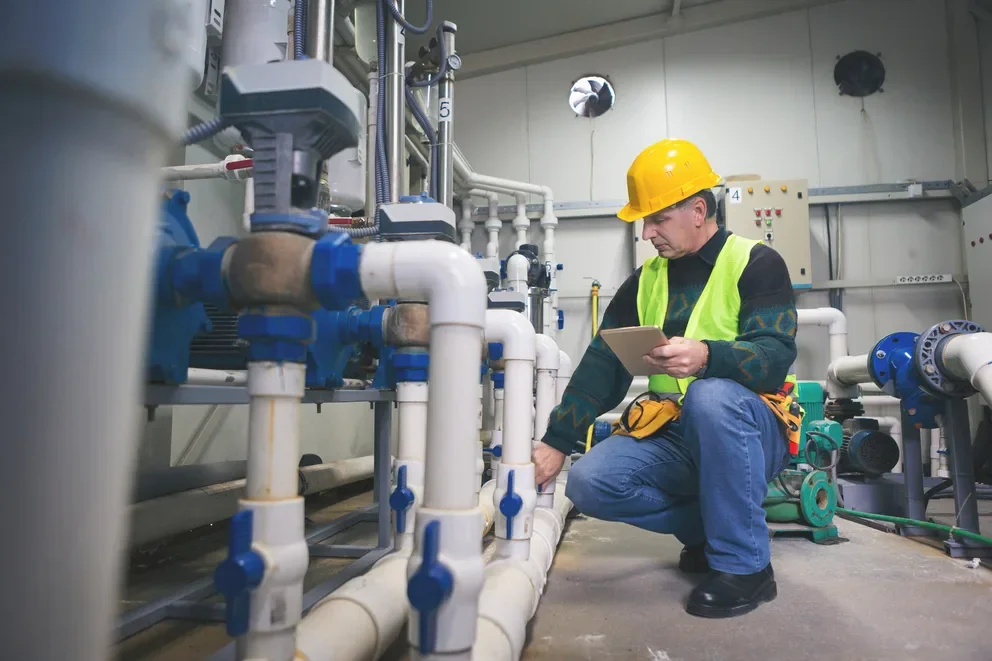
AI tools help plumbers troubleshoot problems fast by pulling up a home’s service history, identifying likely failure points, and showing the exact schematics and step‑by‑step repair workflows right on their phone—so newer techs can handle complex jobs with the confidence of a master plumber.
They also wipe out busywork: instead of filling out paperwork, plumbers just talk through what they did, and AI automatically builds a full job report with photos, pressure readings, and parts used, then shares it with the office in real time.

Office and dispatch teams
AI turns plumbing operations into a real-time, skill-aware system. It matches plumbers to jobs based on licenses, certifications, workload, location, and experience with systems like backflow, gas, hydronic, and commercial fixtures—so the right tech handles the right work, faster and with fewer callbacks.
Across the board, AI pulls in service calls, maintenance visits, projects, and emergencies into one live view, optimizing routes, priorities, and schedules. When a no-heat, leak, or backup hits, it automatically reshuffles the day, updates customers, and flags risks so teams can focus on solving problems—not shuffling tickets and chasing status.
Plumbing business owners
AI gives plumbing contractors live visibility into margin and performance that spreadsheets can’t. It highlights where hours are drifting, materials are overused, or service calls are trending toward a loss—before it shows up in the P&L.
By pulling real-time data from the field—labor, parts, change orders, and compliance checks—AI compares every job to the original estimate and flags overruns early, helping owners rebalance crews, tighten scope, and manage risk across all active work.
Field supervisors and project managers
AI gives plumbing leaders a clear view of every phase—from rough-in and pressure testing to fixture set, commissioning, and final inspection. It tracks schedule progress, flags slipping phases, and shows how a delay on one zone or riser will impact downstream trades and inspections.
Project managers use predictive scheduling to shift plumbers between jobs based on skills, location, and labor budget, keeping utilization high without burning out top techs. Safety leaders tap into the same data to spot patterns in confined-space, hot work, or PPE compliance and intervene before incidents occur.
Customers and facility managers
Property owners and facility managers expect real-time insight into their plumbing work. AI delivers it with live dashboards and automated updates that show when plumbers are on-site, whether the job is on schedule, and where risks are emerging—without a single status call.
Behind the scenes, AI powers predictive maintenance on pumps, backflow devices, water heaters, and critical piping. It spots patterns that signal future failures and turns emergency floods or backups into planned service, increasing satisfaction and driving recurring maintenance agreements.
Vendors and plumbing suppliers
AI helps plumbing distributors stay ahead of contractor demand by predicting material needs from job schedules, usage history, and real-time field data. It recommends early releases, reduces rush orders and expedited freight, and syncs inventory to actual job progress—so fittings, valves, and fixtures arrive when crews need them, not weeks too early or days too late.
{{related-content-block="/resources/plumbing-field-service-software/"}}
4 types of AI tools used in plumbing field service
AI isn’t just another tool for plumbing companies—it can streamline your entire operation, from scheduling and dispatch to estimating, invoicing, and customer communication.
1. Agentic AI
Agentic AI is software that makes its own decisions and takes action. In the plumbing field service, it spots abnormal water use, checks past jobs, diagnoses likely issues, and automatically routes the right licensed plumber.
It can schedule the visit, generate an estimate, order needed parts, and trigger follow-up reminders. Instead of your office team manually piecing all of this together, agentic AI in field service runs the logic in the background based on rules you set, technician credentials on file, and real-time crew and inventory availability.
2. Predictive AI
Predictive AI uses equipment and service data to spot issues before they become leaks, clogs, or failures—reducing emergency calls and enabling more planned maintenance for plumbing contractors.
3. Generative AI
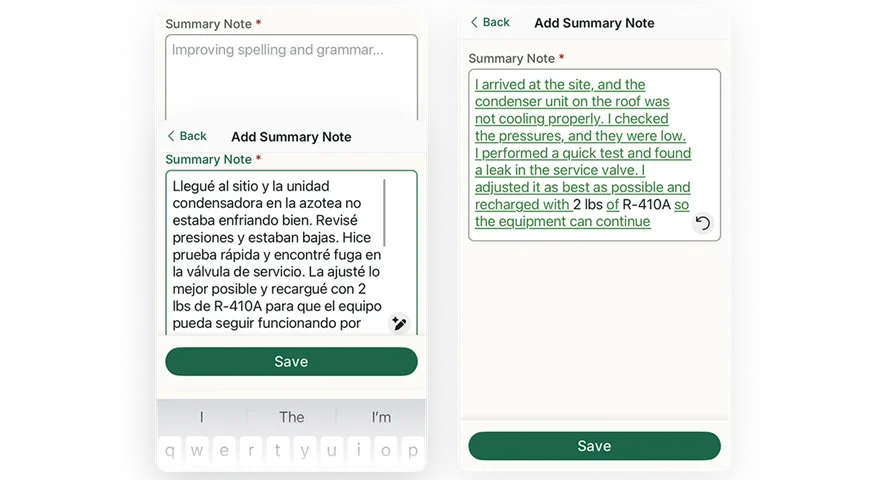
Generative AI turns raw inputs like voice notes, photos, and gauge readings into clean service reports. After a plumber finishes a backflow test, boiler start-up, or leak repair, they just talk into their phone and get a detailed report—with pipe sizes, valve locations, test pressures, and code references—sent to the office in seconds, speeding up invoicing.
4. Computer vision AI
Computer vision AI turns field photos and video into usable data. Plumbing techs can snap equipment labels, and AI reads key details like manufacturer, model, and ratings. It also checks safety and quality by scanning jobsite images for proper PPE, correct pressure-relief piping, and compliance with confined-space and lockout/tagout procedures in real time.
How to scale plumbing field service ops with AI & automation
AI in field service management helps plumbing teams work faster, reduce costly errors, and keep every job moving from dispatch through final invoice. Here are the five ways plumbing contractors use AI to scale operations without adding overhead.
1. Scheduling & dispatch
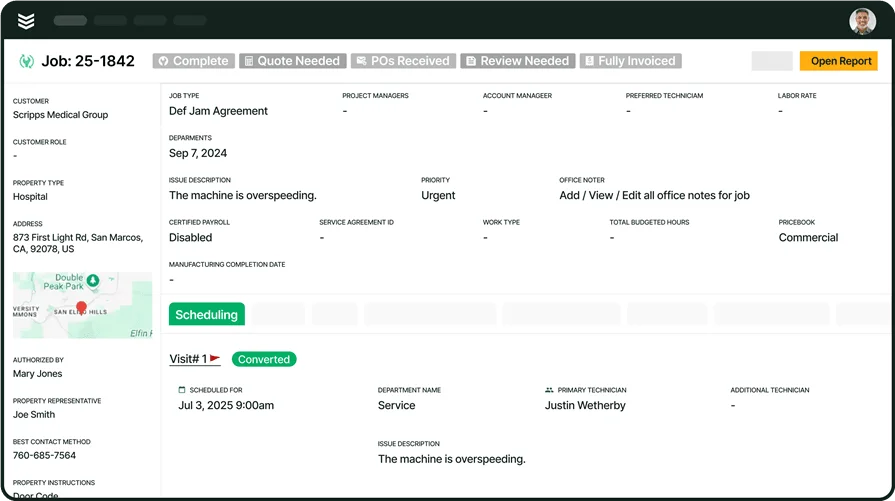
AI-powered scheduling tools analyze each plumber's license type, certifications, active workload, and proximity to automatically assign the best-fit tech for every call.
When a priority job comes in, like a burst main in a commercial kitchen or a backflow failure at a medical facility, the system instantly reshuffles the day's board, reassigns lower-priority fixture installs and drain cleanings, and notifies affected customers without your dispatcher touching a thing. That kind of automated scheduling, paired with smart dispatch tools, keeps your crews productive and eliminates the dead time between calls that kills utilization rates.
2. Field notes & reporting automation
After finishing a backflow test, boiler start-up, or leak repair, a plumber can snap photos of pipe labels and gauge readings, speak observations into their phone, and let AI generate a complete service report with pipe sizes, valve locations, test pressures, and code references filled in automatically.
Every field in tools like BuildOps, including labor, assets, and parts used, becomes a reportable metric through reporting automation. Techs stop spending 30 minutes typing up notes at the end of a shift, and the office gets clean documentation the moment the job closes.
3. Fleet route optimization
AI sequences work orders by analyzing job priority, tech certifications, traffic patterns, and location so your plumbers follow the fastest, most productive route across the day's calls.
When a last-minute emergency, like a sewer backup at a restaurant or a water-main break in a tenant space, drops onto the board, AI dynamically recalculates routes and reassigns nearby techs without disrupting the rest of the schedule. For plumbing contractors running crews across a metro area, this kind of fleet management saves hundreds of hours per year in windshield time alone.
4. Invoices & purchase orders

Managing fitting orders, valve shipments, and subcontractor invoices across multiple active jobs creates a paperwork bottleneck that slows cash flow. AI automatically reads, extracts, and categorizes key details from scanned invoices and purchase orders, including vendor names, line items, quantities, and amounts, then records them against the correct project budgets.
Some tools, like BuildOps invoicing connected to a payment processing tool, can even take field notes from a completed repipe or water-heater replacement and auto-generate the invoice, getting bills out faster and cutting days off your service-to-cash cycle.
5. Asset capture
AI automatically identifies and logs plumbing equipment, including water heaters, boilers, backflow preventers, pumps, and pressure-reducing valves, when a tech scans or photographs a nameplate in the field.
Details like manufacturer, model, serial number, and installation date are captured instantly and tied to the customer's asset hierarchy, eliminating manual inventory tracking. Over time, this builds a complete equipment history for every property you service through your technician mobile app, giving your team the data they need to sell service agreements and schedule predictive maintenance before failures happen.
Artificial intelligence is reshaping commercial plumbing service by pairing real-world trade expertise with AI and automation built specifically for plumbing contractors. With BuildOps’ AI‑native platform, plumbing teams diagnose issues faster, prevent costly failures, and close out work with greater speed and accuracy—protecting margins, elevating the customer experience, and powering scalable, predictable growth for your plumbing business.
Download our Pivot Point: AI and the Future of Commercial Contracting report below. It shares key insights on how leading plumbing service businesses are using AI to transform field operations. If you’re looking for tools today, set up a demo with BuildOps to see how our AI-native OpsAI can start saving you countless hours across every part of your plumbing field service workflow.