
BuildOps vs Procore for Subcontractors
BuildOps is the only operating platform built for commercial subcontractors who live in service, maintenance, and construction projects—and can’t afford to depend on a GC’s Procore instance as their only system of record.
See how BuildOps has helped our commercial customers compared to other businesses:
- 62% faster cash collection—DSO drops from 66.4 to 25.2 days
- 65% more revenue per technician—More output from the same field headcount
- +14-point higher quote-to-close rate—62.8% vs. 48.9% average





Trusted by 1,500+ commercial contractors across North America















TECHNICAL CHECKLIST
See the difference
Procore and BuildOps both stand out when it comes to projects. Procore is for GC’s managing subcontractors for construction, while BuildOps provides a more robust field service management platform that unifies the complexity of projects with the granularity of managing the day to day effectively.
Per-user pricing
BuildOps pricing is a standard monthly fee based on your business’ needs, and you pay per user. Everything in our platform is included, and our only add-ons are Payments, Fleet+ and CRM, because not every team needs these. In Procore, you pay an upfront annual fee by product, and you also pay a fee based on your Annual Construction Volume (ACV).
Full data ownership
Own your tenant and independent history, even after a project ends.
Integrated projects & service
Native workflows for service tickets, PM agreements, and T&M.
Asset & equipment tracking
Full service history, warranties, and forms tied to specific assets.
Live dispatch & GPS
Real-time board with tech skills, certifications, and GPS tracking.
Trade-Grade Job Costing
Real-time visibility with fully burdened labor rates and crew tracking.
Subcontractor-first UI
Built for the specialty contractor's field and office workflow.
Direct accounting sync
Real-time QuickBooks integration for fast AIA billing and payroll.
Forms tied to assets
QA/QC and inspections linked directly to equipment history.
AI power included
OpsAI is built right into the platform, empowering your entire operation from the field to office to finance to sales to owners. It works within BuildOps features, helping automate manual tasks and take next steps. Procore AI offers 3-different complex AI add-on pricing plans limited to 6-12 month terms.
Integrations included
Both tools have a large library of integrations commonly used by construction teams, including QuickBooks, Sage, NetSuite, and Viewpoint. Integrations in Procore are all add-on fees, with tiered costs based on your AVC or fees charged by the tool you are connecting to.

Why You Can’t Rely on the GC’s Procore
For most subs, Procore is one step in the workflow, not the whole journey. This creates:
- Double entry between Procore, service tools, and accounting
- Risk when a GC’s Procore access is removed mid‑project or during litigation
- Blind spots in crew productivity, project profitability, and service margins because the truth lives everywhere and nowhere
BuildOps becomes your operational source of truth—and Procore becomes one of the places you share, not where you run your business.
"Commercial work isn't just bigger residential. It requires a different data architecture. From complex asset sub-units to multi-day project accounting, BuildOps closes the gaps that residential tools leave open with workarounds."







Partners
Trusted by leading commercial operators
Every month, advanced commercial teams outgrow residential-first tools and move to a backbone built for the commercial trade — multi-location, multi-asset, and built for the complexity your work actually demands.
Specialized Infrastructure
What makes a "commercial backbone" different?

Data granularity
Residential tools track jobs. BuildOps tracks the full asset lifecycle — units, sub-components, warranty windows, and long-term maintenance costs.

Financial logic
Go beyond paid vs. unpaid. Track WIP and committed costs with a ledger built for how CFOs actually manage commercial projects.

Offline-first engineering
Built for the field. Techs complete complex work with no signal, then sync automatically when back online.
One System, Every Workflow
A single operating backbone
AI that already knows your business
OpsAI is built into BuildOps. It already knows your jobs, your crews, and your data. It handles the busywork, flags what matters, and keeps your team focused on the work that actually moves the needle.


Service that scales without slipping
More service work only pays off if margins hold and customers come back. BuildOps keeps every job on track from first dispatch to final invoice, so growth doesn't come at the cost of control.


Find, quote, and close more work
Good contractors lose deals not because they can't do the work, but because follow‑ups slip and quotes go cold. BuildOps keeps your pipeline moving so the right jobs don't get away.


The Industry Standard
Proven outcomes. Industry verified





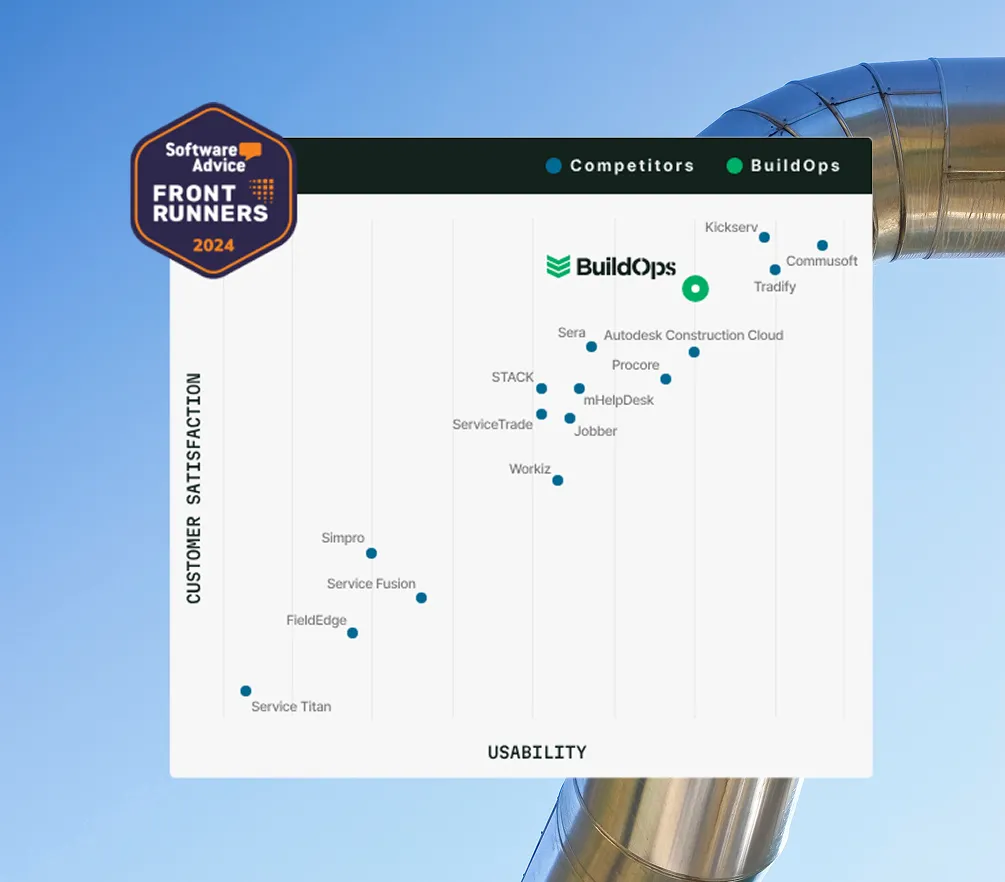

Proven Results
Real-world impact for commercial leaders


"We've seen an increase in day-to-day operations efficiencies that's going to add up to significant savings in time and energy over the course of a year."

"If we didn't have BuildOps and the additional cyber security they give our company, we would be dead in the water."


"The ability to produce reports either on an individual job basis, a quarterly basis, or a project basis is something we'd never seen before in other software that we've used."

"We've cut down in our receivables from about 120 days to 30 days on average."


"Before we knew it, we were seeing quicker turnaround times on job closeout and a huge improvement in the time it took for quotes to be accepted by our customers."


"With BuildOps, we feel like we can go after anything. The sky is the limit as far as the size of the project."
.webp)

"BuildOps gave us an all‑in‑one system for both service and projects. Once we saw that, it was a no‑brainer."


"With the integration of BuildOps and Sage Intacct, our accounting system, we've been able to speed up the time it takes for us to bill customers."


"Our consulting division increased 300% because we were able to free up more time from the office to help other customers."

![Service First Logo]](https://cdn.prod.website-files.com/69cad9cd3a5ef3196ea9bb65/69fa0ca0adc28a56d26717c9_Service%201st%20white.webp)
"Sometimes systems promise you the moon, then you use them and see the weaknesses. It's been the exact opposite with BuildOps. Everything we wanted it to do, it could do."

"We used to be two weeks behind on job costing. Now we're up to date daily."
Common Questions
FAQs about BuildOps vs Procore for commercial teams
How secure is BuildOps’ operational and financial data?
BuildOps is cloud-based with enterprise-grade security, role-based access controls, and encrypted data at rest and in transit. Your data stays protected, always accessible, and never exposed.
What is included in BuildOps pricing compared to Procore?
In BuildOps, there’s one monthly cost per user you pay based on your company’s needs, determined in our custom demos. This includes scheduling & dispatching, field notes, custom field workflows, advanced analytics and reporting, asset & equipment management, service agreements, invoicing, and so much more. The only add-ons BuildOps has are CRM, Fleet, and Payments, because not all of our customers need it.
In Procore, the only things included are: “unlimited users, unrivalled support, unlimited data storage and product enhancements”. This is a critical thing to understand about Procore’s pricing, every single “product” you want access to has an add-on fee, so you have to pick and choose each product, and whether you need it or not, and most products have 2-3 tiers of costs associated with them. No actual features in the platform are included in any base pricing.
How does Procore’s pricing model work?
With Procore, you pay an upfront annual fee, determined by the products you want to use, all ‘custom pricing’ that’s determined by them. You then additionally pay an Annual Construction Volume (ACV) fee for the aggregate dollar value of the construction work across your projects. This means you are pre-paying Procore based on the success of the work you do, and on an ongoing basis, they are basically getting a commission on your work. If you continue to grow and do better, they are pocketing a portion of that success.
What are the biggest problems with Procore’s pricing model?
This kind of pricing Procore uses is extremely punishing to most businesses. Here are some of the ways their customers have complained about this pricing model:
- Penalized for growing. The more you grow and the greater success you achieve, the more you pay Procore.
- Margin traps. Procore charges based on revenue, so if you were running on incredibly thin margins or even losing money on projects, you’re still paying Procore out based on the revenue, not the profits.
- Open yourself to a huge potential liability. Smaller or mid-sized businesses that have sudden growth or a great year end up bumped into enterprise-level pricing, owing a huge $40,000+ liability to Procore after that great year, rather than being able to predict standard monthly pricing based on users.
- Unpredictable costs. Most reviewers on G2 that mention Procore’s pricing list it as a con, even in positive reviews. They cite it as being unclear, unpredictable, non-transparent, and difficult to understand.
- Substantial hidden onboarding fees. Even their implementation is broken down by packages, and not included. So you have to pay them to help you get on their platform. They have over 11 different packages for implementation alone, ranging from 4-18 weeks, and from $3000-$16,000 for those listed, though most packages don’t have transparent pricing.
Which types of businesses are Procore and BuildOps best suited for?
BuildOps is built for commercial trades businesses, primarily Plumbing, Electrical, HVAC, Refrigeration, and Fire & Life Safety. In BuildOps, service, projects, sales, and financials all run on one connected platform. Whether it's a 30-minute PM visit or a six-month build-out, every workflow lives in one place with no separate tools, and no double entry.
Procore is built for General Contractors, Owners, Public Sector, and Subcontractors.
How does BuildOps OpsAI compare to Procore’s AI?
BuildOps OpsAI is built directly into the platform, assisting with insights and suggestions across your whole operations, with features like Smart Recap, Smart Dispatch, PO Scanning, Revenue Finder, and more. OpsAI is built right in, offering insights when and where you need them, as a part of each feature already in the platform.
Procore’s AI is a library of 20 agents that can run to review information in the platform, and then summarize findings for you. AI features are all add-ons in Procore in tiered plans, and their cheapest plan does not include any scheduled automations, which means you need to manually run the agents yourself.
What are BuildOps & Procore’s biggest strengths and weaknesses when compared to each other?
When Procore stands out: For general contractors and owners managing subcontractors on long-term construction projects, with more of a focus on project cost and resource management, already using other tools to actually manage the day-to-day work of the jobsites.
When BuildOps stands out: For commercial construction teams that need a single, unified tool that can link together the day-to-day of construction operations with the long-term necessities of project management from start to finish.
When Procore falls short: Procore’s pricing model is extremely punishing to most businesses, and is not well-suited to any smaller or mid-market teams looking to grow, who will end up paying portions of their revenue to Procore.
When BuildOps falls short: If you already have another field service management tool helping you manage scheduling & dispatching, jobsite work, job workflows, invoicing, and reporting, then you might not need BuildOps’ all-in-one platform.